
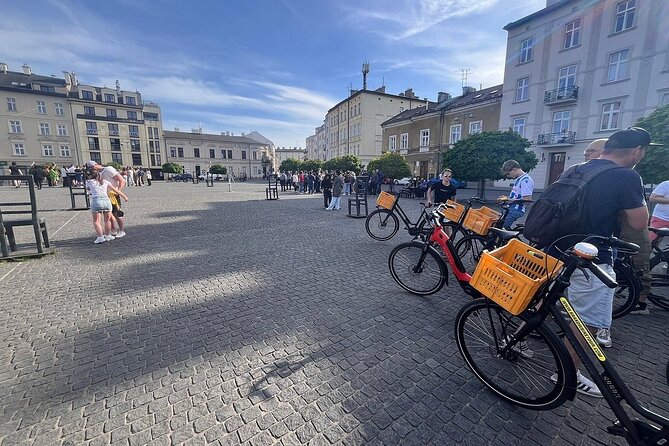
Reviewed · CYCLING TOURS
Discover Kraków by Bike with a Dutch guide
Kraków’s best feature for a bike tour is its compact center. In three hours, you can roll from the medieval Market Square to Wawel Hill, across Kazimierz, through the former ghetto, and back along the old fortifications. You get a clear sense of how the city fits together instead of seeing each sight as a separate stop. I especially like the mix of grand landmarks and small stories, from the dragon under Wawel to the old ghetto wall. I also like that Dutch-speaking guides such as Wesley, Johan, Max, and Jeroen add local facts and practical tips along the way.
The main consideration is pace. You stop often for short talks, but this is still a moving tour rather than a series of long museum visits. Admission to Schindler’s Enamel Factory is not included, and an e-bike costs an additional €15. If you want to study every exhibit or spend hours inside Wawel Castle, plan a separate visit.
Key points to know before you ride
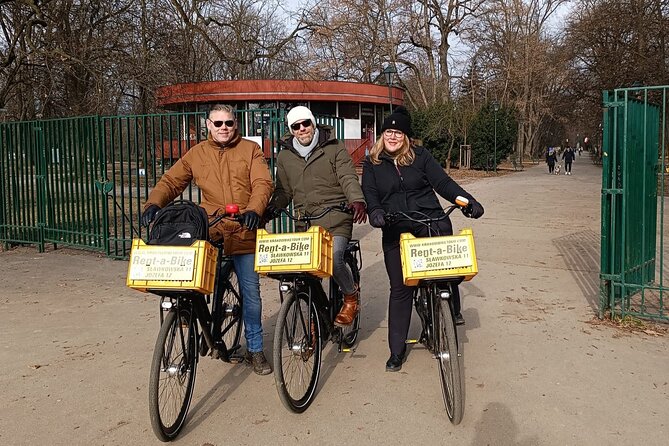
- Three hours covers a lot: The route links Old Town, Wawel, Kazimierz, the former ghetto, Planty Park, and the medieval city walls.
- A Dutch-speaking guide leads the way: Guides including Wesley, Johan, Max, and Jeroen are praised for clear explanations, humor, and unusual local facts.
- You see Kraków’s difficult past as well as its beauty: The route includes the Old Synagogue, Schindler’s List Passage, Ghetto Heroes Square, the ghetto wall, and Schindler’s Factory.
- Classic bicycles are included: You can choose an e-bike for an extra €15, a useful option if you prefer less effort.
- There is a taste of local life: The tour includes a break with the chance to try zapiekanka, Kraków’s popular open-faced toasted snack.
- The group can reach 20 people: That is small enough for a guided city ride, though it will not feel like a private tour.
Why a bike is a smart way to see Kraków
Kraków’s central sights are close together, but the city can still feel spread out when you walk from one end to the other. A bicycle gives you more ground without turning the day into a transport exercise. You move through streets, squares, parks, and neighborhoods while keeping enough time for short stops and stories.
The ride begins at the rental point on Garbarska Street near Hotel Alexander. The staff help you choose a suitable bicycle and explain how it works. You can use the restroom before setting off, which is a small but useful detail at the start of a three-hour outing.
The standard bicycle is included in the price of $31.53 per person. That is fair value if you want an introduction to several parts of Kraków in one morning or afternoon. You are not paying for museum admissions, but you are paying for equipment, a guide, and a route that ties the city together.
The group size can reach 20 people. That keeps the cost down, but it also means you should expect a group ride rather than a private conversation at every stop. The guides have handled mixed conditions well, including cold and rain, but you should dress for the weather. Cycling is described as relaxed and safe, though your comfort will still depend on your own riding confidence and the day’s conditions.
More Bike Tours in Krakow
- Complete Cracow Bike Tour (small group of maximum 15 people!)
★ 5.0 · 1,322 reviews - Krakow: Bike Tour of Old Town, Jewish Quarter and the Ghetto
★ 4.9 · 1,155 reviews - Highlights of Krakow Bike Tour – Small group
★ 5.0 · 662 reviews
Rynek Główny and Kraków’s medieval center
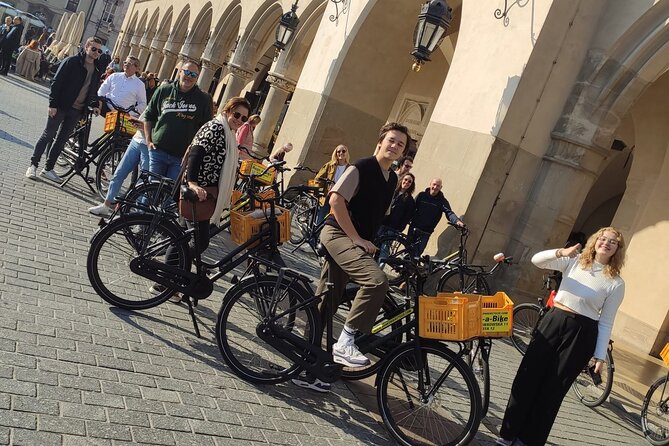
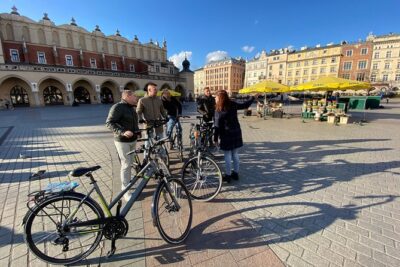
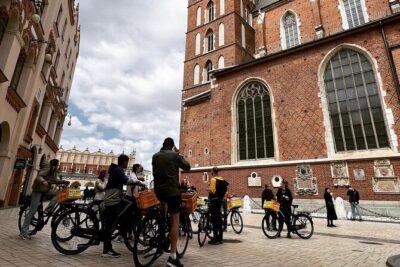
The first major stop is Rynek Główny, Kraków’s enormous central square. It is one of the easiest places in Europe to understand medieval city life because the square still anchors the modern center.
Your guide points out the Cloth Hall, where merchants once traded goods, along with the Town Hall Tower and St. Mary’s Basilica. You hear the story of the trumpeter whose short musical call is linked to a dramatic moment in the city’s past. The guide also brings in the customs of medieval trade, so the square becomes more than a place for photographs.
A story about Stalin and Lenin adds a later political layer. This mix is typical of the tour. You get major sights, but you also hear details that help explain how Kraków changed over time.
The stop lasts about 15 minutes. That is enough for orientation and photos, but not enough for a full look inside St. Mary’s Basilica or the Cloth Hall. I would treat this stop as your introduction, then return on foot later if one of the buildings catches your attention.
Collegium Maius and the royal route to Wawel
From the Market Square, the route continues to Collegium Maius, the oldest university building in Poland. Its Gothic architecture gives you a change of mood after the open square, and the connection to Nicolaus Copernicus adds a memorable human detail.
The stop is short, about 10 minutes. You will hear about the building and its place in Polish education, but you should not expect a full museum visit. If university history or historic interiors interest you, mark Collegium Maius for another visit.
At Maria Magdalena Square, the guide pauses for about 15 minutes to discuss the architecture and cultural role of the area. It is a quieter stop than the Market Square and helps break up the ride before Wawel.
The route then reaches Wawel Hill. First comes the dragon monument, linked to the old tale of a monster that frightened the city until a clever craftsman defeated it with a trick. This is one of the tour’s lighter moments, especially after the more serious historical sections later in the route.
Wawel Castle follows. The guide explains why the hill served as the seat of Polish kings and how the castle fits into the country’s story. You will see the hill and hear its legends, but entry to the castle’s interiors is not part of this bike ride. The stop lasts about 15 minutes, so think of it as a useful preview rather than a castle tour.
Kazimierz, where several chapters meet
The ride from Wawel into Kazimierz is one of the most useful parts of the route. You shift from royal Kraków to a district shaped by Jewish life, trade, faith, war, and later artistic renewal.
At Plac Wolnica, the guide explains that this was once a market square nearly as important as the main Rynek. Kazimierz was founded in 1335, and the square handled trade, administration, and legal affairs. Goods such as furs, tobacco, salt, and amber once passed through here.
The old town hall now houses the Ethnographic Museum. A plaque also recalls the medieval arrival of Jews in Poland. These details make the square a good place to pause and consider how Kazimierz functioned before it became one of Kraków’s most popular areas for cafés and galleries.
The tour then moves through the former Jewish district. Today, Kazimierz has a creative, social feel, but the guide keeps the focus on the layers beneath the modern cafés and shops. You will see streets where religious, commercial, and community life once centered.
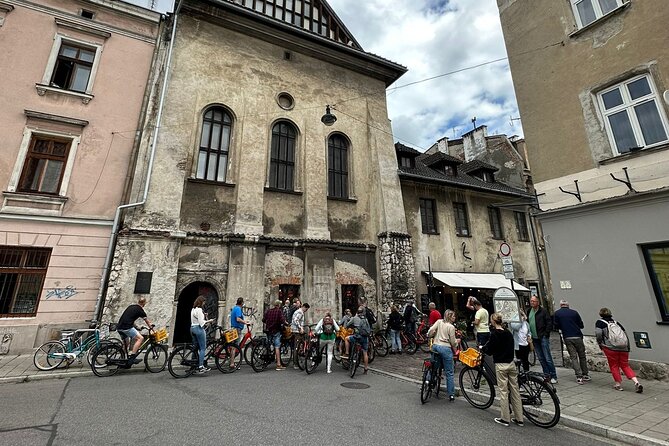
At the Old Synagogue, you hear about the origins of Kazimierz and the district’s Jewish community. Admission is not included, and the stop lasts about 10 minutes. That is enough to understand why the building matters, but not enough for a museum visit. I recommend noting the location and returning later if you want more time with the exhibits.
A useful feature of this section is the contrast. The same neighborhood can appear lively and fashionable today, yet the tour does not let you forget the people and traditions that shaped it.
Same city, a completely different kind of day:
- Kraków: Evening or Night River Cruise
★ 4.0 · 7,386 reviews - Krakow: Oskar Schindler’s Factory Entry Ticket & Guided Tour
★ 4.2 · 3,793 reviews - Krakow: City Sightseeing Tour by Electric Golf Cart
★ 4.5 · 3,264 reviews - Krakow: Schindler’s Factory Tour with Entrance Ticket
★ 4.5 · 3,182 reviews
From Schindler’s List Passage to the former ghetto
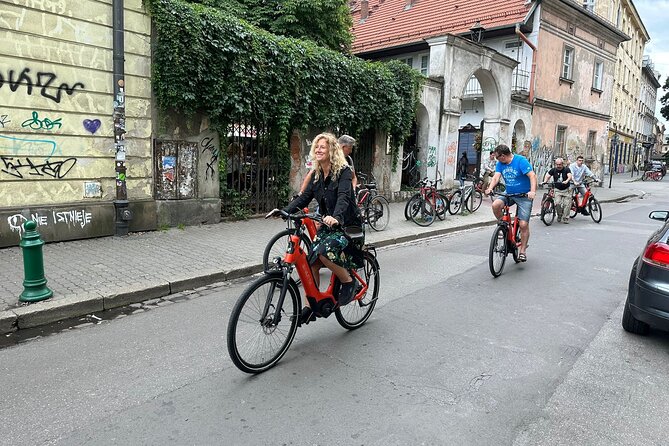
The historical tone becomes more serious as you leave Kazimierz for the former ghetto. At the Schindler’s List Passage, the guide pauses for about 20 minutes and explains its connection to Steven Spielberg’s film. The film reference may be familiar, but the place also works as a starting point for understanding the real events behind the story.
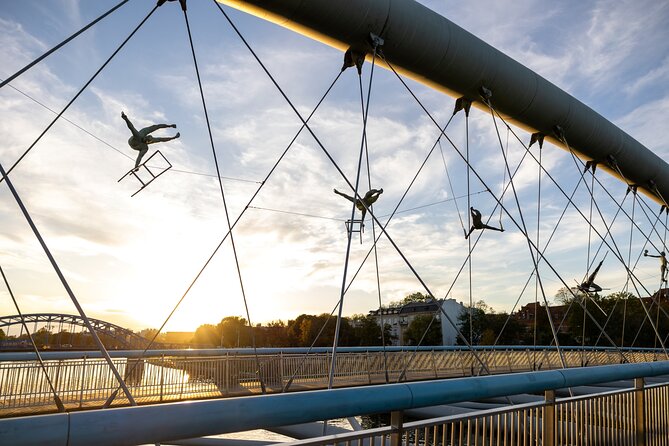
You then cross Father Bernatek’s Bridge, a modern pedestrian bridge with its own visual appeal. This creates a sharp change from the older streets and historic buildings. It is a simple connection between districts, but it gives the ride a good rhythm.
At Ghetto Heroes Square, the guide discusses the monument to the victims of the Jewish ghetto and points out the Pharmacy Under the Eagle. This is one of the places where the tour asks you to slow down and reflect. The route does not treat the city only as a collection of pretty views.
The remaining fragment of the ghetto wall is another important stop. It can be easy to miss a surviving wall section when exploring alone, and the guide provides the context that makes the fragment meaningful. You will spend about 10 minutes here.
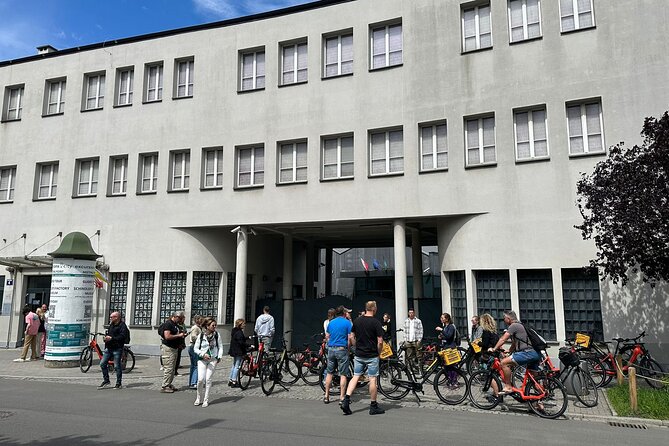
The ride continues to Oskar Schindler’s Enamel Factory. The stop itself is scheduled for around 15 minutes, but the entrance fee is not included. If you want to visit the museum inside, allow extra time and budget for the ticket. The bike tour gives you the setting and background, while the museum offers the longer, more detailed experience.
This part of the route is a key reason to choose the tour over a simple sightseeing ride. You are not just moving from one famous building to another. You are following the geography of Kraków’s wartime story.
Planty Park and the medieval defenses
After the former ghetto, the route returns toward the Old Town through green space around the historic center. Planty Park forms a ring where the old city walls once marked the edge of medieval Kraków. Riding here gives you a welcome change after the heavier stories of the ghetto.
The next stops are the Barbican and St. Florian’s Gate. The Barbican is part of the surviving medieval defense system, and the guide explains how Kraków protected its entrances. St. Florian’s Gate was once the main approach to the city, so together the two stops help you picture Kraków as a fortified medieval town.
The final section brings you back to the bicycle rental on Slawkowska Street. You return the bikes there and finish at the original meeting point. Because the route loops through several districts, you finish with a better mental map of central Kraków than you would get from visiting isolated sights.
What the guides add to the ride
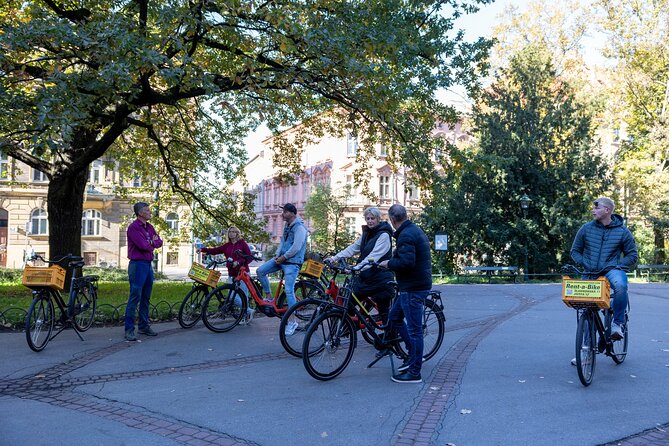
The guide is the heart of this experience. Dutch-speaking guides named in the feedback include Wesley, Johan, Max, and Jeroen. Their style appears to vary, but the common thread is enthusiasm for Kraków and a willingness to answer questions.
Wesley is especially noted for adapting the route when a small group became a private tour. That kind of flexibility cannot be guaranteed, but it shows why it is worth telling your guide what you have already seen. Jeroen is praised for answering unexpected questions, while Johan is associated with a relaxed ride through wet weather and useful tips for the rest of a Kraków visit.
The strongest feature is not a polished performance. It is the extra information around the official stops. You may hear a detail about a square, building, or historical figure that changes how you see the next part of the route. Several guides also offer suggestions for what to do after the tour, which is useful if this is your first day in town.
The tour is conducted in Dutch, so it is best suited to Dutch-speaking participants. If your group is comfortable in Dutch, you get a more natural experience than you would from translating every explanation.
Food, equipment, and practical value
The tour includes the use of a bicycle and the Dutch-speaking guide. The chance to taste zapiekanka gives the ride a local food moment without turning it into a full food tour. This toasted open-faced snack is strongly associated with Kraków, and the break gives you time to rest and ask questions.
An e-bike costs €15 extra. I would choose it if you want to conserve energy, are unsure about cycling for three hours, or simply prefer an easier ride. The classic bicycle is enough for many people, but the e-bike option makes the experience more accessible to different fitness levels.
The price of $31.53 is strongest when you want a broad first look at Kraków. You cover several districts, get a guide’s context, and avoid spending the day walking between distant points. The value is weaker if your main goal is museum time, because the tour only pauses briefly and does not include the admission fee to Schindler’s Factory.
You receive confirmation at booking, and the activity is near public transport. Most people can participate, with a maximum group size of 20. Free cancellation is available up to 24 hours before the start time. After that point, the payment is not refunded, so check your schedule before booking.
Who should book this Kraków bike tour?
I would choose this tour for a first or second day in Kraków. It gives you an overview, shows you where the major districts sit, and helps you decide which places deserve a longer return visit.
It suits you best if you:
- Want to see more than the Old Town in a short time
- Enjoy history explained through places rather than only through museum displays
- Are comfortable riding a bicycle for three to three and a half hours
- Prefer a Dutch-speaking guide
- Want to combine famous sights with less obvious historical stops
- Plan to visit Auschwitz separately and want another tour focused on Kraków itself
It may not suit you if you dislike cycling, need long periods at each sight, or want to spend most of the day inside museums. Families and mixed-age groups should also consider the route length and the extra e-bike charge if some riders need assistance.
Should you book it?
Book this tour if you want a fast but meaningful first look at Kraków. The route is unusually well balanced: Market Square and Wawel provide the classic sights, Kazimierz adds neighborhood character, and the former ghetto brings necessary historical weight.
The main tradeoff is limited time at each place. I would book it early in your stay, keep a note of the stops you want to revisit, and schedule Schindler’s Factory separately if you want to see the museum properly. At $31.53, it is a practical way to get oriented, especially with a guide such as Wesley, Johan, Max, or Jeroen leading the ride.
FAQ
How long does the Kraków bike tour last?
The tour lasts approximately three to three and a half hours.
Where does the tour begin and end?
It begins at the bike rental near Hotel Alexander, Garbarska 18, Kraków. The tour ends back at the meeting point after you return the bicycles.
Is bicycle use included in the price?
Yes. Use of a standard bicycle is included. An e-bike costs an additional €15.
Is admission to Schindler’s Enamel Factory included?
No. Entry to Schindler’s Enamel Factory is not included in the tour price.
How many people can join the tour?
The activity has a maximum group size of 20 people.
Can I cancel for a full refund?
Yes, if you cancel at least 24 hours before the scheduled start time. Cancellations made less than 24 hours in advance are not refunded, and changes within that period are not accepted.
Just added around Krakow
- stag dog chase Krakow prank★ 5.0 · 4 reviews
- Divine Mercy Sanctuary – Private Tour from Krakow★ 5.0 · 4 reviews
- ZALIPIE – painted village, unique small group tour from Krakow★ 5.0 · 7 reviews
- ZALIPIE – painted village, unique PRIVATE tour from Krakow★ 5.0 · 20 reviews
- Zalipie Private Tour from Krakow The Painted Village★ 5.0 · 4 reviews
- Wooden Churches Unesco List Private Tour from Krakow★ 5.0 · 14 reviews
- Guided tour to Salt Mine & Schindler Factory with Pick-Up Options★ 4.0 · 58 reviews
- Wawel Castle, Cathedral, & Rynek Underground Tour with Lunch★ 5.0 · 4 reviews
Cycling Tours, compared.
Complete Cracow Bike Tour (small group of maximum 15 people!)
Read our review →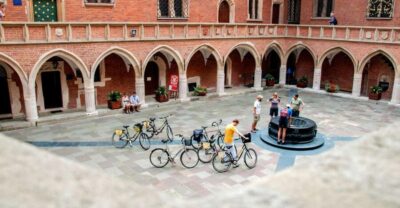
Bike Tour of Old Town, Jewish Quarter and the Ghetto
Read our review →
Full Bike Tour – the Old Town, Jewish Qtr & the Ghetto NEW BIKES
Read our review →
Bike Tour of the Old Town, Kazimierz, and the Ghetto
Read our review →
Half-Day Warsaw City Sightseeing Bike Tour for Small Group
Read our review →Browse the lists this tour appears in