
Reviewed · WALKING TOURS
Private Walking Tour of Gdansk Old Town
Gdansk’s prettiest streets are best seen on foot, and this private tour gives you a clear route through the city’s grandest sights. You begin at the Golden Gate, follow the Royal Way, and finish beside the Motlawa River, where the old port’s maritime character comes into focus. Along the way, your English-speaking guide explains the city’s history and points out details you could easily miss alone.
I like the private format, since your group can ask questions and set a comfortable pace rather than follow a large crowd. I also like the route itself: the Great Armoury, St. Mary’s Basilica, Neptune’s Fountain, the Main Town Hall, the Crane, and the riverfront make a strong first introduction to Gdansk. The main consideration is time. Two hours is enough for an overview, but not enough for long visits inside every building.
Key points to know before you book
- The route covers Gdansk’s classic center: You see the Golden Gate, Royal Way, St. Mary’s Basilica, Neptune’s Fountain, Main Town Hall, Crane, and Motlawa waterfront.
- A private group of up to 15 keeps the walk personal: You are not sharing the tour with unrelated groups.
- The tour lasts about two hours: The listed stops add up to roughly that length, so expect a brisk introduction rather than a full museum visit.
- The guide can add useful local context: Past guides named Martin, Olga Libura, Michael Maj, Agnieszka Syroka, and Basia Lasota have led similar walks.
- The route is entirely on foot: That lets you reach streets and viewpoints that buses and cars cannot.
- The price works best for a group: At $159.70 total, 15 people would pay about $10.65 each, while a solo visitor pays the full group rate.
Starting at the Golden Gate

The walk begins at the Highland Gate, at Wały Jagiellońskie 2A, and continues to Langgasser Tor, better known in English as the Golden Gate. This is a smart starting point because the gate introduces Gdansk’s civic pride before you reach the denser Old Town streets.
The Golden Gate was designed by Abraham van den Block and built by Hans Strakowski. Its decoration carries a clear civic message through inscriptions and allegorical figures. Your guide can help you read the building as more than a handsome entrance. It expresses the qualities Gdansk once expected from its citizens and the ideals the city wanted to project.
You spend about 10 minutes here, with no separate admission charge. That short stop is enough for an explanation and photographs, though you will not linger long over every sculptural detail.
More Walking Tours in Gdansk
- Gdańsk City Sights & History Guided Walking Tour in English
★ 4.8 · 876 reviews - Main Town Gdańsk Walking Tour
★ 5.0 · 644 reviews - Discover Gdansk Walking Tour
★ 5.0 · 495 reviews
The Great Armoury and Dutch Renaissance design
The next stop is the Great Armoury on Piwna Street, another quick visit of about 10 minutes. It is one of the strongest examples of Dutch Renaissance architecture in Poland, and its ornate facade gives this part of the walk a grand theatrical feel.
This stop is especially useful if you enjoy architecture but do not always know what to look for. Ask your guide to point out the building’s symmetry, decorative elements, and relationship to the Coal Market area. The Great Armoury works well as a visual counterpoint to the Golden Gate: both are showy civic buildings, but they belong to different parts of the city’s ceremonial route.
There is no admission fee listed for the stop. The tour treats it as an exterior sight, so plan to admire the facade rather than count on an extended indoor visit.
Following the Royal Way for 20 minutes
The Royal Way is the backbone of the experience. Polish kings traditionally used this route during visits to Gdansk, and walking along it gives you a simple way to understand how the city presented itself to important visitors.
This is where a guide adds real value. On your own, you can photograph the colorful facades and grand public buildings. With a guide, you can connect them to the city’s political and commercial past, and learn why this particular route mattered.
The walk is outdoors and spread across historic streets, so comfortable shoes are sensible. You should also expect other people in the central area, particularly around the main landmarks. A private guide cannot remove the crowds, but can make the route easier to follow and help you pause in better spots.
St. Mary’s Basilica: a vast brick church
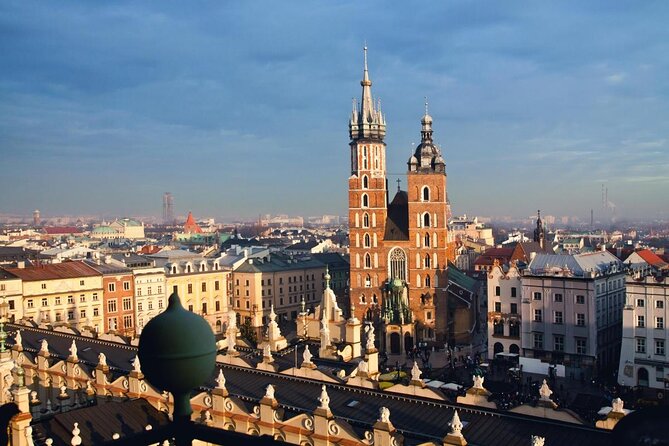
The 15-minute stop at St. Mary’s Basilica is one of the tour’s most striking moments. The church is widely described as the largest brick church in the world, and its size is hard to grasp from a photograph. Inside, the vault is supported by 37 windows, with more than 300 tombstones and 31 chapels contributing to the scale and detail.
The basilica could hold up to 25,000 people. That capacity also gave it a role in more recent Polish history. During martial law from 1981 to 1983, members of the Solidarity movement sought refuge here.
That combination of architecture and political memory makes this more than a quick church stop. I would pay close attention to how your guide explains both sides. If you are especially interested in the interior, ask how much time is available, since the full experience may require more than the scheduled 15 minutes.
The tour information does not include a separate admission charge. It also does not promise tower access or a long interior visit, so do not book this walk solely for a church climb or an in-depth religious art tour.
Same city, a completely different kind of day:
- Gdansk: City Cruise on Historical Polish Boat
★ 4.8 · 2,913 reviews - Gdańsk: Sunset Cruise on a Historic Polish Boat
★ 4.9 · 977 reviews - Gdansk: Firearm Shooting Experience with Instructor
★ 4.8 · 866 reviews - Gdansk: Guided Round-Trip Cruise to Westerplatte
★ 4.3 · 865 reviews
Neptune’s Fountain and the Long Market
Neptune’s Fountain sits in the Long Market, one of Gdansk’s most representative public spaces, directly in front of Artus Manor. The fountain dates from the 17th century, with its creation initiated by Mayor Bartłomiej Schachmann and the city council in 1633.
You spend about 15 minutes here. That is enough to hear the story, take in the surrounding facades, and understand why Neptune became such a fitting symbol for a city tied to the sea.
The stop also gives you a chance to see how Gdansk’s civic buildings work together. The fountain is not an isolated monument. It belongs to a larger ceremonial setting formed by the Long Market, Artus Manor, and the Main Town Hall. A guide can help you read the square as a planned public stage rather than a collection of unrelated sights.
This is one of the busiest parts of the route, so keep your group together and listen for the guide’s meeting instructions. The private format helps, but the location itself remains an active public square.
The Main Town Hall and the city’s mixed influences
The Main City Hall receives another 15-minute stop. Its architectural form includes links to the Hanseatic House, or Osterlinghaus, in Bruges, showing how Gdansk’s connections reached well beyond present-day Poland.
The building also reflects the city’s multicultural character. That matters because Gdansk’s identity was shaped by trade, outside influence, and contact with other European cities. The town hall is a useful place to ask how architecture reflects those connections.
The tour identifies the building as the Museum of Gdansk, but the scheduled visit does not guarantee a museum entry. Treat the stop as an exterior explanation unless your guide tells you otherwise. If you want time inside, confirm that before booking or ask about extending the walk.
The short timing suits people who want a broad city orientation. It is less suitable if you prefer to study exhibits, read displays, or spend several minutes in each room.
The Crane and Gdansk’s port story
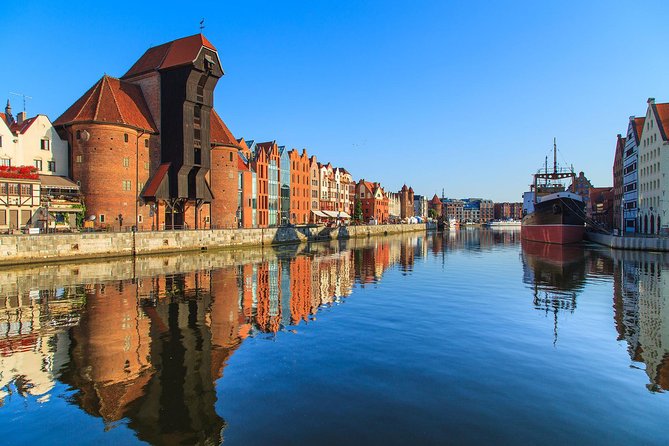
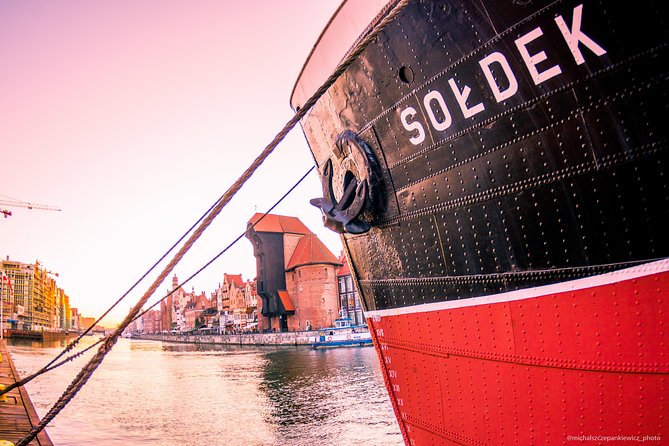
The medieval Crane is one of the city’s best-known symbols and a direct link to Gdansk’s maritime past. The stop lasts about 15 minutes and gives your guide a chance to explain the old port’s importance.
The Crane is also connected with an exhibition about the activities of the former Gdansk port. Its shape makes the city’s working past easy to picture: this was not only a city of grand gates and decorated squares, but also a place where goods moved through a busy harbor.
The experience does not state that the exhibition is included in the tour or that you will enter the building. Again, consider this primarily an exterior stop unless arrangements are confirmed. The value lies in seeing the Crane in its waterfront setting and hearing how it fits into the city’s trade story.
Ending beside the Motlawa River
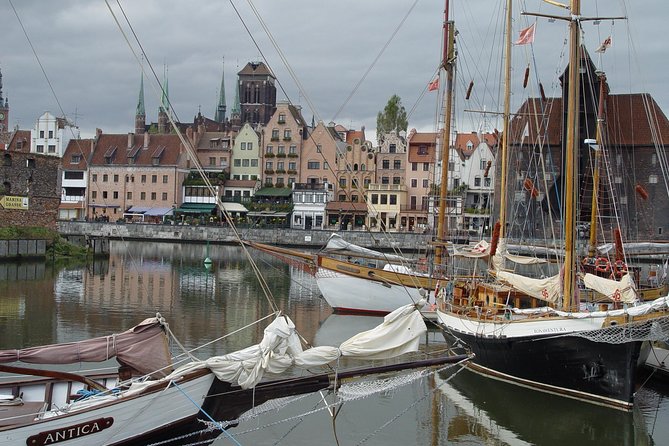
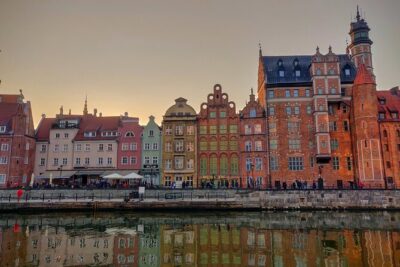
The final 20-minute stop takes you along the Motlawa River Embankment, or Dlugie Pobrzeze. This is the historic harbor area and the natural ending for a walk that begins with civic gates and ends with the water that helped make Gdansk prosperous.
The harbor is described as a place where up to 300 ships moored each day in the 7th century. That figure gives you a sense of the port’s former scale, even if the modern waterfront feels more relaxed than a working medieval dock.
I like this ending because it pulls the route’s themes together. The Golden Gate and Royal Way show the city’s public face. The Crane and riverfront show its commercial and maritime life. You finish back at the meeting point after the waterfront stop, so the tour is easy to fold into a day of independent sightseeing.
What the private format changes
The group limit is 15 people, and only your party takes part. That does not turn the walk into a fully flexible private guide service, since the route and stop times are already set, but it does make conversation easier.
You can ask about a building as soon as something catches your eye. You can also tell the guide if your group needs a slower pace. The information provided says a moderate level of physical fitness is needed, so expect steady walking through the historic center rather than a seated sightseeing experience.
Past guides have included Martin, Olga Libura, Michael Maj, Agnieszka Syroka, and Basia Lasota. The guide assigned to your booking may be different. The strongest descriptions of the guiding style point to clear explanations, humor, strong command of Polish and Eastern European history, and an ability to adjust the walk to the group.
Michael Maj was described as speaking Mandarin, English, Norwegian, and Russian, while Agnieszka Syroka was praised for making subjects such as brick-making useful later during a wider Eastern European trip. Those details suggest that the best guides do more than recite dates. They help you notice why Gdansk looks the way it does.
Is $159.70 good value?
The price is $159.70 per group, with up to 15 people included. For a full group, that is excellent value at roughly $10.65 per person. For two people, the calculation is very different, at about $79.85 each.
The strongest value comes from the private arrangement and local explanation, not from admission tickets. All listed stops show free admission, and the tour is mainly an outdoor city walk. You are paying for the guide’s time, route planning, and ability to make sense of the sights.
I would recommend it most for a family, group of friends, or cruise party that can share the cost. If you are alone or traveling as a couple, compare the price with other guided walks before booking. The private setting may still be worth it if you care about questions and a calmer pace, but the per-person cost is much higher.
Timing, fitness, and practical planning
The advertised duration is about two hours, and the stop times add up to roughly 120 minutes. That makes this a useful first look at central Gdansk, not a full-day historical program.
You will be outdoors for the walk, and a moderate fitness level is recommended. Children must be accompanied by an adult. Since the route covers several central landmarks, wear shoes suited to steady city walking and allow time for photographs.
The tour starts at the Highland Gate and returns to the meeting point. Confirmation is provided when you book. Free cancellation is available if you cancel at least 24 hours before the start time. A cancellation inside that window is not refundable, and changes made less than 24 hours before the start are not accepted.
Who should book this Gdansk walk?
This tour suits a first-time visitor who wants the main Old Town sights explained in a logical order. It is also a good fit for a cruise stop, since the route covers major landmarks without requiring transport between them.
Families may appreciate the private group and the ability to ask questions. History and architecture fans will get the most from the Golden Gate, Great Armoury, Main Town Hall, and St. Mary’s Basilica. Anyone focused on Gdansk’s port past will especially enjoy the Crane and Motlawa waterfront.
I would choose something else if you want long museum visits, tower access, a food-focused experience, or a slower photographic walk. The two-hour schedule is compact, and several stops are designed as short explanations rather than extended visits.
Should you book it?
Book this tour if you want a well-organized introduction to Gdansk with your own English-speaking guide and a route that links the city’s ceremonial, religious, civic, and maritime sides. The private format is the main advantage, especially for a group that can split the $159.70 cost.
Think twice if you are traveling alone or as a couple and mainly want free exterior sightseeing. You can see many of these landmarks without a ticket, and the scheduled time at each is brief. For a group arriving with limited time, though, this walk offers a practical way to get oriented quickly and understand what you are seeing.
FAQ
How long does the Private Walking Tour of Gdansk Old Town last?
The tour lasts approximately two hours. The scheduled stops add up to about 120 minutes.
How much does the tour cost?
The price is $159.70 per group, with up to 15 people included.
Is the tour private?
Yes. Only your group participates in the activity.
What language is the tour offered in?
The tour is offered in English.
Where does the tour begin?
The meeting point is the Highland Gate at Wały Jagiellońskie 2A, 80-887 Gdańsk, Poland.
Where does the tour finish?
The activity ends back at the meeting point.
What sights are included?
The route includes the Golden Gate, Great Armoury, Royal Way, St. Mary’s Basilica, Neptune’s Fountain, Main Town Hall, Crane, and Motlawa River Embankment.
Do the stops require admission tickets?
The listed stops show free admission. The tour information does not promise extended indoor visits or entry to every building.
What is the cancellation policy?
You can cancel for a full refund up to 24 hours before the experience starts. Cancellations or changes made less than 24 hours before the start time are not accepted for a refund.
Just added around Gdansk
- Gdansk and Malbork Castle Small Group Tour from Warsaw with Lunch★ 4.5 · 20 reviews
- Westerplatte private tour led by Expert-Guide (door to door)★ 5.0 · 5 reviews
- Whisky Tasting in Gdańsk★ 5.0 · 3 reviews
- Gdansk EVERYDAY Vodka Tasting Tour★ 5.0 · 6 reviews
- Westerplatte – 2h private trip by luxury car|★ 5.0 · 4 reviews
- Private WW2 Tour of Westerplatte,Gdansk and Stutthof Including Lunch★ 5.0 · 12 reviews
- Aiport Gdansk Transfer to Malbork Castle or Stutthof★ 5.0 · 3 reviews
- 5 hours Individual trip to the Stutthof Concentration Camp★ 5.0 · 5 reviews
Walking Tours, compared.


Gdańsk City Sights & History Guided Walking Tour in English
Read our review →
Browse the lists this tour appears in