
Reviewed · WALKING TOURS
Poznań Experience 2-Hours Guided Walking Tour
Poznań’s story makes more sense when you walk from its 19th-century squares to the old market and then pause at the monument to the city’s 1956 anti-Communist protests. I like this tour for its small maximum group of 15 and for Wiktor’s use of humor, questions, photos, and small historical surprises to keep the walk moving.
I also like that the route links the imperial quarter with the old town instead of treating them as separate sights. The main consideration is pace: two hours is enough for a strong introduction, but most stops are exterior visits, and several buildings receive only five minutes of explanation.
The key points at a glance
- Start at Liberty Square: Begin beside the 19th-century architecture of Plac Wolności, a useful launch point for understanding modern Poznań.
- Walk through two sides of the city: The route joins the imperial quarter’s grand institutions with the older market area and churches.
- Pause at June 1956 Events Monument: This is the clearest link to Poznań’s anti-Communist protest history.
- Expect an English tour led by Wiktor: His approach combines dates and architecture with quizzes, anecdotes, Polish words, food tips, and restaurant suggestions.
- See 17 named stops in about two to two and a half hours: Most are exterior explanations, with possible entry to the Fara Church if conditions allow.
- Pay for orientation, not admissions: At $39.60 per person, the value rests in the guide’s explanation and route planning, not in included museum or castle tickets.
Why this walk works as a first look at Poznań
A good city walk should help you place the pieces. This one begins in the newer part of central Poznań, crosses the grand university and theater district, and finishes among the old town’s churches, market buildings, and royal connections.
That layout gives you more than a parade of pretty facades. You can see how Poznań changed from a historic Polish center into a city shaped by Prussian and German rule, modern education, cultural institutions, war, Communism, and renewed civic life.
Wiktor is the main reason the route feels more personal than a self-guided stroll. He explains the buildings in clear English, welcomes questions, and uses a binder of photographs and other visual material to help you understand places that may look quite different today. Little quizzes and Polish alphabet lessons add variety without turning the walk into a classroom.
You should also expect practical guidance. Wiktor has given visitors suggestions about places to eat, local dishes, further sightseeing, and sites outside the center, including Fort VII. That makes the tour especially useful early in your stay, when you can still use the advice.
More Walking Tours in Poznan
- Old Town Poznan: Guided Walking Tour in English
★ 4.6 · 78 reviews - Poznan Old Town and Top Attractions Private Walking Tour
★ 4.8 · 24 reviews - Poznan Private City Walking Tour from Cathedral Island
★ 4.5 · 24 reviews
Liberty Square begins the modern story
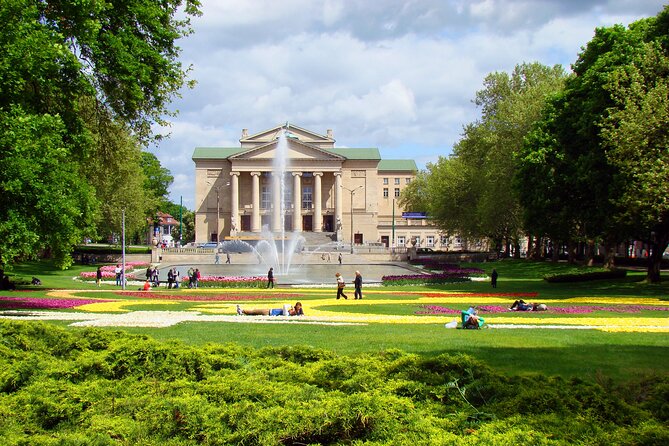
The meeting point is at the Freedom Fountain on Liberty Square, or Plac Wolności, at Fontanna Wolności, Plac Wolności 18. The square is a broad 19th-century space lined with impressive architecture, and it sets the tone for the first part of the walk.
You will spend about 15 minutes here. That is enough time for the guide to explain the square’s role and point out details you might otherwise pass without noticing. It is also a practical place to meet because it is central and close to public transportation.
From here, the route moves toward the Raczynski Library, the Bazar Poznański, and the National Museum. Each stop is short, so keep your ears open and take photographs as the group moves. The tour is designed for orientation rather than long visits inside individual buildings.
Libraries, hotels, and the city’s public face
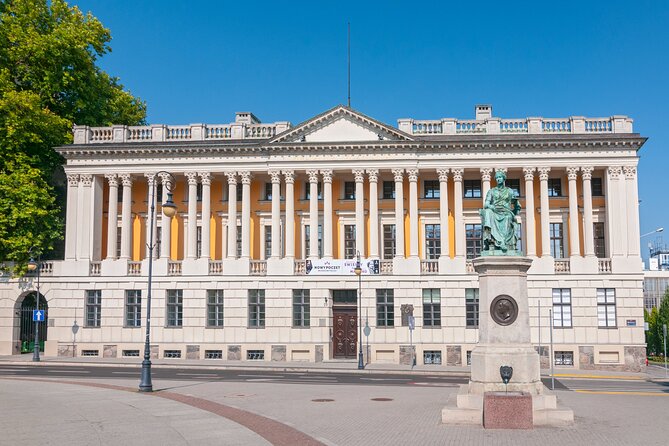
The Raczynski Library receives about five minutes, but the stop has unusual weight. It is described as Poland’s oldest and one of its largest libraries, and Wiktor uses the building to explain surprising facts about the institution.
The Bazar Poznański follows. This building carries an important local story, and the guide’s explanation gives you a reason to look beyond its facade. The National Museum comes next, also as an exterior stop. You will hear about the building and its place in Poznań, but admission is not part of the experience.
This pattern is worth understanding before booking. You are not signing up for a museum tour. You are paying for context, movement, and a human explanation of what you see from the street. If you want to explore the National Museum, the Royal Castle, or other interiors, you will need to return on your own.
The imperial quarter brings grand buildings into view
The route then shifts toward the Theatre of Poland, Okrąglak, the Church of the Most Holy Saviour, Collegium Maius, and the Grand Theatre named for Stanisław Moniuszko. Most of these stops last about five minutes.
This section is particularly useful for visitors who want to understand the imperial quarter without spending half a day inside museums. The buildings represent different sides of civic life: theater, education, religion, commerce, and public architecture.
Okrąglak is a quick but memorable stop because of its distinctive modern form. The churches provide a change of scale and mood, while Collegium Maius and the Grand Theatre show how much of central Poznań is tied to learning and culture.
You will mainly see facades here. The tour’s strength is the connections between them, not detailed interior access. If architectural detail matters to you, have your camera ready and listen for the stories behind the exteriors.
Same city, a completely different kind of day:
- Undercover City Games: Poznan
★ 5.0 · 88 reviews - Poznań: Private or Public Highlights Tour with a local guide
★ 5.0 · 66 reviews - From Golden Age to Fall and Rebirth of Poland
★ 5.0 · 17 reviews - Private Icons of Poznań
★ 5.0 · 17 reviews
June 1956 gives the walk its political weight
The June 1956 Events Monument is one of the most important stops. The monument recalls Poznań’s protests against Communist rule, giving the tour a clear link to the city’s modern political history.
This stop helps balance the grand buildings and polished squares. Poznań is not only churches, libraries, theaters, and market architecture. It is also a city where public protest left a lasting mark.
The route then continues to Collegium Minus, another university building, and the Zamek Cultural Center. The latter occupies the former imperial castle complex, and the guide explains the building from outside. Together, these stops show how major structures can take on new meaning as political systems change.
For me, this is where a guided walk earns its fee. A facade alone may be attractive, but an explanation of what the building meant under different governments gives it a place in the city’s story.
St. Martin and the Fara Church slow the pace
The Church of St. Martin receives about 10 minutes, giving the group more time than most earlier stops. You will hear about the building and its place in Poznań before continuing toward the old town.
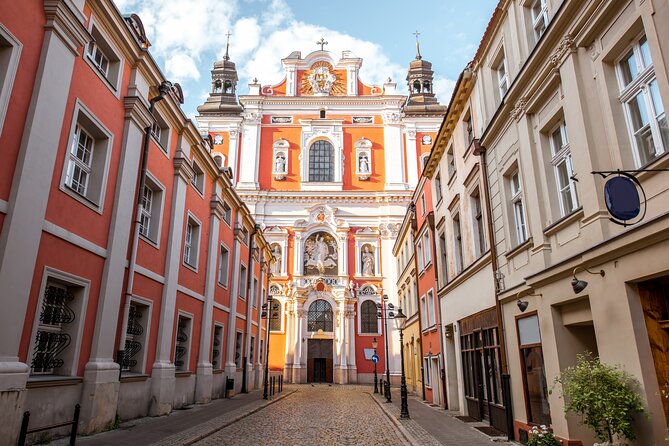
The Parish Church of St. Stanislaus, usually called the Fara Church, is another 10-minute stop. If possible, you may enter the church. The information does not promise interior access every time, so plan on an exterior explanation and treat entry as a welcome extra.
This is one of the route’s practical limitations. A two-hour walk cannot guarantee open doors at every church or building. Still, the Fara Church is an important place to include, and even a short visit adds variety after a long series of facades.
Comfortable shoes matter here. The route is considered manageable at a gentle pace, and the walk has been completed in damp weather, but you are still on your feet for roughly two hours. A rain jacket is sensible when the forecast looks uncertain.
The old market saves the best-known postcard views
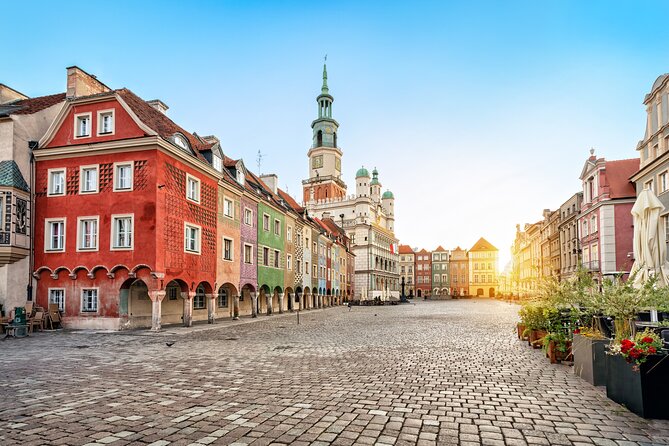
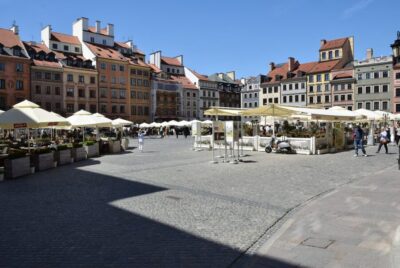
The Old Market Square receives about 15 minutes and is one of the route’s natural highlights. Here you get the broadest visual break from the imperial quarter: open space, colorful historic buildings, and the sense of Poznań as an older trading city.
This is a good point to ask questions and take photographs. The guide explains the square before moving to the Poznań Town Hall, or Ratusz Poznański, which receives about 10 minutes.
The Town Hall is viewed from outside, and admission is not included. That distinction matters because the building can invite a longer visit. You may want to return later if you would like to explore interiors or spend more time with the architecture.
The old town section also makes the walk useful for practical planning. Once you know the square and nearby streets, you can return independently for meals, further photographs, or a slower look at places that received only a few minutes during the tour.
The Royal Castle closes the loop
The final stop is the Royal Castle, seen from outside for about five minutes. The tour then returns to the Liberty Square meeting point.
Ending where you began is convenient. You do not need to work out a new pickup point or figure out public transportation from an unfamiliar neighborhood. It also makes the walk easy to fit into a morning or afternoon in the city center.
The full activity is advertised at roughly two hours to two and a half hours. The exact length can depend on questions, group pace, photographs, and whether the church can be entered. If you have a fixed appointment immediately afterward, leave some breathing room.
What Wiktor adds beyond dates and buildings
The guide’s style is a major part of the experience. Wiktor is described as friendly, witty, approachable, and easy to talk with. He keeps explanations clear rather than piling on dates, and he makes room for questions.
That balance matters. You get an overview of Poland and Poznań, but also smaller details such as Polish pronunciation, the alphabet, local cuisine, and places to eat. A binder of old or comparison photographs can help you see how buildings and streets have changed.
Some groups have received Polish sweets at the end, and practical handouts or restaurant suggestions may also be offered. These touches are not the formal product, so I would not book solely for them, but they fit the tour’s welcoming character.
The guide also points out less obvious subjects. One particularly useful suggestion concerns Fort VII, a former German concentration camp outside the city center. If that part of Poznań’s wartime history interests you, the walk can help you decide what to visit next.
Is $39.60 a fair price?
At $39.60 per person, this is not the cheapest way to see Poznań’s center. The tour does not include museum, castle, or other paid admission, and you spend only a short time at most stops.
The value comes from route design and explanation. In two hours, you cover Liberty Square, the imperial quarter, university buildings, theaters, churches, the June 1956 monument, the old market, the Town Hall, and the Royal Castle. A self-guided walk could cover the same ground, but you would need to research the connections yourself.
The cap of 15 people also matters. A small group makes it easier to hear the guide, ask questions, and keep a reasonable pace. On quieter dates, the group may be much smaller and can even feel like a private walk, though you should not assume that will happen.
I see the price as fair for a first-day orientation, especially if you want history and architecture explained in plain English. It is less compelling if you prefer to spend your time inside museums or want a specialist architectural tour with long stops.
Who should book this Poznań walk?
I would choose it if you are visiting Poznań for the first time, have limited time, or want the city’s main areas placed in context. It also suits solo visitors and couples who enjoy asking questions without joining a large crowd.
The route works well for people who like a mix of architecture, political history, religion, local customs, and practical food advice. It is also a good fit if you want to learn what deserves a second visit.
You may want something else if you need extensive interior access, dislike walking in uncertain weather, or want a narrow focus on one period. This is an introductory city walk, not a museum pass or a full-day history seminar.
The meeting point is near public transportation, service animals are allowed, and most people can participate. The activity requires good weather. If poor conditions force cancellation, you can take another date or receive a full refund. You can cancel for a full refund up to 24 hours before the start time, but later cancellations and changes are not accepted.
Should you book it?
Book this tour if you want a friendly, well-paced introduction to Poznań that connects the old market with the imperial quarter and gives the June 1956 events their proper place. Wiktor’s humor, visual material, quizzes, and practical suggestions make the route more engaging than a bare list of buildings.
Skip it if you want to go inside every attraction or prefer to explore entirely at your own speed. At $39.60, the tour is best understood as a smart orientation with a personal guide, not as a bundle of admissions.
For most first visits, I would schedule it near the beginning of your stay. You will leave with a city map in your head, several ideas for later, and a better sense of where Poznań’s buildings fit into its complicated story.
FAQ
How long does the Poznań walking tour last?
The tour lasts approximately two hours to two and a half hours.
How much does the tour cost?
The listed price is $39.60 per person.
Where does the tour begin?
It begins at the Freedom Fountain on Liberty Square, Fontanna Wolności, Plac Wolności 18, 61-738 Poznań, Poland.
Where does the tour end?
The activity ends back at the meeting point on Liberty Square.
What language is the tour offered in?
The tour is offered in English.
How many people can join the tour?
The maximum group size is 15 people.
Are attraction admission fees included?
No. The guide’s service is included, but admission fees for places such as the National Museum, theaters, Collegium buildings, the Royal Castle, and the Town Hall are not included. The Fara Church may be entered if possible.
Is the tour suitable for most people?
Yes. Most people can participate, and the tour is near public transportation. Service animals are allowed.
What is the cancellation policy?
You can cancel at least 24 hours before the local start time for a full refund. Cancellations or changes made less than 24 hours before the start time are not accepted. If poor weather cancels the tour, you will be offered another date or a full refund.
Just added around Poznan
- Private walking city tour in Poznan★ 4.0 · 9 reviews
- The Best of Poznan 4 Hour Guided Private Walking Tour★ 5.0 · 7 reviews
- Palace, Castle and Ancient Oaks – Rogalin and Kórnik guided tour from Poznan★ 5.0 · 4 reviews
- Private 3-hour Poznan Old Town Tour★ 5.0 · 5 reviews
- Poznan private tailor made tour with a local guide-driver★ 5.0 · 6 reviews
- Discover Poznan: Walk, Take a tram and have a traditional snack★ 5.0 · 4 reviews
- Poznan Private Vodka Tasting Tour★ 5.0 · 3 reviews
- Poznan Old Town and Croissant Museum Private Walking Tour★ 5.0 · 3 reviews
Walking Tours, compared.
Gdańsk City Sights & History Guided Walking Tour in English
Read our review →
Browse the lists this tour appears in