
Reviewed · SELF-GUIDED TOURS
The Birthplace of Poland: A Self-Guided Audio Tour of Poznań
Poznań’s Cathedral Island is where Poland’s early story comes into sharp focus, and this GPS-guided audio walk gives you a useful path through it. You’ll move from the island’s scale model past churches, royal remains, bridges, a colorful mural, and modern museums before finishing near the Lubrański Academy.
I like the freedom to pause whenever you wish, and I like the low price: $8.99 is fair for an English route with lifetime access. The main catch is that this is an app, not a person beside you. A phone glitch, poor preparation, or missed GPS cue can leave you unsure where to go, so download everything before you start.
Key points at a glance
- Mieszko’s palace beneath a church: Hear about the remains of the first Polish ruler’s palace and chapel under the Church of Our Lady in Summo.
- Two districts, one walking route: Cross the Jordan Bridge from Cathedral Island into Śródka, a district that was once independent from the rest of Poland.
- A short but useful history walk: The route takes roughly 45 minutes to 1 hour 15 minutes, depending on your pace and pauses.
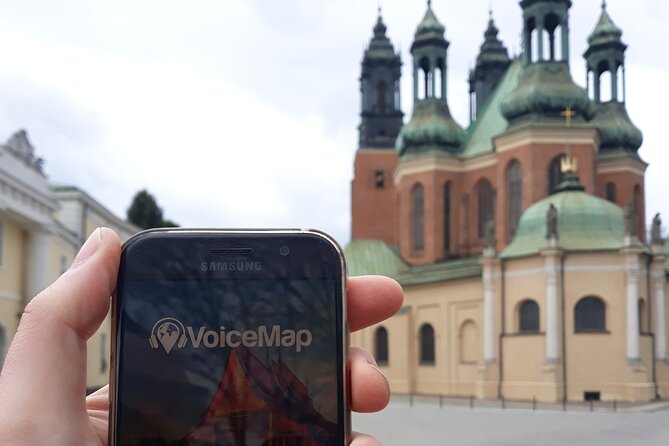
- Offline access included: Audio, maps, and location data can be downloaded in the VoiceMap app for Android or iOS.
- A strong budget choice: The price is far below a typical private guided walk, though you give up the chance to ask questions.
- Several museums along the way: Brama Poznania, Genius Loci, and the Archdiocese Museum give you options to extend the outing.
Why Cathedral Island matters to Poland’s story
Begin at the scale model of Ostrów Tumski, or Cathedral Island, at Ostrów Tumski 9. This opening is practical. You get your bearings, learn how VoiceMap works, and begin with a broad explanation of the island before the route narrows to individual buildings.
Cathedral Island is not simply a pleasant place for a walk beside the water. It is tied to the early formation of the Polish state and to the Christian rulers who shaped it. The tour uses the island’s buildings to explain that past rather than asking you to absorb a long lecture in a museum room.
That works well for me because the surroundings give the history a physical anchor. You are not only hearing about a palace or a medieval church. You are walking near the places where those structures once functioned, changed, disappeared, or were rebuilt.
The opening section should take only a few minutes. If you want to spend longer studying the model or taking photographs, pause the audio. The ability to stop and restart is one of the best reasons to choose this format.
More Self-Guided Tours in Poznan:
- From Krakow: Auschwitz-Birkenau and Self-Guided Day Tour
★ 4.1 · 576 reviews - From Krakow: Auschwitz Birkenau Self-Guided Tour
★ 3.6 · 67 reviews - Auschwitz Birkenau Tour from Krakow with guidebook Self-Guided
★ 4.5 · 15 reviews
The Church of Our Lady in Summo and Mieszko’s palace
The first major stop is the Church of Our Lady in Summo. The important detail is below ground: the church sits over remains connected with Mieszko’s palace and palace chapel.
That gives the stop unusual weight. From the outside, you may see another church in a city filled with old religious buildings. The audio points you toward what is beneath it and explains why those remains matter. It turns an ordinary-looking view into a clue about the earliest center of power on the island.
You should not assume that the tour price includes entry to the church or any archaeological area. Admission to museums and attractions is not included, so treat this walk as an outdoor introduction. If a site is open and you want to enter, you will need to handle that separately.
The tour’s strength here is context. You hear what the building represents, then continue before the subject becomes too heavy. For a first visit to Poznań, that steady movement helps connect the city’s early political and religious story.
Poznań Cathedral, the oldest cathedral in Poland
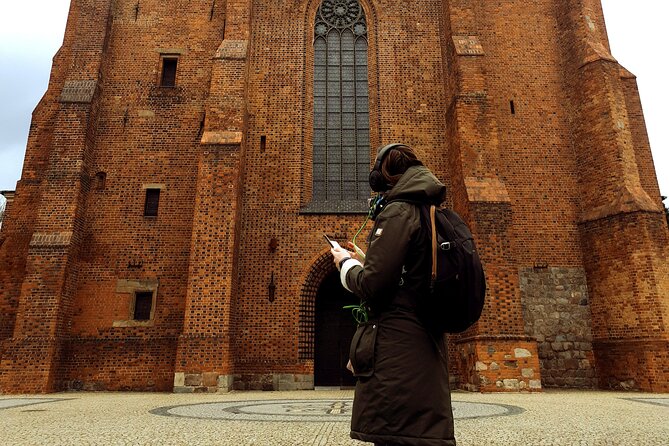
The route then passes Poznań Cathedral, identified as the oldest Polish cathedral. This is likely the most important building on the walk, and the audio gives you background as you approach and pass it.
A self-guided route cannot point out details in quite the same responsive way as a live guide. Still, the location-based narration means you can listen while facing the cathedral instead of trying to match a printed paragraph to the view. I recommend stopping here for a moment rather than walking past with your headphones on and your eyes down.
The cathedral is also a good place to decide how much time you want to spend indoors. The tour itself continues, but you can pause the route, look around, and resume later. This flexibility matters because the advertised time is an estimate, not a strict schedule.
If you are interested in Poland’s beginnings, this is the central stop. If your main goal is shopping, food, or a quick photo walk, the historical material may feel more detailed than you need.
The Archbishop’s Palace and layers of rebuilding
Next comes the Archbishop’s Palace. The audio explains the building and its many versions over time.
That phrase, many versions, is important. Old European buildings often appear fixed and permanent, but they are usually records of rebuilding, changing taste, political shifts, and practical repairs. The palace gives the tour a chance to show how Poznań’s story continued after its earliest rulers.
This is also where an audio format works better than a simple map. A map can tell you that a palace is nearby. A narrator can explain why its appearance may not reveal its full age and why repeated changes matter.
The route does not require you to enter the palace. You are hearing about it while moving through the district, which keeps the walk compact. If you want a more detailed look at the interior, you will need to arrange that separately.
A few more Poznan half-days worth comparing
- Wroclaw: E-Car Tour and Audio Guide
★ 4.6 · 1,738 reviews - Krakow: Vistula River Sightseeing Cruise with Audio Guide
★ 4.4 · 820 reviews - Krakow: Sightseeing Cruise on Vistula River with Audio Guide
★ 4.4 · 480 reviews - Krakow: Vistula River Sightseeing Cruise with Audio Guide
★ 3.9 · 270 reviews
Crossing the Jordan Bridge into Śródka
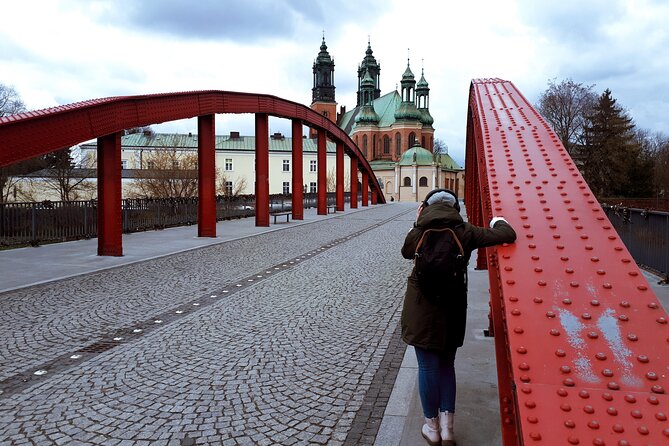
The Jordan Bridge is one of the route’s clearest physical transitions. The audio explains how the bridge was built, destroyed, and rebuilt, eventually reconnecting Cathedral Island with the Śródka District.
I like this stop because the bridge is both a route marker and a piece of the story. You are not just told that two districts connect. You cross between them while hearing how that connection was interrupted and restored.
The bridge also changes the feel of the outing. Cathedral Island is tied closely to Poland’s early church and state. Śródka brings in the story of a district that was, at one stage, independent from the rest of Poland. The walk becomes less about one enclosed historic zone and more about how separate communities related to one another.
Take care with your surroundings while listening, especially near roads and crossings. GPS narration is useful, but it does not replace ordinary attention. Keep your phone charged, and download the route before leaving reliable Wi-Fi.
Śródka and the district’s independent past
In Śródka, the audio explains the district’s separate status and its place in Poznań’s development. This is one of the more valuable parts of the walk because it widens the story beyond grand religious buildings.
You get a sense of how a city can contain several identities close together. The route does not treat Poznań as one unbroken center. Instead, it links places that once had different roles and degrees of independence.
The district also gives you a change of pace from the cathedral area. You can continue following the audio, pause to look around, or use the route as a starting point for more time in Śródka. Since the tour has no fixed group departure, you are free to set the rhythm.
That freedom is particularly useful if you are traveling with someone who wants to photograph buildings or stop often. It is less useful if you prefer lively conversation, spontaneous questions, or a guide who adjusts the route to your interests.
The Śródka mural and Saint Margaret Church
The tour passes the Śródka mural, described as one of the first wall paintings of its type in Poland. It adds a more recent visual note to a walk otherwise focused on churches, rulers, fortifications, and archaeological remains.
Look at the mural while the audio explains its place in the district. This is the kind of stop that can be easy to miss if you follow only a standard list of major monuments. The mural shows how a historic neighborhood can use modern public art to shape its identity.
The next stop is Saint Margaret Church. You hear about the church as you walk past, adding another religious building to the route without turning the entire outing into a series of interior visits.
That balance is helpful. You get a broad view of the district’s religious and civic landmarks, but you are not required to enter every one. The downside is that the treatment of each place must stay fairly short. If Saint Margaret or the mural especially interests you, you will want to return with more time.
Brama Poznania, a modern museum beside an old story
Brama Poznania, also called the Porta Posnania Heritage Center, is one of the route’s most useful optional stops. Opened in 2014, it presents the story of Cathedral Island and Śródka through a modern museum approach.
The audio introduces the center as you pass. That is useful planning information because you can decide if you want to return for a fuller indoor visit. The self-guided tour does not include admission, so budget separately for any museum you choose to enter.
I would treat Brama Poznania as a possible second stage rather than trying to force it into the short walk. First follow the outdoor route and learn how the two districts fit together. Then, if you want more detail, spend extra time at the heritage center.
This stop also helps balance the tour. The earlier sites focus on remains and historic buildings. Brama Poznania gives you a modern place to organize what you have just seen.
Prussian fortifications at the Cathedral Lock
The Cathedral Lock is a 19th-century part of the Prussian fortification system. It may not have the instant visual impact of the cathedral, but it shows how the area continued to matter for defense long after Poland’s earliest rulers.
This is a good example of the route’s range. In a little over an hour, you move from early royal remains to medieval religious power, then to later military infrastructure. The story is not limited to one period.
The lock also helps you notice practical features that are easy to pass without explanation. Fortifications often blend into a modern city. Once you know what you are looking at, the structure becomes part of the city’s political story rather than just another piece of old masonry.
Genius Loci and the last stretch to the museum
Genius Loci is a modern museum focused on the remains of the roughly one-thousand-year-old borough walls. It also uses 3D films to present the site.
Like Brama Poznania, this is an optional indoor extension rather than part of the $8.99 price. The audio gives you enough background to decide if the museum suits your interests. If archaeology and visual displays appeal to you, this may be one of the best places to continue after the walk.
The route ends in front of the Archdiocese Museum in Poznań, near the Lubrański Academy at Jana Lubrańskiego 1. The museum’s location makes sense as an ending because it links the city’s religious institutions to a wider national role. The audio explains that this place mattered in Poznań and across Poland from the 1500s through the 1700s.
Finishing here gives you a clear endpoint rather than sending you back to the start. You can stop after the final narration, enter the museum if it is open and you wish to pay for admission, or continue exploring on your own.
How the VoiceMap format works in practice
The tour is available in English through the VoiceMap app for Android and iOS. Lifetime access is included, along with offline audio, maps, and geodata.
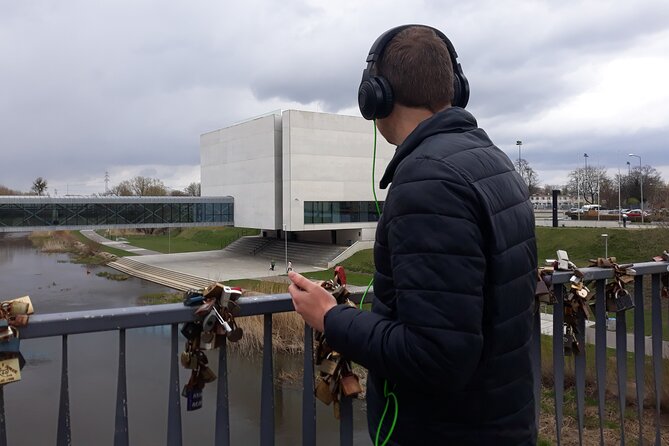
The GPS feature automatically plays the appropriate guidance based on your phone’s location. That removes the need to keep checking a printed route, but it also makes your phone central to the experience. Download the tour in advance, charge your battery, and bring headphones.
Technical problems are possible. One reported problem was fixed quickly after downloading the route again and contacting support. Another person had trouble with the guide not recognizing their location and did not know what to look at. These are useful warnings, not reasons to avoid the tour altogether. Test the app before setting off, and contact VoiceMap support by email or phone if the route does not behave correctly.
You should also remember that this is not a live private guide. Your group can walk alone, which is pleasant for couples, families, or friends who dislike joining a larger party. But there is no person to answer a question, change the pace, or explain a detail that catches your eye.
Price, timing, and who gets the best value
At $8.99 per person, the tour is a strong budget option if you want an introduction to Cathedral Island and Śródka. The price includes the audio route, maps, location data, and lifetime access. It does not include museum admission, food, drinks, transportation, a phone, or headphones.
The stated walking time is about 45 minutes to 1 hour 15 minutes. Your actual time will depend on how often you pause, take photos, enter museums, or stop to study the churches and mural.
I would choose it for:
- A first visit to Poznań when you want a clear historical route.
- Independent walkers who prefer to start when convenient.
- People comfortable using GPS apps and headphones.
- Visitors who want to pause, stop for coffee, and resume without holding up a group.
- Budget-minded visitors who do not need a live guide.
I would choose a live walking tour instead if you want questions answered as you go or if phone navigation makes you uneasy. The absence of a human guide is the main tradeoff, not a minor detail.
The tour is described as suitable for most participants and near public transportation. It is a private activity in the sense that only your group takes part, though the narration itself is prerecorded. Booking confirmation arrives at the time of booking, and the purchase is non-refundable, so check your plans before paying.
Should you book this Poznań audio walk?
Book it if you want a low-cost, flexible way to understand the area where Poland’s early state and church life took shape. The route has a pleasing mix: Mieszko’s palace remains, the oldest Polish cathedral, an evolving archbishop’s palace, a rebuilt bridge, an independent district, modern public art, Prussian defenses, and three possible museums.
Skip it if you want a guide who can react to you in real time. Also think twice if you cannot reliably use a smartphone, download audio, or follow GPS directions.
For most independent visitors, the value is clear. Prepare the app properly, allow more than the bare 45 minutes if you like museums, and treat the audio as a well-planned introduction rather than a substitute for every indoor visit in the area.
FAQ
How long does the self-guided tour take?
The walk takes approximately 45 minutes to 1 hour 15 minutes. The exact time depends on your walking pace and how often you pause.
What language is the tour offered in?
The tour is offered in English.
Where does the tour start?
It starts at the scale model of Cathedral Island, at Ostrów Tumski 9 in Poznań.
Where does the tour end?
It ends in front of the Archdiocese Museum in Poznań, near the Lubrański Academy at Jana Lubrańskiego 1.
Are museum tickets included?
No. Entry fees for museums and other attractions along the route are not included.
What do I need to bring?
You need a smartphone and headphones. The VoiceMap app provides offline access to the audio, maps, and geodata, so downloading the tour before walking is advisable.
Just added around Poznan
- Private walking city tour in Poznan★ 4.0 · 9 reviews
- The Best of Poznan 4 Hour Guided Private Walking Tour★ 5.0 · 7 reviews
- Palace, Castle and Ancient Oaks – Rogalin and Kórnik guided tour from Poznan★ 5.0 · 4 reviews
- Private 3-hour Poznan Old Town Tour★ 5.0 · 5 reviews
- Poznan private tailor made tour with a local guide-driver★ 5.0 · 6 reviews
- Discover Poznan: Walk, Take a tram and have a traditional snack★ 5.0 · 4 reviews
- Poznan Private Vodka Tasting Tour★ 5.0 · 3 reviews
- Poznan Old Town and Croissant Museum Private Walking Tour★ 5.0 · 3 reviews
Self-Guided Tours, compared.

Auschwitz Birkenau Tour from Krakow with guidebook Self-Guided
Read our review →
Birkenau Self-Guided Visit from Krakow with Private Transfers
Read our review →
Krakow Walking Tour with Audioguide on Your Smartphone
Read our review →Browse the lists this tour appears in