

Reviewed · SELF-GUIDED TOURS
Warsaw at War 1939-1945: A Self-guided Audio Tour
Warsaw’s wartime story is best understood on foot, where rebuilt streets, solemn memorials, and grand public spaces reveal how much the city lost and recovered. This self-guided walk connects the Little Insurgent memorial, the Tomb of the Unknown Soldier, and Józef Piłsudski’s statue in about 90 minutes.
I like the freedom to pause for lunch, photos, or a museum, and I like that the app includes offline audio, maps, and route data. The main drawback is navigation: the route alert can be overly sensitive, even sounding when you walk on the other side of the street.
Key points to know before you go
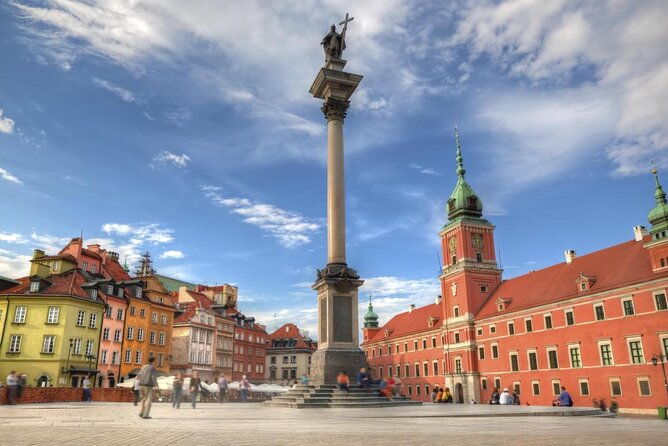
- A 3-kilometer route through central Warsaw: You begin near St. Anne’s Academic Church and finish at Piłsudski’s statue.
- The Little Insurgent sets the tone: Learn about the child soldiers linked to the Warsaw Uprising of 1944.
- The Tomb of the Unknown Soldier adds a quiet pause: Its story reaches across Polish battlefields of the 20th century.
- Offline access keeps the walk simple: Download the audio, maps, and geodata before setting out.
- The route is flexible: Pause the narration for food, photos, museums, or a stroll through Saxon Garden.
- Navigation needs your attention: The app guides you, but its map and off-route alarm may take some getting used to.
Warsaw’s wartime story begins outside the Old Town
This is not a museum tour with display cases and a fixed schedule. It is a narrated walk through the streets near Warsaw’s Old Town, using the city itself as the setting. You start at Kościół Akademicki św. Anny, or St. Anne’s Academic Church, at Krakowskie Przedmieście 68.
The walk covers about 3 kilometers and takes roughly 90 minutes. The audio explains Warsaw’s struggle during the Second World War, including the city’s resistance to Nazi Germany and Communist Russia. It also places the story in the wider fight for Polish independence, rather than treating 1939 to 1945 as an isolated chapter.
That wider frame matters. The final stop focuses on Józef Piłsudski, a Polish statesman and military leader who fought against Russian control and defeated Lenin’s Red Army near Warsaw in 1920. His story comes before the wartime period named in the tour, but it helps explain the long national struggle that shaped Polish memory.
The narration is professionally recorded and uses music and sound effects. That should appeal to you if you prefer an atmospheric audio experience instead of a plain sequence of dates. It is also suitable for anyone who can use earbuds, headphones, or a small speaker.
More Self-Guided Tours in Warsaw:
- Warsaw’s Old Town A Self-Guided Audio Tour
★ 4.5 · 10 reviews - From Krakow: Auschwitz-Birkenau and Self-Guided Day Tour
★ 4.1 · 576 reviews - From Krakow: Auschwitz Birkenau Self-Guided Tour
★ 3.6 · 67 reviews
The Little Insurgent and the human cost of 1944
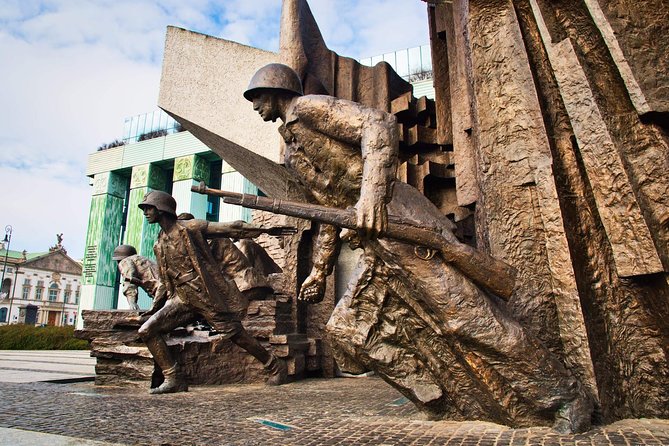
One of the most affecting stops is the memorial known as the Mały Powstaniec, or Little Insurgent. It honors child soldiers who fought and died during the Warsaw Uprising of 1944.
The memorial gives the tour a human scale. Large military events can become a blur of armies and political decisions, but the image of children caught up in the uprising brings the cost closer to home. The audio provides background for understanding why this small monument carries such weight in Warsaw.
You should expect this stop to be brief rather than a long museum-style presentation. Its value comes from standing near the memorial while the narration explains what it represents. If you want time for photographs or quiet reflection, pause the app. The route is not a race, and the audio can be resumed as you continue.
This is also where the tour’s tone becomes clear. It is interested in courage and national survival, but it does not present war as a clean adventure. The city’s story includes bravery, sacrifice, destruction, and a painful fight to preserve Polish identity.
A walk through a city rebuilt from ashes
The tour presents Warsaw as a city that rose from the destruction of the Second World War. That idea is central to the experience. You are not simply hearing about battles in distant places. You are walking through a capital whose streets and buildings carry the memory of occupation, uprising, and recovery.
The narration covers the Polish struggle against two powerful forces: Nazi Germany and Communist Russia. That is an important point for first-time visitors. Poland’s wartime experience did not end with one clear moment of freedom. The story includes pressure from both sides and the difficult political consequences that followed.
You will get the most from this section if you pay attention to the contrast between the attractive central streets around you and the difficult events being described. Warsaw today is a city of culture, art, restaurants, and carefully restored public spaces. The audio asks you to remember what had to be endured before that modern city could return.
The route gives you room to look around rather than keeping your eyes fixed on a guide. Put your phone away once the tour is playing, but keep it available for navigation when needed. That balance is useful here. You can listen while noticing the city around you, then stop the audio when a street, building, or view deserves more time.
The Tomb of the Unknown Soldier offers the quietest stop
The walk pauses at the Tomb of the Unknown Soldier, one of the most solemn points along the route. Here, the focus shifts from the individual story of the Little Insurgent to a national memorial for those who died fighting for Poland.
The audio explains the monument’s history and the soil and ashes associated with Polish battlefields from across the 20th century. That detail gives the site a broad reach. It is not meant to represent just one battle or one war. It gathers the memory of many Polish soldiers and conflicts into one place.
This is a good spot to pause even if you normally move quickly through audio walks. The setting offers a moment of respect and a change in pace. After the emotional weight of the uprising story, the Tomb gives you time to consider the scale of loss across generations.
You should not expect an entrance ticket or an indoor visit here. The stop is part of the outdoor walk, and the tour price covers the audio experience rather than museum admissions. If you choose to visit attractions nearby, those costs are separate.
A few more Warsaw half-days worth comparing
- Wroclaw: E-Car Tour and Audio Guide
★ 4.6 · 1,738 reviews - Krakow: Vistula River Sightseeing Cruise with Audio Guide
★ 4.4 · 820 reviews - Krakow: Sightseeing Cruise on Vistula River with Audio Guide
★ 4.4 · 480 reviews - Krakow: Vistula River Sightseeing Cruise with Audio Guide
★ 3.9 · 270 reviews
Saxon Garden gives you room to pause
The route allows time for side trips and breaks, including a possible wander through Saxon Garden. You can also stop for lunch, take photographs, or visit a museum along the way. The tour is designed to pause whenever you wish, which makes it more useful than a tightly timed group walk for many visitors.
That flexibility is one of its strongest features. If you are traveling alone, you do not have to keep pace with a group or wait for other people to finish taking pictures. You can stop the narration, explore, and restart it when you are ready.
There is a tradeoff. A self-guided route gives you independence, but it does not give you a person beside you to answer questions or point out a turn. You need to manage the pauses yourself and keep an eye on your place in the app.
The suggested detours are not included admissions. Food, drinks, transport, and tickets to museums or other attractions are all separate. The walk itself has no admission charge beyond the purchase of the audio tour.
Following the VoiceMap route on your phone
The experience uses the VoiceMap application. Your purchase includes lifetime access to the Warsaw at War tour, along with offline access to the audio, maps, and geodata. Downloading the material before you begin is a sensible step, especially if you want to avoid relying on a mobile connection during the walk.
The app is meant to guide you from one point to the next, with the narration connected to your location. You can start at St. Anne’s Academic Church and follow the route toward the final stop at Piłsudski’s statue on plac Marszałka Józefa Piłsudskiego.
Navigation is the weakest part of the experience. The route map may not always make your direction clear, and the off-route alert can be too sensitive. It may sound when you have simply crossed to the opposite side of the street, not when you have genuinely lost the route.
I suggest checking the map before you start and paying attention to major turns rather than reacting to every alert. If the app warns you that you have left the path, look at your position before turning around. The alert is a prompt, not absolute proof that you are lost.
Because this is a self-guided audio walk, you need a charged smartphone and a way to hear the narration. A smartphone is not included. Earbuds or headphones work for one person, while a small speaker may suit a small group.
What the sound design adds
The audio is professionally mastered and includes music and sound effects. That gives the walk a more produced feel than a simple spoken map prompt. The sound helps connect the stops and keeps the historical material moving during the walk.
I would choose headphones if you are walking alone and want to hear the narration clearly. A small speaker could work for a small group, but you should still remain aware of the people and surroundings around you. The product information specifically presents the tour as suitable for people who can use earbuds, headphones, or a small speaker.
The format also makes the experience approachable for different ages. The subjects are serious, but the combination of narration, music, and location-based storytelling may hold attention better than reading a long historical panel at each stop.
Still, sound design cannot replace a live guide. If you want to ask why a certain event happened, compare different interpretations, or get personal recommendations for other Warsaw sights, this tour will not provide that conversation. It gives you a prepared route and story, not a discussion.
Price, timing, and who gets the best value
At $9.99 per person, the tour costs far less than a conventional guided walking tour. The value comes from the flexible format and lifetime access. You can take the walk at your own pace and retain access to the audio for another visit.
The price is especially reasonable if you want a focused introduction to Warsaw’s wartime story without committing to a longer tour. Ninety minutes is long enough to cover several important memorials, but short enough to fit into a day that includes other sights.
It is less useful if you want extensive museum time. The route passes through an area where you might choose to eat, take photos, visit a museum, or wander in Saxon Garden, but those activities are not part of the included tour. You will need to allow extra time and pay any separate entrance fees.
The tour is available in English. It is offered every day according to the stated schedule, with hours listed from midnight to midnight. Confirmation arrives at booking, and the activity has a maximum of 10 participants, though the self-guided format means you are not relying on a traditional guide-led group.
Most people can take part, and service animals are allowed. The start is near public transportation. The walk ends at Piłsudski’s statue, so plan your next move from that location rather than assuming you will return to the starting point.
The final stop at Józef Piłsudski’s statue
The route ends at the statue of Józef Piłsudski on plac Marszałka Józefa Piłsudskiego. This ending gives the walk a clear historical arc. You begin with Warsaw’s wartime suffering and resistance, then finish with a figure associated with Poland’s earlier fight for independence.
The narration describes Piłsudski as a political and military hero who fought to free Poland from Russian control. It also covers his defeat of Lenin’s Red Army at the gates of Warsaw in 1920. That event sits outside the 1939 to 1945 period, but it helps place the later conflict in a longer story of Polish sovereignty.
I like this choice of ending because it avoids treating the city’s wartime experience as the whole of Poland’s national story. The final stop points toward the country’s earlier battles for independence and the people whose memory still shapes public spaces in Warsaw.
Once the audio ends, you are free to continue exploring, but the tour itself is finished. There is no transport back to the start included.
Should you book Warsaw at War?
Book this tour if you want a low-cost, flexible introduction to Warsaw’s wartime story and you are comfortable navigating with a phone. It suits solo visitors, independent planners, and anyone who prefers to pause for food, photos, or nearby sights instead of following a fixed group schedule.
The Little Insurgent and Tomb of the Unknown Soldier give the walk emotional focus, while the Piłsudski ending adds useful context about Poland’s longer fight for independence. Offline maps and audio are practical, and lifetime access adds value to the modest price.
Skip it if you need a live guide, detailed question-and-answer time, or perfectly clear turn-by-turn navigation. The sensitive route alarm and sometimes awkward map guidance require patience. Also note that the booking is non-refundable and cannot be changed, so buy only when your plans are firm.
FAQ
How long is the Warsaw at War audio tour?
The tour takes approximately 1 hour and 30 minutes. The walking distance is about 3 kilometers.
Where does the tour begin?
It begins outside St. Anne’s Academic Church at Krakowskie Przedmieście 68, 00-322 Warsaw, Poland.
Where does the tour end?
The tour ends at the statue of Józef Piłsudski on plac Marszałka Józefa Piłsudskiego, 00-073 Warsaw, Poland.
What language is the audio tour offered in?
The tour is offered in English.
Is a smartphone included?
No. You need to provide your own smartphone. The tour uses the VoiceMap application, and you can use earbuds, headphones, or a small speaker.
Can I use the tour without mobile data?
Yes. The purchase includes offline access to the audio, maps, and geodata through the VoiceMap application.
Are museum tickets and food included?
No. Food, drinks, transportation, museum tickets, and entrance fees for other attractions are not included.
Can I cancel or change the booking?
No. The experience is non-refundable and cannot be changed for any reason.
Just added around Warsaw
- Wolfs Lair and Swieta Lipka Small Group Tour from Warsaw with Lunch★ 4.5 · 21 reviews
- Wolf’s Lair & Treblinka Tour in 1 day from Warsaw★ 5.0 · 37 reviews
- Tour from Warsaw: Wolf’s Lair, Hitler’s HQ Zones I and II★ 5.0 · 32 reviews
- Wolf’s Lair Private Day Trip from Warsaw★ 5.0 · 50 reviews
- Wolfs Lair “Hitler’s Headquarters” – Full Day Tour from Warsaw by private car★ 4.5 · 4 reviews
- Warsaw Must-See Local City Tour with Antek and Tomek★ 5.0 · 51 reviews
- Off the Beaten Track in Warsaw: Private City Tour★ 4.5 · 9 reviews
- Warsaw’s Old Town A Self-Guided Audio Tour★ 4.5 · 10 reviews
Self-Guided Tours, compared.



Auschwitz Birkenau Tour from Krakow with guidebook Self-Guided
Read our review →
The Birthplace of Poland: A Self-Guided Audio Tour of Poznań
Read our review →
Birkenau Self-Guided Visit from Krakow with Private Transfers
Read our review →
Krakow Walking Tour with Audioguide on Your Smartphone
Read our review →Browse the lists this tour appears in