
Reviewed · COMMUNIST HISTORY TOURS
Communist Warsaw: private tour by retro minibus with hotel pickup
Warsaw’s communist past is written across its streets, housing blocks, grand offices, and one enormous Palace of Culture. This private three-hour tour ties those pieces together by minibus, so you can cover more ground than you would on foot and hear how postwar planning changed daily life.
I like the small-group format, which gives you room to ask questions instead of listening from the back of a large bus. I also like the old minibus itself. It is more than transport: it gives the tour a fitting period feel while carrying you between districts.
The main drawback is practical. The vintage vehicles do not have air conditioning, and some do not have seat belts, which is permitted for historic vehicles. Also, hotel transfers count toward the total time, so a distant hotel can shorten the time spent seeing Warsaw.
Key points to know before booking
- The Palace of Culture sets the tone: You begin beside Warsaw’s most controversial communist landmark, built as a Soviet gift between 1952 and 1955.
- A private guide means real conversation: Your group receives the guide’s full attention, with no strangers joining the vehicle.
- The minibus saves your feet: The vehicle links several districts, but you still walk at each stop, so wear proper shoes.
- Muranów shows planned postwar society: This green residential district was built on wartime ruins as a model socialist neighborhood.
- Praga reveals the other side of communism: Its neglected courtyards became places for informal trade, foreign currency, and Western music.
- Hotel pickup is convenient but not always efficient: Meeting downtown may leave more of your three hours for sightseeing.
Why this tour helps explain Warsaw
Communist Warsaw can be hard to read on your own. A monumental tower may look like just another landmark, while a quiet housing estate may seem unrelated to politics. With a guide beside you, buildings become clues to how the city was rebuilt after World War II and how the communist state tried to shape work, housing, movement, and public life.
This is not a museum visit with a fixed display. It is a city tour built around streets and buildings that still serve everyday purposes. You see how Soviet influence appeared in grand architecture, how modernist planners redesigned ruined neighborhoods, and how ordinary people found ways around shortages and official control.
The tour lasts about three hours. That is enough time for a useful overview, but not enough for long visits inside every district or building. Think of it as a focused introduction to communist Warsaw, followed by places you may want to revisit on your own.
The private arrangement matters here. Warsaw’s postwar story has plenty of details that are easy to miss, and you can ask about whatever catches your eye. If your guide is Tom, expect a guide who can connect buildings and statues with the wider story of the city. He is described as explaining the period clearly and covering much of central Warsaw during the outing.
More Communist History Tours in Warsaw
- Private Tour: Warsaw’s Communist History by Retro Fiat
★ 5.0 · 115 reviews - Warsaw: Communism Tour in an Original Socialist Van
★ 4.9 · 75 reviews - Warsaw: Cold War Museum Entry Ticket
★ 4.6 · 55 reviews
Starting at the Palace of Culture and Science
The tour begins at the Palace of Culture and Science, the city’s most recognizable communist landmark. Built from 1952 to 1955, it was presented as a gift from the Soviet Union. Its scale was meant to impress, and it still dominates Warsaw’s skyline.
The building creates an immediate question: how should a city live with a symbol imposed by a former power? Some people see it as part of Warsaw’s identity. Others associate it with Soviet control. Your guide can use the building to explain why communist architecture often favored height, ceremony, and state power.
You spend about 20 minutes here. That is enough to look at the exterior and discuss its place in the city, but do not expect a full architectural visit. The tour does not include the terrace on the 30th floor, so book this experience for the history and city context, not for a high-level view.
The Palace is also a useful first stop because it gives you a visual reference for the rest of the tour. Later, when you see government buildings and postwar housing, you will have a clearer sense of the style and political message the authorities wanted Warsaw to project.
Muranów and the planned socialist neighborhood
Before the war, Warsaw was a dense capitalist European city filled with tenement buildings. After 1945, much of that city had been destroyed. Communist officials and modernist architects treated reconstruction as a chance to build something different rather than simply restore what had been lost.
Muranów grew from that idea. The district was built in the late 1940s on wartime ruins, with green spaces and planned residential blocks. It was intended as a model socialist neighborhood, where the arrangement of homes and open areas would support a new kind of society.
You spend about 20 minutes here. The stop is less about a single dramatic building and more about reading the district as a plan. Look at the spacing, the greenery, and the way the neighborhood differs from the crowded prewar city described by the guide.
This is one place where a private tour earns its keep. You can ask how reconstruction decisions affected residents, why planners favored modernist layouts, and what was gained or lost when the old city was replaced. The tour does not promise an interior visit, so expect a walking explanation outdoors rather than a formal architectural tour.
Passing the rebuilt Old Town route
On the way to Praga, the minibus passes through the Old Town area. Warsaw’s historic center was rebuilt after the war, a huge undertaking that gave the city back a version of its prewar appearance.
Beneath the area, a major traffic route was built with assistance from Soviet engineers involved in the Moscow metro. This detail shows how postwar reconstruction was not limited to façades and monuments. It also involved transport systems and large engineering projects designed to move people through the new city.
You do not stop here for a separate 20 or 30-minute visit. Instead, the route provides useful context between the main stops. If you are hoping for a full Old Town tour, this experience is not a substitute. Its focus is the communist period and the physical changes that followed the war.
Still, passing through by minibus has a benefit. You cover more of Warsaw without spending the whole afternoon walking between districts. The vehicle is used mainly to transfer you between locations, while the historical explanations and short walks happen at the stops.
More retro car tours around Warsaw:
- Discover the Dark Side of Warsaw in Praga District by Retro Bus
★ 5.0 · 327 reviews - Warsaw: 2.5-Hour Dark Side – Praga District by a Retro Bus
★ 4.5 · 248 reviews - Warsaw City Sightseeing in a Retro Bus
★ 5.0 · 196 reviews - Best of Warsaw – private tour by retro minibus with hotel pickup
★ 5.0 · 111 reviews
Praga Północ and everyday survival
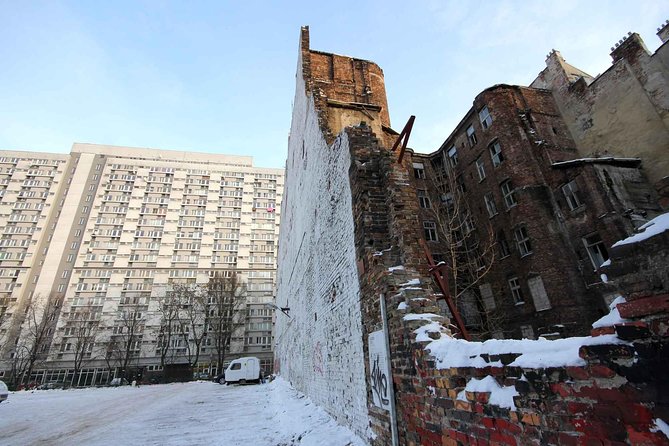
Praga Północ offers a more complicated picture of communist life. The district received less state investment than the showcase areas of central Warsaw. Its neglected courtyards and older buildings became associated with informal and illegal activity.
The guide explains how residents exchanged foreign currency, traded Western music, and searched for goods that could not be found through official channels. These details bring the period down from government slogans to everyday problems. Shortages were not abstract. They shaped what people bought, listened to, wore, and traded.
You spend about 30 minutes in Praga. Expect walking through an urban district and looking closely at its courtyards and streets. Comfortable shoes matter here, and you should be ready for a stop that feels less polished than the central monuments.
That contrast is useful. The Palace of Culture shows official power at its most grand. Praga shows what happened when a neighborhood was left outside the main investment plan. Together, the stops give you a less tidy and more honest picture of the period.
The minibus is particularly helpful on this section. You can reach Praga without spending a large part of the tour walking across central Warsaw. The vehicle also lets the guide set up the contrast between districts as you move through the city.
The government district and socialist realism
The final main stop is Śródmieście, Warsaw’s government district. Here, prewar modernist architecture meets the monumental style favored by communist authorities.
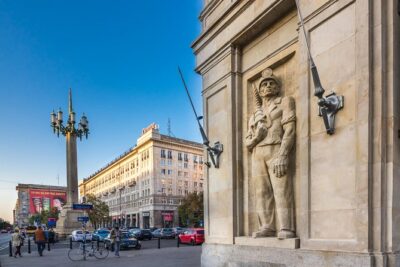
That meeting creates some of the tour’s best architectural tension. Modernism tends to favor clean lines and practical forms, while socialist realism often uses scale and decoration to express state authority. Seeing both styles in one district helps you understand that communist Warsaw was not built from one single design language.
You spend about 45 minutes here, the longest stop of the tour. That gives the guide time to discuss government buildings, statues, and the political ideas behind them. One amusing detail concerns the new party headquarters. The leader of communist Poland reportedly refused to move into it, saying it looked more like a capitalist bank than an office for a workers’ party.
That story is worth remembering because it shows how official architecture could become politically awkward. A building might be intended to express working-class rule while looking expensive, formal, and financially powerful.
The district also makes a strong ending because it brings the tour back to the question raised at the Palace of Culture. What should a new state look like? Warsaw’s answer was often monumental, but the details did not always match the message.
What the retro minibus adds
The vehicles accommodate up to eight people, and the operator has a fleet of five minibuses. Since the activity is private, only your group takes part. That is a good setup for families, couples, or friends who want to talk freely with the guide.
The classic vehicle is part of the appeal. You are not simply moving between attractions in an ordinary modern van. The retro minibus fits the subject and gives the experience a clear character.
There are tradeoffs. The minibuses are used mainly for transportation, so do not expect a long guided ride through every street. You will get out and walk at the stops. Historic vehicles may lack air conditioning, and some do not have seat belts. Heating is available during the winter season.
In warm weather, light clothing and water are sensible, though the tour information specifically stresses comfortable clothing and suitable footwear. If you are sensitive to heat or want modern vehicle comfort, this is worth considering before you book.
Is the $134.43 price good value?
At $134.43 per person, this is not the cheapest way to see Warsaw. But the price covers a private English-speaking guide, a retro minibus, hotel pickup and drop-off, and all fees and taxes.
The value improves as your group gets larger, since the tour is private and the minibus can carry up to eight people. For two people, the cost is harder to justify if you only want transportation. For a small group that wants a dedicated guide and a focused history lesson, it makes more sense.
You are also paying for time saved. Warsaw’s communist-era sites are spread across several districts. Using the minibus lets you connect the Palace of Culture, Muranów, Praga, and Śródmieście in one compact outing.
Hotel pickup is convenient, but it has a catch. Transfer time counts toward the three-hour total. If your hotel is far from the center, meeting the guide downtown may give you more sightseeing time. If convenience matters most, keep the pickup. If you want the strongest use of the clock, ask about meeting in the city center.
Who should book this Warsaw tour?
I would choose this tour if you want Warsaw’s communist period explained through the city itself rather than through a museum display. It works especially well for visitors who enjoy architecture, urban planning, political history, or stories about how people managed daily shortages.
It is also a good choice if long walking tours are tiring. You still walk at each stop, but the minibus handles the longer connections between districts. The private format suits anyone who prefers questions and conversation over a fixed group script.
Families can book for adults and children over 150 centimeters. Polish law requires booster seats for shorter children, so contact the operator before booking if a child under 150 centimeters will join. The tour is offered in English.
I would not choose it if your main goal is the Palace of Culture viewing terrace, since that is not included. It is also not ideal if you want extensive time inside buildings, a full Old Town tour, or the comfort of an air-conditioned modern vehicle.
Booking and cancellation tips
The experience can be booked instantly, and confirmation is provided at booking. It is usually reserved about five days ahead, so booking several days early is sensible if your schedule is tight.
Free cancellation is available up to 24 hours before the start time. Cancellations or changes made less than 24 hours before the tour are not accepted for a refund. The cut-off follows local Warsaw time.
Ask the operator about your pickup address if it is not shown in the selection box. Before paying, consider the location of your hotel and the time you want to spend on the road. A central meeting point may be the better choice for a hotel on the outskirts.
Should you book it?
Book this tour if you want a focused, private look at communist Warsaw with a guide who can connect grand buildings to ordinary life. The sequence works well: the Palace shows Soviet influence, Muranów shows planned reconstruction, Praga shows informal survival, and Śródmieście shows the state’s public face.
Skip it if you need air conditioning, modern vehicle safety features, or a tour centered on interior visits. For everyone else, the combination of a retro minibus, short walks, and a dedicated English-speaking guide offers a practical way to understand a difficult period without spending hours crossing the city on foot.
FAQ
How long does the Communist Warsaw tour last?
The tour lasts approximately three hours. Hotel pickup and drop-off are included within that total time.
Is hotel pickup and drop-off included?
Yes. Pickup and drop-off are included, but transfer time from your hotel counts toward the tour’s total duration.
What language is the tour offered in?
The tour is offered in English and includes a professional local English-speaking guide.
How many people can travel in each minibus?
Each retro minibus accommodates up to eight passengers. The operator has a fleet of five minibuses, and the activity is private for your group.
Does the tour visit the Palace of Culture viewing terrace?
No. The tour visits the Palace of Culture and Science, but it does not include the terrace on the 30th floor.
Can children join the tour?
Adults and children over 150 centimeters can book online. For a child under 150 centimeters, contact the operator in advance because Polish law requires a booster seat, and availability must be checked.
Are the vehicles air-conditioned and fitted with seat belts?
The classic vintage minibuses do not have air conditioning, and some do not have seat belts, as permitted for historic vehicles. All vehicles have heating for winter use.
Just added around Warsaw
- Wolfs Lair and Swieta Lipka Small Group Tour from Warsaw with Lunch★ 4.5 · 21 reviews
- Wolf’s Lair & Treblinka Tour in 1 day from Warsaw★ 5.0 · 37 reviews
- Wolf’s Lair Private Day Trip from Warsaw★ 5.0 · 50 reviews
- Wolfs Lair “Hitler’s Headquarters” – Full Day Tour from Warsaw by private car★ 4.5 · 4 reviews
- Tour from Warsaw: Wolf’s Lair, Hitler’s HQ Zones I and II★ 5.0 · 32 reviews
- Warsaw Must-See Local City Tour with Antek and Tomek★ 5.0 · 51 reviews
- Off the Beaten Track in Warsaw: Private City Tour★ 4.5 · 9 reviews
- Warsaw’s Old Town A Self-Guided Audio Tour★ 4.5 · 10 reviews
Communist History Tours, compared.
Legendary Private Nowa Huta Communism Tour with Crazy Guides
Read our review →
Nowa Huta: Steelworks Administration Buildings/Shelters Tour
Read our review →
Private Tour: Warsaw’s Communist History by Retro Fiat
Read our review →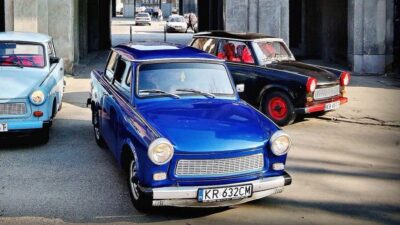
Private Nowa Huta Adventure Tour in Communist Cars
Read our review →
Browse the lists this tour appears in