
Reviewed · CITY TOURS
Faces of Warsaw’s 3-hour orientation city tour with hotel pick-up
Warsaw’s story comes in sharp contrasts: royal gardens beside communist-era concrete, a carefully rebuilt Old Town beside places marked by wartime loss. This three-hour private tour gives you a useful first look at those layers without making you solve the city’s transport system on your own.
I like the hotel pickup and private vehicle, especially if you have only one day in Warsaw. I also like the serious balance of the route: Łazienki Park and royal Warsaw lead into Jewish history, World War II, communism, and modern Poland. The drawback is pace. With eight stops in about three hours, several places are introductions rather than full visits.
Key points at a glance
- Private hotel pickup in central Warsaw: Your guide collects you at reception or waits by the entrance in an air-conditioned car or minibus.
- A clear Warsaw timeline: The route moves from royal Poland to the ghetto, wartime destruction, communism, and today’s rebuilt capital.
- Important Jewish heritage sites: Grzybowski Square, the POLIN Museum area, the Ghetto Heroes Monument, and Umschlagplatz receive focused attention.
- Old Town with major landmarks: You see Sigismund’s Column, the Presidential Palace, and the Market Square before finishing near the Marie Curie Museum.
- A guide-led experience: Marzena has been praised for her historical perspective, patient answers, and cheerful manner.
- Good for first-time visitors: The tour covers a lot quickly, but it does not include lunch or a full museum admission program.
Why this short Warsaw tour works
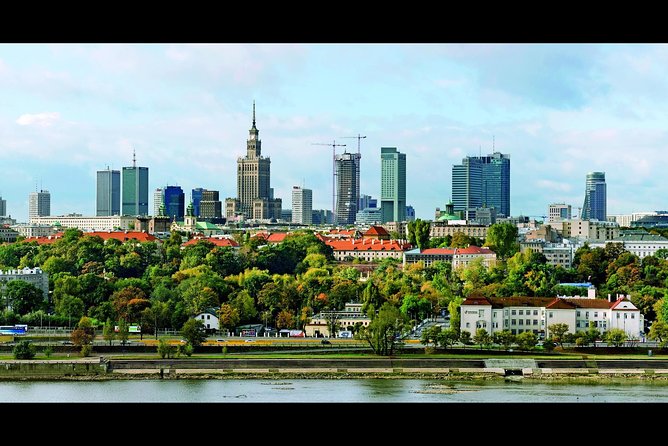
Warsaw can feel confusing at first. Its historic center was rebuilt after wartime destruction, while other parts of town preserve traces of the ghetto and the communist period. A map alone does not always explain what you are seeing.
This tour gives you a framework. You begin with Poland’s royal past, move through the city’s Jewish heritage, confront the Holocaust and wartime resistance, then finish among Old Town streets and famous Polish names. That order helps you understand Warsaw as a city repeatedly damaged, reshaped, and rebuilt.
The private format matters. Only your group takes part, so you can ask questions without competing with a large crowd. One especially praised guide, Marzena, is described as patient, cheerful, and strong at explaining life in Poland as well as major historical events. Guide quality can shape a short tour, and that personal approach is one of the experience’s best features.
You should still set your expectations correctly. This is an orientation tour, not a series of long museum visits. The vehicle helps cover ground, but the stops are short. You will see and discuss major places, then return later if one deserves more of your time.
More City Tours in Warsaw
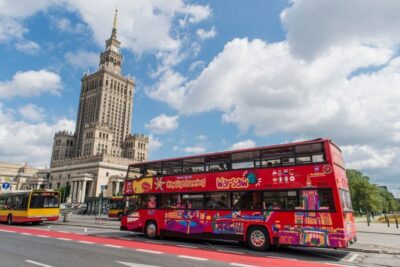
- Warsaw: City Sightseeing Hop-On Hop-Off Bus Tour
★ 3.6 · 1,415 reviews - Private Tour: Warsaw City Sightseeing by Retro Fiat
★ 5.0 · 562 reviews - Warsaw: Afternoon Public City Tour with Pickup and Drop-off
★ 4.4 · 421 reviews
Łazienki Park and the royal opening
The tour begins with about 30 minutes at Łazienki Royal Park and Palace Complex. This is the greenest and most graceful part of the route, offering a calm opening before the heavier subjects later in the day.
Łazienki is presented as one of Europe’s distinctive royal park and palace settings. You should expect a guided look at the grounds and complex rather than a long palace visit. The listed admission for this stop is free, which keeps the opening simple.
I like beginning here because it gives you a sense of Warsaw before the twentieth century. The park helps place the city’s royal and cultural identity before the tour turns to political trauma. If you are hoping to explore every path or spend time inside the palace, 30 minutes will feel brief. For a first orientation, it is a sensible introduction.
Parliament, the Palace of Culture, and modern contrasts
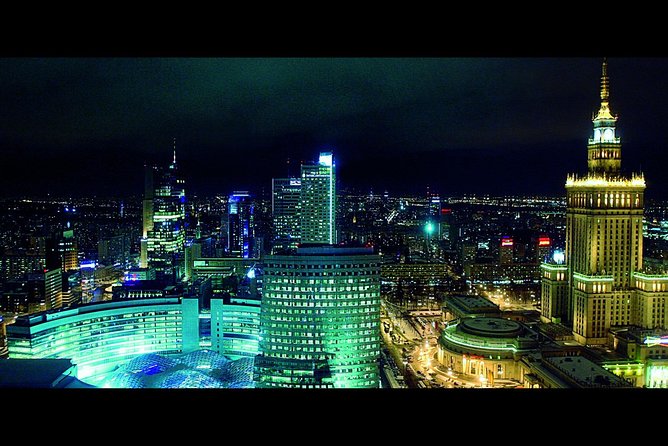
The route also points out the seat of Poland’s parliament and explains the Palace of Culture, including its controversial connection to Stalin. These parts are important because Warsaw’s built environment tells a political story.
The Palace of Culture is not just a tall city landmark. Its presence recalls the period when Poland was under communist influence and when Stalin presented the building as a gift. The tour uses it to explain the uneasy relationship between Polish identity and Soviet power.
You also hear about Warsaw as one of Europe’s fast-developing capitals, where modern construction and older landmarks meet around nearly every corner. That contrast is easy to notice, but a guide can help connect the visual details to the city’s political past.
The supplied timing does not assign a separate stop length to the parliament or Palace of Culture. They appear as part of the vehicle-based orientation, so do not plan on an extended visit inside either one. This is a useful city view, not a government-building tour.
Grzybowski Square and the former ghetto
At Grzybowski Square, you spend about 15 minutes learning about the former Warsaw ghetto and the city’s Jewish population. The square is one of the points where the tour shifts from broad city orientation to specific wartime memory.
A short stop here cannot cover the full history of Warsaw’s Jewish community. Still, it gives your guide a place to explain the setting and the destruction that followed. I appreciate that the route does not treat the Old Town as the whole of Warsaw. The Jewish history of the city is central, not an optional footnote.
The listed admission is free. Because the stop is brief, listen for the geographic clues your guide gives you. They will help you understand how the former ghetto sites relate to the rest of central Warsaw.
A few more Warsaw half-days worth comparing
- 3-Hour Guided Cycling Tour of Warsaw
★ 4.9 · 624 reviews - Warsaw Old Town 1.5-Hour or Full 3-Hour Segway Tour
★ 4.9 · 209 reviews - Warsaw: 3-Hour Panoramic City Bus Tour with Pickup
★ 4.5 · 169 reviews - Warsaw: 3-Hour Guided City Highlights Tour by Segway
★ 4.9 · 102 reviews
POLIN, the Ghetto Heroes Monument, and Umschlagplatz
The next section includes the POLIN Museum of the History of Polish Jews, the Ghetto Heroes Monument, and Umschlagplatz. Together, these stops address Jewish life, resistance, and the machinery of deportation during the Holocaust.
At the Ghetto Heroes Monument, you learn about the Warsaw Ghetto Uprising and the memorial’s place in public memory. The description also points out Willy Brandt’s famous act of kneeling before the monument. That detail links Warsaw’s local history to Germany’s later effort to face its past.
Umschlagplatz is more stark. This was the place where deportations were carried out as part of the Nazi plan to murder Europe’s Jews. Your guide explains what happened at this real location, which gives the subject a physical setting rather than leaving it as a list of dates.
The planned times are about 20 minutes at POLIN and 15 minutes at Umschlagplatz, with no admission charge listed for these stops. Read that as a guided introduction, not a full museum experience. If the POLIN Museum becomes a priority, reserve separate time for it after the tour. The route lets you understand why the museum and memorial sites matter, but it does not provide enough time for a full museum visit.
These are serious stops, and the schedule leaves little room for lingering. That is not a flaw so much as a choice. The tour gives you a broad Warsaw story, then lets you decide which subject deserves a longer return visit.
Sigismund’s Column and rebuilt Old Town
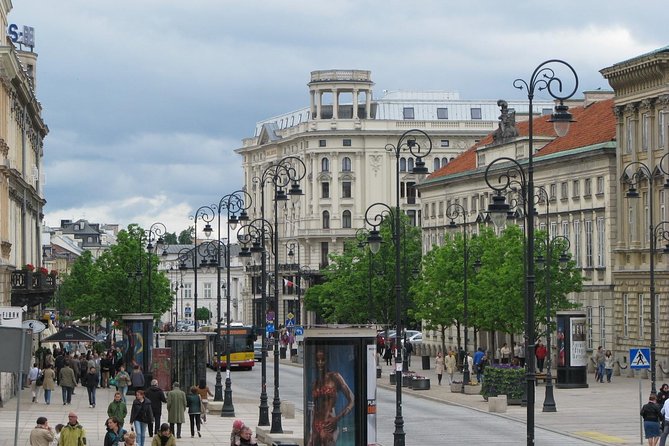
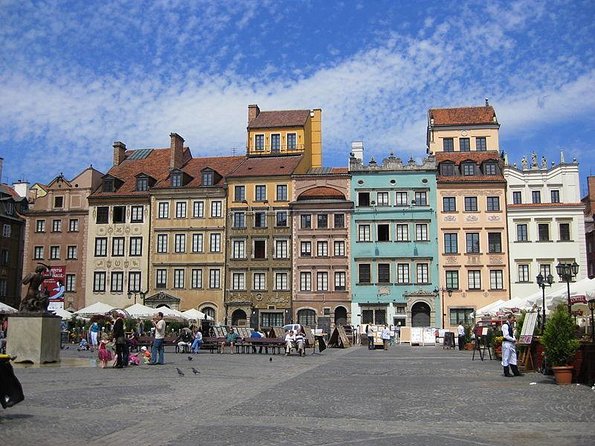
The route then reaches Sigismund’s Column in Castle Square, a natural gateway to historic Warsaw. You learn about the rebuilt Old Town, its royal residences, major monuments, and UNESCO recognition.
The word rebuilt matters here. Warsaw’s Old Town looks historic, but much of it was reconstructed after the city’s wartime destruction. The result is not a preserved medieval quarter in the usual sense. It is a major example of a city restoring its architectural identity after catastrophe.
You have about 15 minutes at Sigismund’s Column, followed by roughly 30 minutes at the Old Town Market Square. That is enough for a guided walk through the romantic streets and a quick look at the main urban spaces. It is not enough for every church, museum, shop, or side street.
I like this section because it gives the tour a visual lift after the difficult wartime material. You see royal Warsaw, the Old Town’s colorful facades, and the continuing effort to preserve the city’s character. Keep your camera ready, but pay attention to the explanation of reconstruction. Without it, you may miss one of the most important facts about what you are seeing.
The Presidential Palace and famous Polish figures
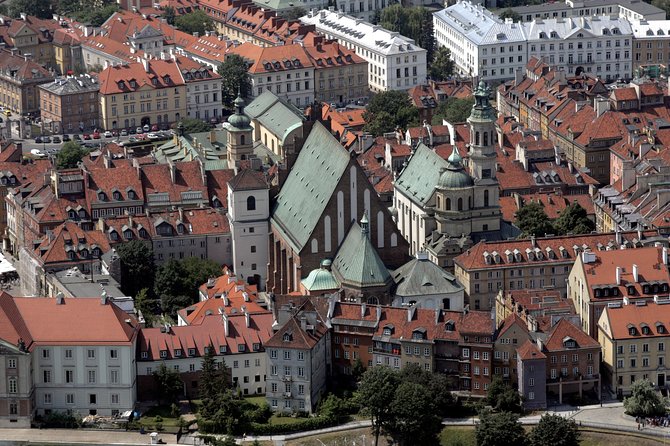
The Presidential Palace receives about 10 minutes. Here, the guide connects Warsaw’s public buildings with notable Polish figures, including Frederick Chopin, Marie Curie, and Lech Wałęsa.
This is a compact stop, but it helps broaden the tour beyond war memorials. Chopin represents Warsaw’s cultural identity, Curie connects the city to science, and Wałęsa points toward Poland’s modern political change. The guide’s job here is to show how these names fit into the larger national story.
Do not expect a formal visit inside the palace. The value comes from seeing the setting and hearing the context. If you enjoy connecting places to people, this short stop adds useful depth to the route.
Finishing at Marie Curie’s birthplace
The tour ends near the Maria Skłodowska-Curie Museum on Freta Street, in the Old Town area. The final stop lasts about 10 minutes and focuses on Curie’s birthplace and her connection to Warsaw.
This is a smart ending. After seeing royal buildings, wartime memorials, communist architecture, and reconstructed streets, you finish with one of Poland’s best-known scientific figures. The museum admission is not included, so treat the stop as an introduction and decide if you want to enter afterward.
The endpoint also gives you flexibility. You are already in the Old Town area, surrounded by places to continue exploring. Since lunch is not included, this is a practical place to arrange your own meal after the tour, though the experience itself does not specify a restaurant or lunch break.
What $72.72 buys you
The price is $72.72 per person. For that amount, you are paying mainly for a private guide, private transportation, hotel pickup and return, parking fees, and a route that joins several parts of Warsaw in one compact outing.
The value is strongest if you want a quick first orientation and would otherwise need taxis or public transport between distant areas. An air-conditioned car or minibus saves time and energy, particularly when you are trying to fit royal gardens, former ghetto sites, the Old Town, and the Curie museum area into one morning or afternoon.
It is less attractive if you prefer slow walks and long museum visits. Admission to the Marie Curie Museum is not included, lunch is not included, and the other stops are designed around brief guided visits. You are buying access to a well-organized overview, not a full day of entrances and meals.
Group discounts are available, which may improve the price for larger parties. Since this is a private activity, the cost should be judged against the size of your group and the value of having the schedule and discussion tailored to you.
Pickup, timing, and practical details
Pickup is offered from hotels or accommodations in Warsaw’s city center. The guide either meets you at reception with a PolinTours sign or waits in the car in front of the entrance. Confirming the exact pickup point matters, especially if your accommodation has more than one entrance.
The published meeting point is Sigismund’s Column at Plac Zamkowy, though central hotel pickup is offered. The tour finishes at the Maria Skłodowska-Curie Museum, Freta 16, rather than returning you to the hotel. That ending works well if you want to continue in the Old Town, but it is worth planning your next step.
The tour is offered in English and uses an air-conditioned car or minibus. Service animals are allowed, and the route is near public transportation. Most people can participate, but the tight schedule means you should be comfortable moving between vehicle stops and short walking sections.
You receive confirmation at booking. Free cancellation is available until 24 hours before the start time. Changes or cancellations inside that window are not accepted for a refund.
Who should book this Warsaw orientation
I would choose this tour for a first visit, a short stay, or a day when you want the city’s major themes explained in a logical order. It suits couples, families, and small groups who value a private vehicle and the chance to ask questions.
It is also a good match if you care about history but do not want to spend your entire first day inside museums. The route introduces Jewish Warsaw, the Holocaust, communist Poland, royal Warsaw, and modern national figures without ignoring the city’s rebuilt identity.
You may want something else if your main goal is a long visit to POLIN, a detailed Holocaust study tour, or a leisurely exploration of Łazienki Park. In those cases, use this as a first look and return independently, or choose a tour built around one subject.
Should you book it?
Book it if you want a private, efficient first look at Warsaw with hotel pickup and a guide who can explain difficult history in clear terms. The strongest parts are the carefully chosen contrasts, the Jewish heritage stops, the rebuilt Old Town, and the personal attention of a private tour.
Skip it if you dislike short stops or want included museum admissions and lunch. At $72.72 per person, the value depends on how much you prize private transport and a human guide. For a compact introduction that helps you decide what to explore next, it is a strong choice.
FAQ
How long is the Warsaw orientation tour?
The tour lasts approximately three hours.
Is hotel pickup available?
Yes. Pickup and return are offered from hotels or accommodations in Warsaw’s city center. The guide meets you at reception with a PolinTours sign or waits in the car near the entrance.
Is this a private tour?
Yes. Only your group participates in the activity.
What language is the tour offered in?
The tour is offered in English.
Is transportation included?
Yes. Private transportation in an air-conditioned car or minibus is included, along with parking fees.
Is lunch included?
No. Lunch is not included.
Is admission to the Maria Skłodowska-Curie Museum included?
No. Admission to the museum is not included.
Where does the tour end?
The tour ends at the Maria Skłodowska-Curie Museum at Freta 16, in Warsaw’s Old Town area.
Just added around Warsaw
- Wolfs Lair and Swieta Lipka Small Group Tour from Warsaw with Lunch★ 4.5 · 21 reviews
- Wolf’s Lair & Treblinka Tour in 1 day from Warsaw★ 5.0 · 37 reviews
- Wolfs Lair “Hitler’s Headquarters” – Full Day Tour from Warsaw by private car★ 4.5 · 4 reviews
- Tour from Warsaw: Wolf’s Lair, Hitler’s HQ Zones I and II★ 5.0 · 32 reviews
- Wolf’s Lair Private Day Trip from Warsaw★ 5.0 · 50 reviews
- Warsaw Must-See Local City Tour with Antek and Tomek★ 5.0 · 51 reviews
- Off the Beaten Track in Warsaw: Private City Tour★ 4.5 · 9 reviews
- Warsaw’s Old Town A Self-Guided Audio Tour★ 4.5 · 10 reviews
City Tours, compared.
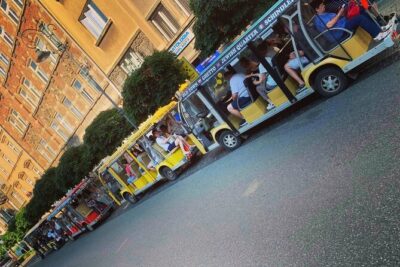
City Sightseeing Tour Eco Electric Buggy Golf Cart
Read our review →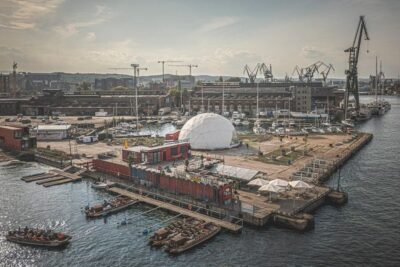
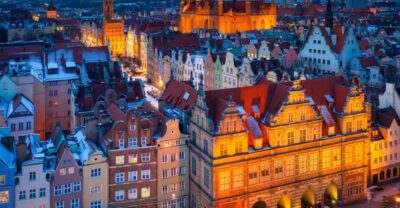
Gdańsk City Sights & History Guided Walking Tour in English
Read our review →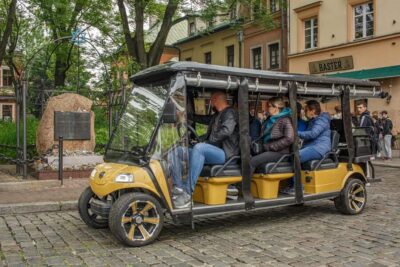
Extended City Sightseeing Tour – Eco Buggy Golf Cart
Read our review →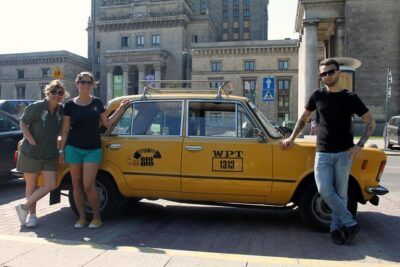
Private Tour: Warsaw City Sightseeing by Retro Fiat
Read our review →Browse the lists this tour appears in