Reviewed · PRIVATE
Lesser Poland Wooden Architecture Trail UNESCO Private Tour from Krakow
The most striking thing about this private day trip is its variety. In one long sweep through southern Lesser Poland, you see late Gothic Catholic churches, Lemko Greek Catholic churches, rural villages, and the timber forms that once shaped everyday life in the region. St. Leonard’s in Lipnica Murowana belongs to a UNESCO World Heritage group of wooden churches, while Sękowa’s church is known as the Pearl of Beskid Niski.
I like the private format, since your guide can adjust the pace instead of pushing a fixed group through each stop. I also like the chance to see interiors with a local church guide or audioguide when available. The main drawback is the length: 10 to 12 hours is a full day, and each listed visit lasts about 30 minutes, so this suits you best if old churches and rural architecture are a real priority.
Key points to know before booking
- Six important wooden churches: Visit Lipnica Murowana, Binarowa, Sękowa, Owczary, and Kwiaton, with two separate church stops early in the day.
- A flexible private outing: The guide can discuss pace and may add more churches, with one account describing up to eight or nine stops when time allowed.
- UNESCO architecture in the countryside: Lipnica Murowana’s St. Leonard’s is one of six southern Lesser Poland wooden churches protected as a UNESCO World Heritage Site.
- Two architectural traditions: Catholic Gothic churches share the route with old Lemko Greek Catholic churches, including Owczary and Kwiaton.
- Hotel pickup in Krakow: Transport is by air-conditioned minibus, with pickup and return to your Krakow accommodation.
- A long but well-organized day: Plan on 10 to 12 hours, bring money for lunch, and tell the operator your full hotel name and address when booking.
Why these wooden churches matter in Lesser Poland
Wood was once the practical building material across much of rural southern Poland. Local builders could work with nearby timber, and the material allowed churches to be built in villages far from major stone-building centers. Over time, builders developed forms that were both useful and distinctive.
This route helps you see that the churches are not all alike. The Catholic examples tend to reflect Gothic design, while the Lemko churches show the traditions of an eastern Christian community from the Carpathian foothills. You are not just checking off old buildings. You are seeing how religion, local craft, and village life shaped one another.
The setting matters, too. The route leaves Krakow and reaches smaller communities where the churches remain tied to their original surroundings. You get wooded hills, open fields, village roads, and views of the Beskid Niski area along the way. The countryside gives the buildings scale and context that you miss when seeing historic architecture only in a city center.
A few more Krakow half-days worth comparing
- Kraków: Evening or Night River Cruise
★ 4.0 · 7,386 reviews - Krakow: Oskar Schindler’s Factory Entry Ticket & Guided Tour
★ 4.2 · 3,793 reviews - Krakow: City Sightseeing Tour by Electric Golf Cart
★ 4.5 · 3,264 reviews
Lipnica Murowana and St. Leonard’s church
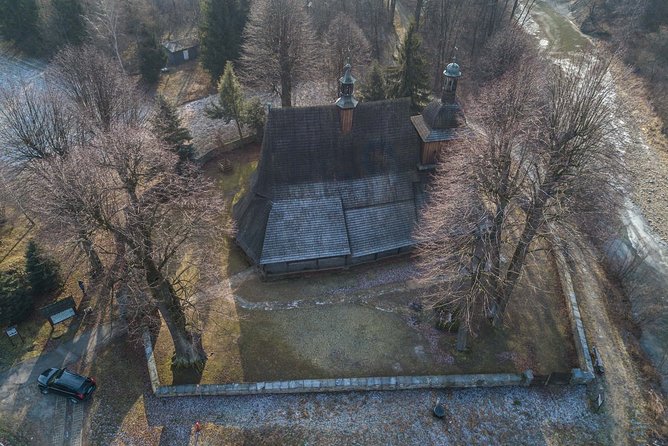
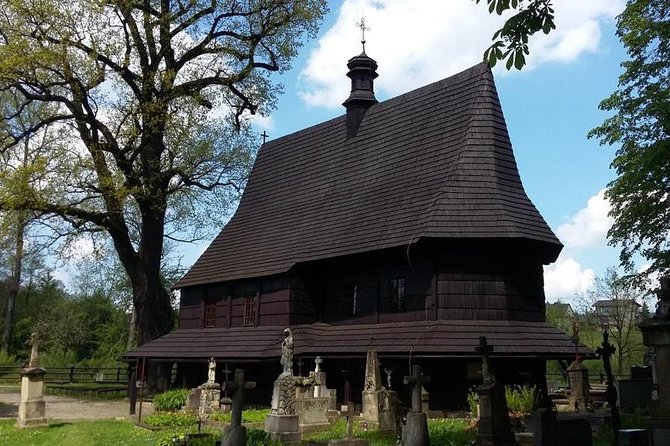
The first stop is Lipnica Murowana, home to St. Leonard’s church, built at the end of the 15th century. It is one of six wooden churches in southern Lesser Poland included on the UNESCO World Heritage list.
A half-hour visit sounds short, but it gives you time to look closely at the construction and get an introduction from your guide. Pay attention to the way the church sits within the village setting. Its importance comes not only from its age, but from the way it preserves a form of wooden religious architecture that was once common across the region.
This is a strong opening stop because it gives you the basic theme of the day right away: local materials, Gothic design, and a church that has survived for centuries. Admission is included, so there is no extra entry charge at this stop.
The 15th-century church of the Visitation
The second stop is another wooden 15th-century church, listed as the Church of the Visitation of the Blessed Virgin Mary. The supplied route information gives this visit about 30 minutes and includes admission.
Details about this church are more limited than those for Lipnica Murowana, so I would treat it as a chance to compare rather than expect a long standalone museum visit. Look for differences in proportions, roof lines, exterior weathering, and the relationship between the church and its village.
Because the day includes several churches, your guide’s explanations are especially useful here. Without context, a series of timber buildings can begin to blur together. The private setup lets you ask why one church looks more Gothic, why another has a different tower form, or how Catholic and Lemko traditions differ.
Binarowa and late Gothic craftsmanship
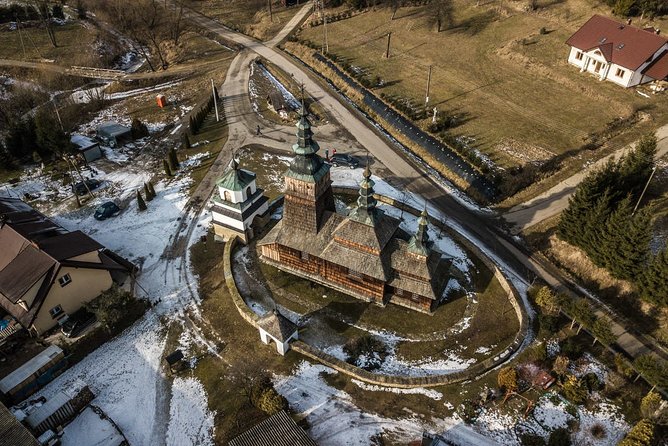
At Binarowa, you visit St. Michael the Archangel, described as one of Poland’s most valuable examples of late Gothic architecture. This is one of the main architectural highlights of the route.
The church gives you another chance to see how wood can carry a formal Gothic design. The word Gothic may make you think of grand stone cathedrals, but here the same broad period and design language appear in a smaller wooden village church. That contrast is one of the pleasures of the day.
Allow your eyes time to adjust to the details. The visit is scheduled for about 30 minutes, so you will want to focus rather than rush through every feature. If an interior guide or audioguide is available, use it. The outside tells you about construction, while the inside helps explain how the building functioned as a place of worship.
Same city, a completely different kind of day:
- Krakow: Schindler’s Factory Tour with Entrance Ticket
★ 4.5 · 3,182 reviews - Krakow: City Sightseeing Tour Eco Electric Buggy Golf Cart
★ 4.7 · 3,143 reviews - Krakow: Schindler’s Factory Skip-the-Line Ticket
★ 4.4 · 3,105 reviews - Krakow: Chopin Piano Recital at Chopin Concert Hall
★ 4.7 · 2,330 reviews
Sękowa, the Pearl of Beskid Niski
The next stop is Sękowa and the Church of St. Philip and St. James the Apostles. Built at the beginning of the 15th century, it is one of the route’s best-known buildings and carries the nickname Pearl of Beskid Niski.
This church is a good example of why the trip works better as a full route than as a single photo stop. You have already seen two older wooden churches, but Sękowa gives you another chance to compare the shape of a Gothic church with the local setting and building methods.
The stop lasts about 30 minutes, and the admission fee is included. Since the route may depend on church opening arrangements, your guide’s timing matters here. The guide may arrange access inside, or an audioguide may help explain what you are seeing. Do not assume every door will be open in exactly the same way at every stop, but the plan allows time for interior visits when available.
Owczary and the Lemko church tradition
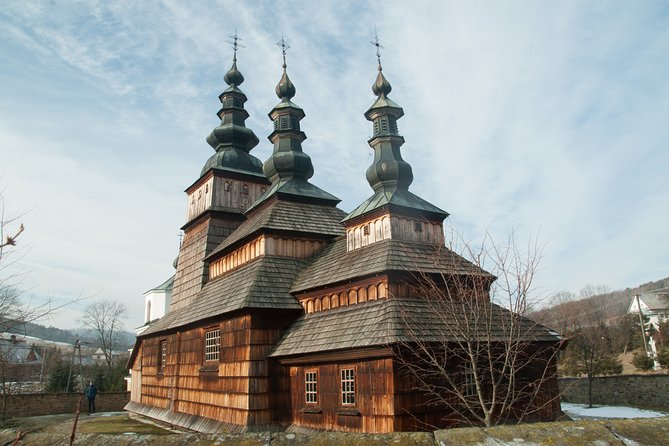
Owczary changes the mood and architectural focus. Here you visit the Greek Catholic Church of the Protection of Our Most Holy Lady, an Orthodox church built in the middle of the 17th century. It is described as one of the oldest Lemko tserkvas, or churches, in the region.
This is an important part of the day because the route is not limited to Polish Catholic Gothic buildings. The Lemko tradition adds another layer to the area’s religious and cultural story. You can compare the church’s form with the earlier Catholic examples and ask your guide about the communities that used these buildings.
The stop is planned for about 30 minutes. That is enough for a focused visit, though anyone fascinated by religious architecture may wish for more time. This is one reason the private format helps. If your group is eager to look longer, the guide can discuss the pace rather than forcing everyone to move on at the same moment.
Kwiaton and St. Parasceve
The final listed church is St. Parasceve in Kwiaton, described as one of the most beautiful wooden churches in Lesser Poland. Like Owczary, it belongs to the eastern church tradition associated with the region’s Lemko communities.
By this point, you will have seen enough examples to make your own comparisons. Look at the silhouette, the number and arrangement of roof sections, and the way the church rises above the village. The value of Kwiaton is not just its appearance. It completes the route’s shift from late Gothic Catholic buildings to the wooden churches of the Carpathian foothills.
The scheduled visit is about 30 minutes, with admission included. If you are taking photographs, remember that interiors may have rules about flash or photography, and follow the instructions given at each church.
How the private tour changes the day
This is not a large coach outing with one fixed script. It is a private activity for your group, using an air-conditioned minibus and hotel pickup in Krakow. That matters because the route covers many miles and the day lasts roughly 10 to 12 hours.
Guide Maciej, also called Matthew, can ask about your preferred pace. The route described here includes six main church visits, but the guide may offer up to eight or nine churches if your group wants more and the day allows it. You can also choose a shorter focus, with four or five churches as a reasonable minimum.
That flexibility is valuable, but it comes with a small tradeoff. More stops mean less time at each church and more time getting in and out of the vehicle. If you care about interiors, architectural details, or photography, tell the guide early that you prefer fewer stops with more time at each one.
The minibus is also more practical than trying to link these rural churches by public transport. Hotel pickup and drop-off remove the need to reach a distant bus station, although the operator asks you to provide your full hotel name and address when booking. Pickup is listed between 7:00 and 8:00 in the morning from Wednesday through Sunday during the stated operating period.
Lunch, timing, and what to bring
Food and drinks are not included. Plan to pay for lunch yourself, and bring water for the long day. The route does not specify a fixed restaurant, but the guide may allow about an hour for lunch at a village restaurant.
That break is useful. Six churches in succession can become tiring, especially if you are reading signs, listening to explanations, and getting back into the vehicle after every stop. A proper meal gives you time to reset and also lets you try Polish dishes outside Krakow’s busy center.
Wear comfortable shoes and dress suitably for entering churches. The supplied information does not list a demanding walk, but you will be getting in and out of the minibus and visiting historic rural buildings. A camera is worthwhile, but do not let photographs replace looking at the construction and the setting.
Is the $299.53 price good value?
At $299.53 per person, this is not a low-cost sightseeing day. Its value depends heavily on group size and your interest in the subject. Since the tour is private, the price buys more than transport: you get a dedicated guide, hotel pickup and return, an air-conditioned vehicle, and a route that would be difficult to organize efficiently on your own.
Entrance fees are included, which keeps the day simpler. Food and drinks are extra, so add lunch to your budget. If two or more people in your party share the private vehicle, the cost may feel more reasonable than it would for one person traveling alone.
I would not book this simply to fill a free day near Krakow. You are paying for a long, specialized outing focused on wooden religious architecture and rural Lesser Poland. If that subject interests you, the private flexibility and number of sites make the price easier to justify. If you prefer major city sights, short excursions, or a relaxed morning, this is probably too much road time.
Who will enjoy this day most?
I recommend it to you if you like historic buildings, religious art, traditional construction, and small villages. It also suits anyone who has already seen Krakow’s main sights and wants a quieter look at the surrounding region.
The tour is a good match for photographers and architecture students, since the churches offer repeated comparisons across different periods and traditions. It also works well for couples, families, or friends who want to set their own pace instead of joining strangers.
You may want to skip it if you tire quickly on long drives or prefer a tour with more walking and fewer short visits. The day is organized, but it is still a full excursion with several 30-minute stops. The more churches you add, the more important it becomes to decide what you want from each visit.
Should you book the Lesser Poland wooden churches tour?
Book it if you want a focused day beyond Krakow and are genuinely interested in wooden church architecture. The best reasons are the UNESCO church at Lipnica Murowana, the late Gothic examples at Binarowa and Sękowa, and the chance to compare them with Lemko churches in Owczary and Kwiaton.
Before booking, decide how many stops you want and tell the guide. Maciej or Matthew can help shape the pace, and the private format makes that possible. If you want a deeper look at fewer buildings, say so. If you want to see as many as possible, the route may expand to eight or nine churches when time permits.
Free cancellation is available up to 24 hours before the start time. That gives you some breathing room, but the day itself still needs an early start and a full commitment. For the right history and architecture enthusiast, this is one of the more distinctive excursions you can make from Krakow.
FAQ
How long does the tour last?
The experience lasts approximately 10 to 12 hours.
Where does the tour begin?
The listed meeting point is Kiss&Ride Zyblikiewicza, Mikołaja Zyblikiewicza 2, 31-029 Krakow, Poland. Hotel, hostel, and apartment pickup in Krakow is offered when you provide the full accommodation name and address.
Does the tour return to Krakow?
Yes. The activity ends back at the meeting point, with hotel drop-off offered in Krakow.
Which churches are included?
The route includes St. Leonard’s church in Lipnica Murowana, a 15th-century Church of the Visitation, St. Michael the Archangel in Binarowa, St. Philip and St. James in Sękowa, the Greek Catholic Church of the Protection of Our Most Holy Lady in Owczary, and St. Parasceve in Kwiaton.
Is Lipnica Murowana a UNESCO site?
Yes. St. Leonard’s church in Lipnica Murowana is one of six wooden churches in southern Lesser Poland included in the UNESCO World Heritage Site.
Is the tour private?
Yes. Only your group participates in the activity.
Is transport included?
Yes. Transport is provided in an air-conditioned minibus, with hotel pickup and drop-off in Krakow.
Are entrance fees included?
Yes. Entrance fees are included in the tour price.
Are food and drinks included?
No. Food and drinks are not included. A lunch break may be arranged, but you should budget separately for your meal.
What days is the tour offered?
The listed operating schedule is Wednesday through Sunday, with pickup between 7:00 and 8:00 in the morning, during the stated period from February 1 through December 30, 2026.
Just added around Krakow
- stag dog chase Krakow prank★ 5.0 · 4 reviews
- Divine Mercy Sanctuary – Private Tour from Krakow★ 5.0 · 4 reviews
- ZALIPIE – painted village, unique small group tour from Krakow★ 5.0 · 7 reviews
- ZALIPIE – painted village, unique PRIVATE tour from Krakow★ 5.0 · 20 reviews
- Zalipie Private Tour from Krakow The Painted Village★ 5.0 · 4 reviews
- Wooden Churches Unesco List Private Tour from Krakow★ 5.0 · 14 reviews
- Guided tour to Salt Mine & Schindler Factory with Pick-Up Options★ 4.0 · 58 reviews
- Wawel Castle, Cathedral, & Rynek Underground Tour with Lunch★ 5.0 · 4 reviews
Private, compared.
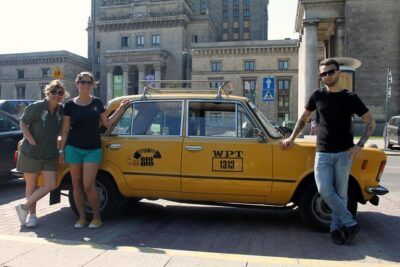
Private Tour: Warsaw City Sightseeing by Retro Fiat
Read our review →
Warsaw Ghetto Private Walking Tour with Hotel Pickup
Read our review →
Private Departure Transfer: Krakow City To Krakow Airport Balice
Read our review →
Legendary Private Nowa Huta Communism Tour with Crazy Guides
Read our review →
Skip-the-Line Wawel Castle Chambers Private Tour
Read our review →