
Reviewed · JEWISH HERITAGE TOURS
Warsaw: Warsaw Ghetto Private Walking Tour with Hotel Pickup
Warsaw’s former Jewish ghetto is mostly gone, but this tour shows you where it was, how it worked, and how its residents resisted. I like the use of wartime photographs and maps, which makes today’s ordinary streets easier to read. I also like the private format: guides such as Marzena and Mary can slow down, answer questions, and shape the three hours around your interests.
The main drawback is practical: the advertised hotel pickup has caused confusion, and some bookings appear to require meeting the guide at Prozna Street 9 instead. This is also a serious walking tour, not a casual city stroll, and it is not suitable for children under 14 or people with mobility impairments.
Key points at a glance
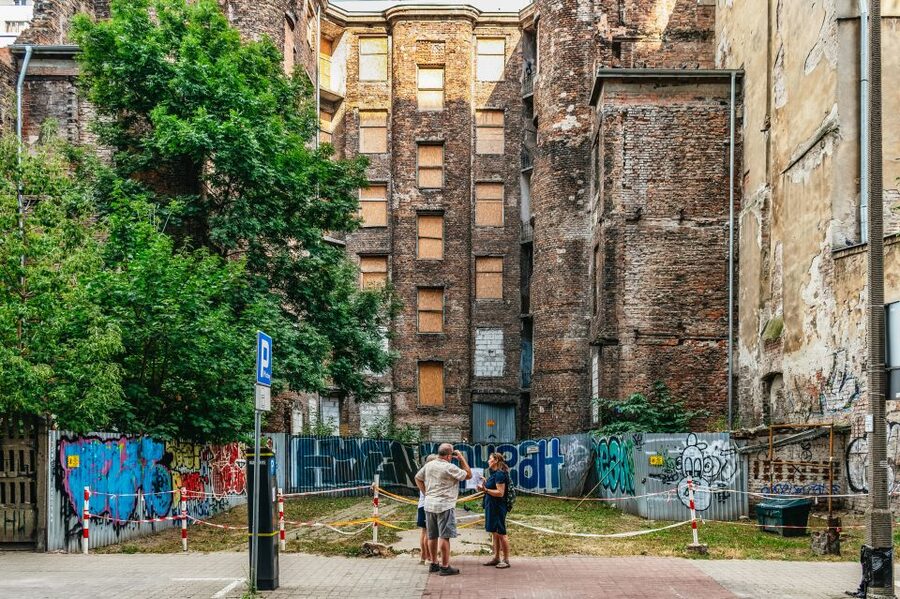
- See the ghetto in fragments: Visit surviving wall sections, the last street within the ghetto, and neighborhoods that once held more than 400,000 people.
- Use the past to read the present: Old photographs and maps help you understand places that now look completely different.
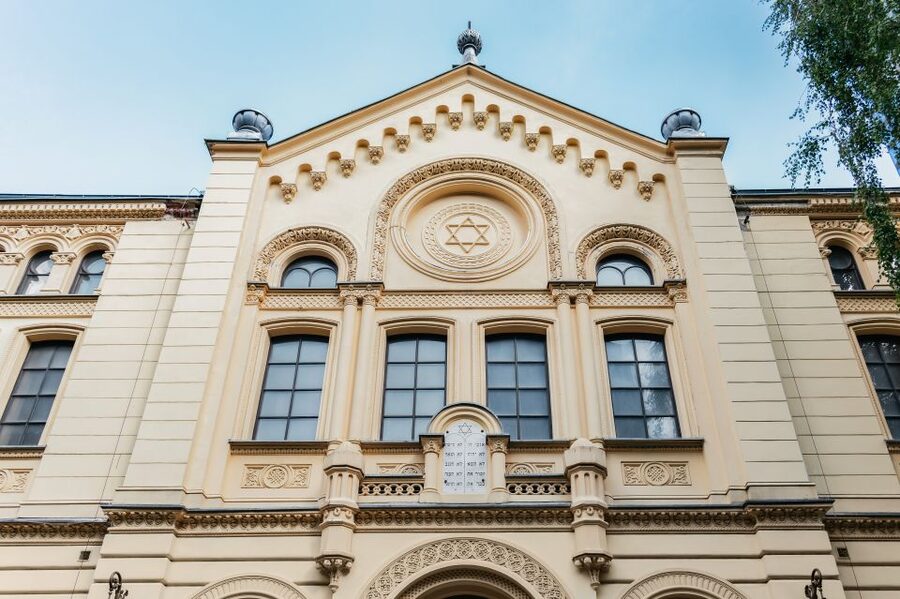
- Visit a living synagogue: The tour includes the only Warsaw synagogue that survived the Second World War and remains in operation.
- Follow the road to the uprising: Learn why Jewish residents took up arms in 1943 and how the revolt was crushed.
- Ask direct questions: A private guide gives you room to pause, discuss, and adjust the pace.
- Plan for a demanding subject: This is a Holocaust history tour with painful material, not light sightseeing.
Why this three-hour tour matters
The Warsaw Ghetto was created by Nazi Germany in 1940 in the center of the city. More than 400,000 Jewish people from Warsaw and nearby areas were forced into roughly four square kilometers. Overcrowding, hunger, exhaustion, and disease killed about 100,000 people inside the ghetto. More than 300,000 others were sent to Treblinka extermination camp and murdered there.
Those numbers are difficult to grasp from a page. The value of walking through the actual districts is that the history becomes tied to streets, walls, intersections, and distances. You are not simply hearing a timeline. You are seeing the places where Nazi policy was carried out and where Jewish families tried to survive.
The ghetto was not a closed episode that ended with deportations. Its residents faced a planned system of starvation, forced labor, separation, and murder. When the Nazis moved to destroy the ghetto completely in 1943, Jewish fighters launched the Warsaw Ghetto Uprising. The unequal battle lasted nearly a month. The German forces eventually destroyed the ghetto, leaving very little of the old neighborhood intact.
A good guide has to handle this subject with care. The strongest guides on this tour build the story in order, linking each stage to the place where you are standing. That structure keeps the facts understandable without turning the experience into a list of dates.
More Jewish Heritage Tours in Warsaw
- Warsaw: Jewish History Guided Walking Tour in English
★ 4.7 · 324 reviews - Private Tour: Warsaw’s Jewish Heritage by Retro Fiat
★ 5.0 · 208 reviews - Warsaw: Ghetto, Jewish Cemetery & POLIN Museum Private Tour
★ 4.8 · 132 reviews
Starting at Prozna Street and getting your bearings
The listed meeting point is Prozna Street 9, between Bistro Charlotte Menora and Strefa Restaurant. Look for a guide holding a PolinTours sign. Hotel pickup and drop-off are included in the activity details, but the meeting instructions also give this fixed central point.
I would confirm the pickup arrangement before the day of the tour. One practical issue has appeared repeatedly in the booking information: some people expected a hotel pickup but instead needed to meet the guide themselves. Do not assume the car will arrive without checking the precise instructions for your booking.
The car is useful because the former ghetto covered a broad area and the tour connects several locations. Still, you should expect to walk. Wear comfortable shoes, carry sunscreen and a hat in warm weather, and avoid bringing large bags or oversize luggage.
The opening part of the tour helps explain what Warsaw was like before the war. The city had one of Europe’s largest Jewish communities, with Jewish residents making up about 30 percent of Warsaw’s population. In less than three years, that community had been destroyed.
That contrast is important. The ghetto was not an isolated place with no connection to the rest of Warsaw. It was imposed on an existing city, filled with homes, businesses, religious institutions, schools, and family networks. Knowing that makes the later destruction more painful and more understandable.
Finding the wall fragments and the last ghetto street
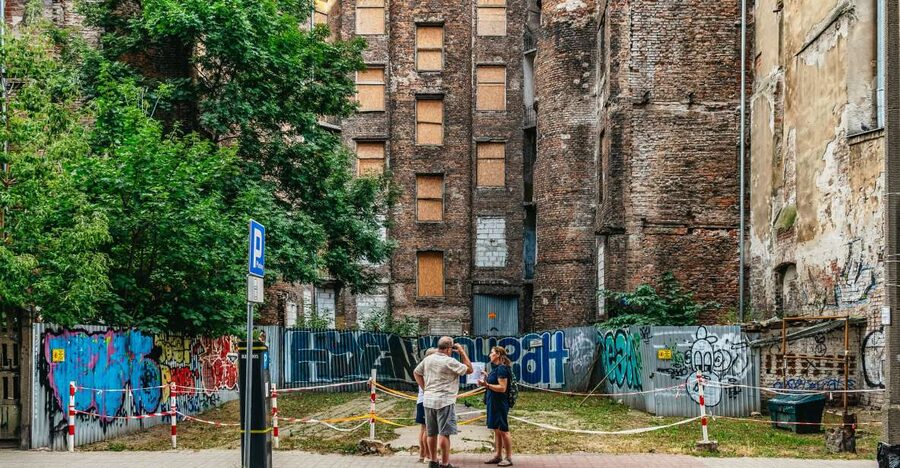
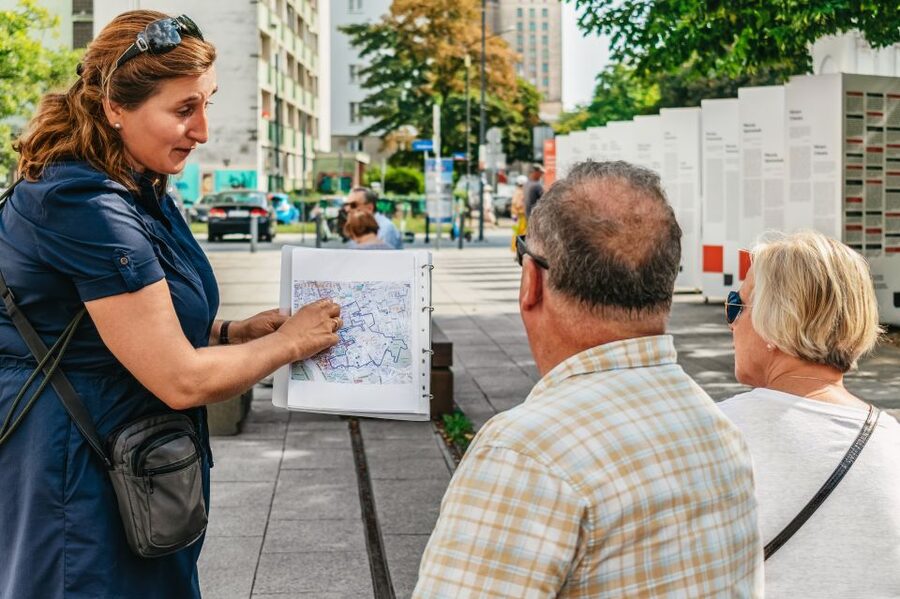
One of the most useful parts of the walk is seeing surviving fragments of the ghetto wall. These pieces are easy to miss if you are exploring Warsaw without a guide. Modern buildings and rebuilt streets can conceal the original boundaries, so maps and photographs are especially useful here.
The wall fragments do not create a complete historic district. That is an important expectation to set. You will not walk through a preserved ghetto with rows of wartime buildings. Much of the area was destroyed, rebuilt, or changed beyond recognition.
That absence is part of the lesson. The Nazi destruction was physical as well as human. The ghetto was erased so thoroughly that a visitor needs careful explanation to understand what once occupied the space. Your guide may hold up an old image and point out how a current building, street line, or open area relates to the wartime view.
The last street of the ghetto offers another clear connection to the past. It helps you picture the shrinking space available to Jewish residents as deportations and destruction continued. The tour also passes through neighborhoods that were within the ghetto, allowing the larger geography to make sense.
I particularly value this kind of location-based explanation. Reading about four square kilometers is one thing. Walking between surviving markers and hearing how the boundaries changed gives you a better sense of confinement.
The synagogue that survived the war
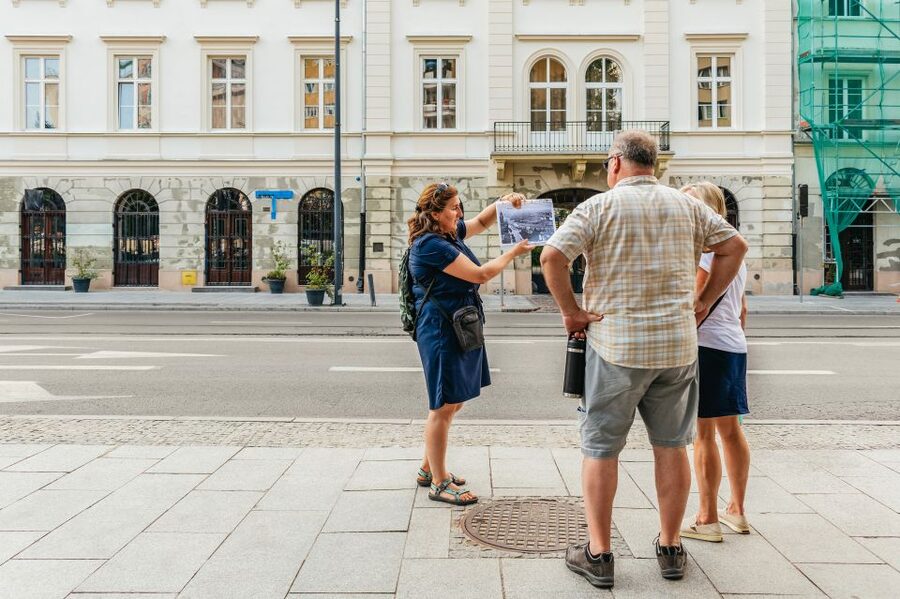
The synagogue visit adds a different note to the tour. It is the only synagogue in Warsaw that survived the Second World War and is still in operation. You pay a separate entrance donation of 20 PLN, 5 EUR, or 5 USD.
Bring a head covering or kippah. This is a functioning place of worship, not simply a monument, so respectful clothing and behavior matter. Cash is also sensible, since the donation is listed as a separate payment.
The synagogue is valuable because it brings Jewish life into the present tense. Much of the tour deals with places that disappeared. Here, you enter a surviving religious space that continues to serve its community. That shift helps prevent the story from ending only with destruction.
The visit may be especially meaningful if you have already seen photographs of prewar Warsaw. The city’s Jewish life included worship, education, trade, family life, and political activity. A surviving synagogue provides one of the few direct links to that world.
Remember that this is one stop within a tightly timed three-hour tour. If you want a long independent visit, ask your guide how much time is available. The tour’s purpose is to connect the synagogue with the broader story rather than treat it as a stand-alone museum visit.
More Walking Tours in Warsaw
- Warsaw: Old Town Highlights Walking Tour in English
★ 4.7 · 1,516 reviews - Warsaw: Old Town Guided Walking Tour
★ 4.9 · 599 reviews - Half-Day Polish Food Walking Tour with Guide and Dinner
★ 4.5 · 381 reviews - Old Town Warsaw Walking Tour
★ 4.5 · 333 reviews
Understanding Umschlagplatz and the final solution
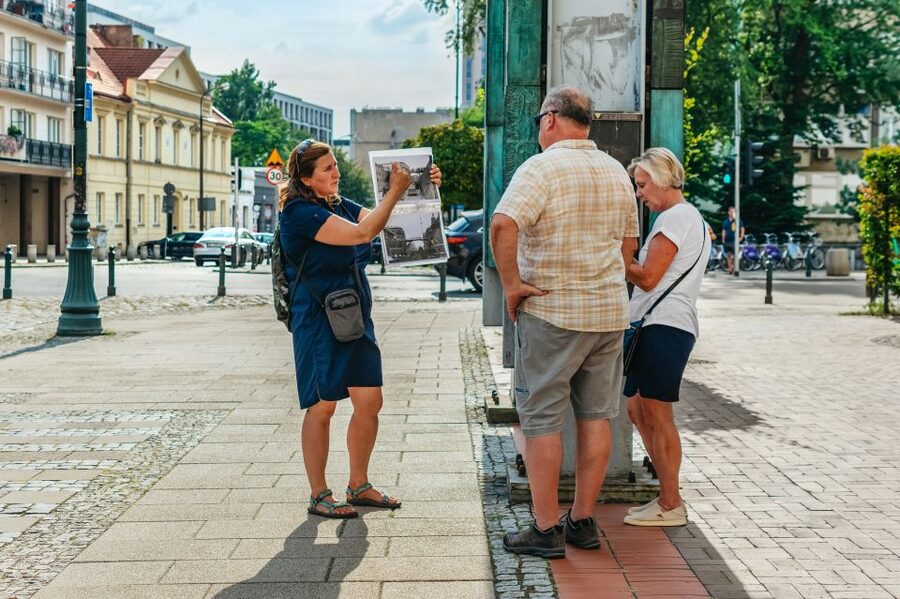
The tour explains Umschlagplatz, the collection point from which Jewish residents were deported. This stop carries strong symbolic weight because it represents the administrative side of mass murder. People were gathered, controlled, and sent away under a system designed to look organized and inevitable.
Your guide also explains how the plan for the final solution was put into practice in Warsaw. That means looking beyond one villain or one event and examining the machinery of persecution: ghettoization, forced movement, deprivation, deportation, and extermination.
This part can be hard to hear. The tour deals directly with hunger, disease, death, deportations, and the destruction of the ghetto. It is not softened into a general Second World War sightseeing stop. I would avoid scheduling it immediately before something that requires a cheerful mood.
At the same time, the tour is not only about Nazi decisions. It also covers everyday life inside the ghetto, the choices people faced, and the ways Jewish residents tried to preserve family, community, and dignity. That wider focus matters because it shows people as more than victims of a system.
The private setting helps here. You can ask about details that may be skipped on a large group outing, and the guide can explain terms or events at your pace. Several guides are described as patient and willing to answer extended questions, which is useful if you already have a strong background in Holocaust history.
The Ghetto Heroes Monument and the 1943 uprising
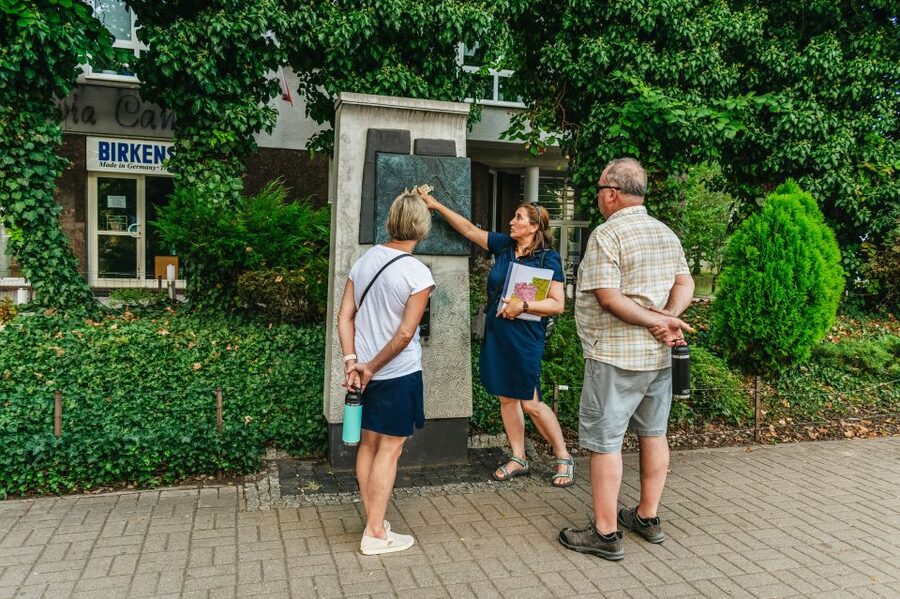
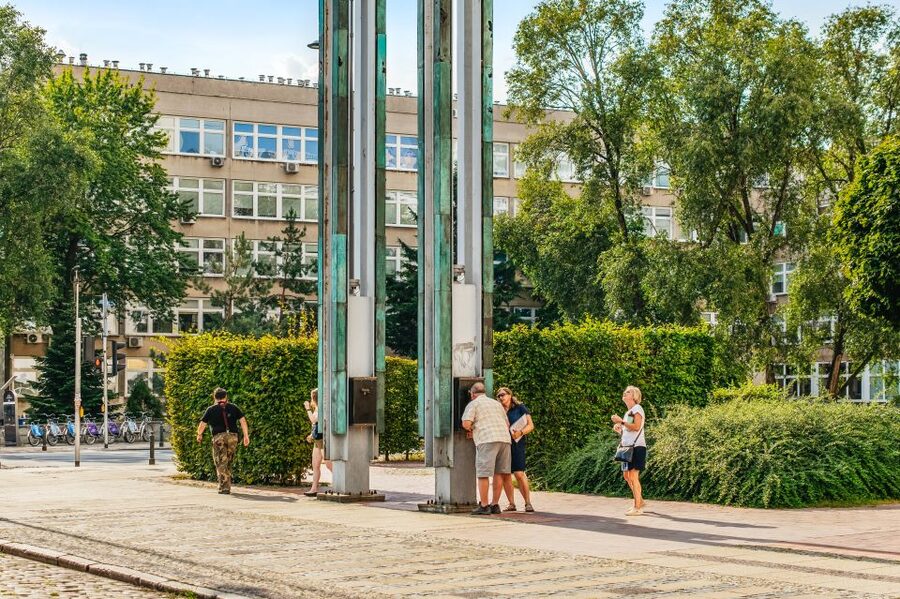
The Monument to the Ghetto Heroes is the natural emotional center of the walk. It recalls the Jewish fighters who resisted the German attempt to liquidate the ghetto in 1943.
The uprising was an unequal fight. The rebels had limited weapons and faced organized German troops. The resistance lasted nearly one month before the Nazis crushed it and destroyed the ghetto in revenge.
A guide can make this history clearer by explaining why resistance began when it did. By 1943, many residents understood that deportation did not mean relocation or labor in the ordinary sense. The uprising was a response to planned annihilation, but it was also part of a longer story of underground activity, mutual aid, and attempts to protect others.
Old photographs are particularly useful at this stop. The monument and surrounding streets are modern, while the wartime images show the devastation that followed. Comparing the two views helps you understand both the city’s rebuilding and the scale of what was lost.
The tour also discusses who helped Jewish residents. That subject requires care because assistance ranged from individual acts to organized efforts, and the dangers were severe. A private guide gives you a better chance to ask about these distinctions instead of receiving a rushed account.
Guides, photographs, and the private format
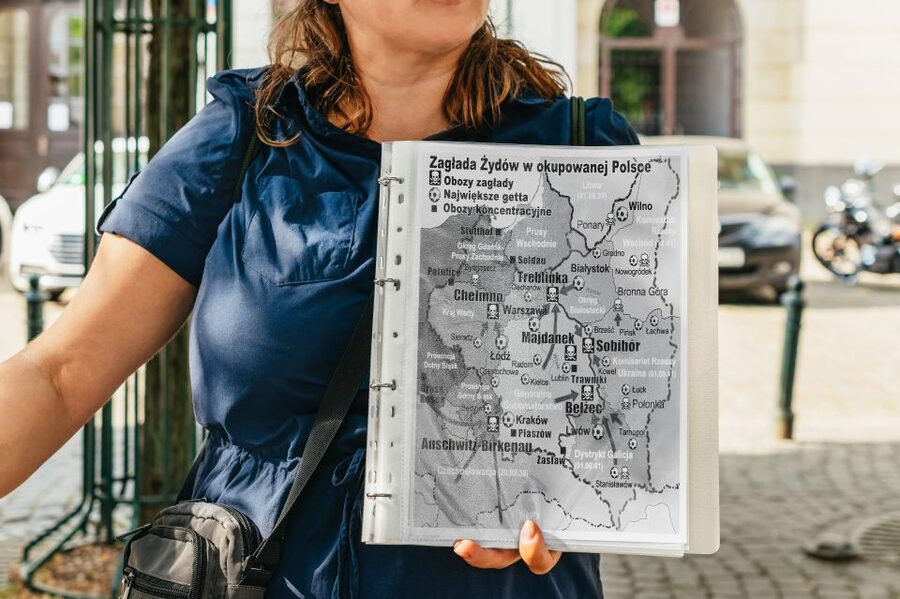
The strongest feature of this experience is the guide. Marzena is frequently requested in the booking details and is described as offering a clear chronological account, strong English, and a warm but serious manner. Mary is another guide associated with the tour and is praised for adapting the pace, using photographs, and answering detailed questions. Other guides, including Eva and Wojtek, have also led the experience.
You cannot guarantee a particular guide unless the operator confirms one, so treat guide names as useful possibilities rather than a promise. The language options are English and German.
The private format is worth considering if you want discussion rather than a standard lecture. One person may want more background on prewar Jewish Warsaw. Another may want to focus on the uprising, the deportations, or the fate of surviving buildings. A private guide can usually give more room to those interests.
The photo material is more than a nice extra. Since so little of the ghetto remains, the guide’s old images and maps help reconstruct the vanished streets. This is the difference between seeing a wall fragment and understanding the neighborhood that wall once divided.
The pace can also be adjusted. One older participant was accommodated with frequent stops, and other tours have been shortened to around two and a half hours. The stated duration is three hours, so plan for that full period, but tell the guide if you need regular breaks.
Is $84 per person fair?
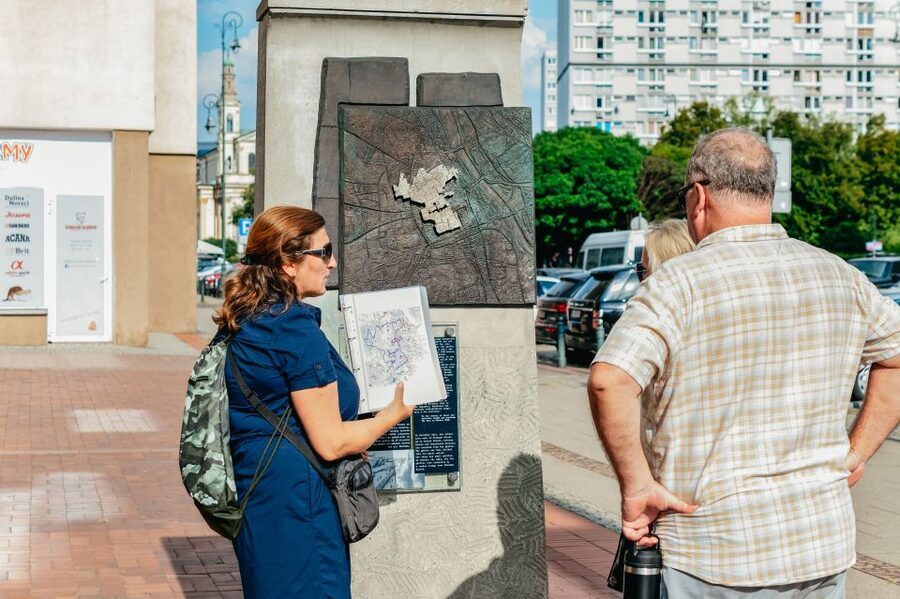
At $84 per person, this is not the cheapest way to see Warsaw’s Jewish heritage. You are paying for a private experience, a licensed guide, transportation by car, hotel pickup and drop-off as arranged, a city plan, and information booklets.
The price makes more sense for two or more people who value personal attention. A private guide can answer questions, adjust the pace, and connect the sites in a way that is difficult on a large public walk. If you have only one day in Warsaw and want a focused introduction to the former ghetto, that time efficiency has real value.
It may feel expensive if you prefer to explore independently or plan to spend several hours at museums. The surviving sites are scattered, and many are easy to overlook, but you can also visit some memorials without paying for a private guide.
I would book this tour if you want context, not simply a checklist of monuments. I would skip it if you dislike emotionally heavy history, cannot walk comfortably, or want a general overview of Warsaw instead.
How to prepare for the walk
Bring comfortable shoes, water, sunscreen, and a hat. A head covering or kippah is needed for the synagogue, and cash is useful for the 20 PLN, 5 EUR, or 5 USD donation.
Do not bring oversize luggage or large bags. The activity is not suitable for children under 14 or people with mobility impairments.
Give yourself mental space after the tour. The subject is severe, and the information can stay with you. Some people choose to continue to the POLIN Museum of the History of Polish Jews afterward, especially because the tour gives useful context for museum exhibits. The museum is not listed as an included part of this activity, so plan and pay for it separately.
Free cancellation is available up to 24 hours before the tour, and you can reserve now and pay later. Starting times vary, so check availability for your date.
Should you book the Warsaw Ghetto tour?
Book it if you want a serious, place-based history lesson led by a guide who can explain what no longer exists. The combination of wall fragments, the last ghetto street, Umschlagplatz, the Ghetto Heroes Monument, and the surviving synagogue gives the three hours a strong shape.
The tour is especially useful for first-time visitors who find the geography confusing, and for people who already know the broad Holocaust story but want to understand Warsaw’s specific experience. Ask about hotel pickup before booking, wear good shoes, and prepare for difficult material.
For most visitors who can manage the walking and subject matter, $84 buys more than transportation and facts. It buys a clearer way to see a city whose most important Jewish places were deliberately erased.
FAQ
How long is the Warsaw Ghetto tour?
The tour lasts three hours.
What languages are available?
The live guide is available in English or German.
Is this a private tour?
Yes. The activity is arranged for a private group.
Is hotel pickup included?
Hotel pickup and drop-off are listed as included, but the meeting instructions also give Prozna Street 9 as a meeting point. Confirm the exact pickup arrangement before the tour.
Where is the meeting point?
The meeting point is Prozna Street 9, between Bistro Charlotte Menora and Strefa Restaurant. Look for a guide holding a PolinTours sign.
What places are visited?
The tour covers fragments of the ghetto walls, the last street of the ghetto, former ghetto neighborhoods, the surviving synagogue, Umschlagplatz, and the Monument to the Ghetto Heroes.
Is the synagogue entrance included?
No. You pay a separate donation of 20 PLN, 5 EUR, or 5 USD.
What should I bring?
Bring comfortable shoes, a hat, sunscreen, cash, and a head covering or kippah for the synagogue.
Can children join the tour?
The activity is not suitable for children under 14.
Can I cancel the booking?
You can cancel up to 24 hours in advance for a full refund. Reserve now and pay later is also available.
Just added around Warsaw
- Wolf’s Lair & Treblinka Tour in 1 day from Warsaw★ 5.0 · 37 reviews
- Wolfs Lair and Swieta Lipka Small Group Tour from Warsaw with Lunch★ 4.5 · 21 reviews
- Wolfs Lair “Hitler’s Headquarters” – Full Day Tour from Warsaw by private car★ 4.5 · 4 reviews
- Tour from Warsaw: Wolf’s Lair, Hitler’s HQ Zones I and II★ 5.0 · 32 reviews
- Wolf’s Lair Private Day Trip from Warsaw★ 5.0 · 50 reviews
- Warsaw Must-See Local City Tour with Antek and Tomek★ 5.0 · 51 reviews
- Off the Beaten Track in Warsaw: Private City Tour★ 4.5 · 9 reviews
- Warsaw’s Old Town A Self-Guided Audio Tour★ 4.5 · 10 reviews
Jewish Heritage Tours, compared.

Bike Tour of Old Town, Jewish Quarter and the Ghetto
Read our review →
Kazimierz, Schindler’s Factory & Ghetto Guided Tour
Read our review →
Full Bike Tour – the Old Town, Jewish Qtr & the Ghetto NEW BIKES
Read our review →
Bike Tour of the Old Town, Kazimierz, and the Ghetto
Read our review →
Browse the lists this tour appears in