
Reviewed · WALKING TOURS
Walk through the Warsaw Old and New Town: like Phoenix from the ashes
Warsaw’s Old Town is not an untouched medieval quarter. It is a careful reconstruction of a city almost destroyed in the Second World War, and that is the most interesting thing about this walk. You’ll see how paintings, photographs, memories, and political will helped bring the center back to life.
I like the route’s strong historical arc, which moves from Chopin and the Polish kings to the Warsaw Uprising and postwar rebuilding. I also like the private-tour format. Your group has the guide’s full attention, and one solo booking even turned into a one-on-one walk.
The main consideration is pace. Two hours covers many stops, but most visits are short, and the route is entirely on foot. The tour is listed as offered in English, yet the guide description says German-speaking, so confirm the language before paying.
Key points before you book
- A private two-hour walk: Only your group participates, which makes questions and timing easier.
- A powerful reconstruction story: Castle Square and the Old Town explain how Warsaw rose from wartime ruins.
- Meeting at Copernicus: The walk begins by the Nicolaus Copernicus Monument on Krakowskie Przedmiescie.
- Important Polish figures: You connect Chopin and Marie Curie to places in the city, not just to names in a guidebook.
- A walk through major civic landmarks: The route includes the Presidential Palace, Tomb of the Unknown Soldier, Royal Castle, and Warsaw Uprising Monument.
- One paid sight: Admission is not included at the Maria Skłodowska-Curie Museum. Other listed stops have no admission charge.
Starting on Krakowskie Przedmiescie with Copernicus
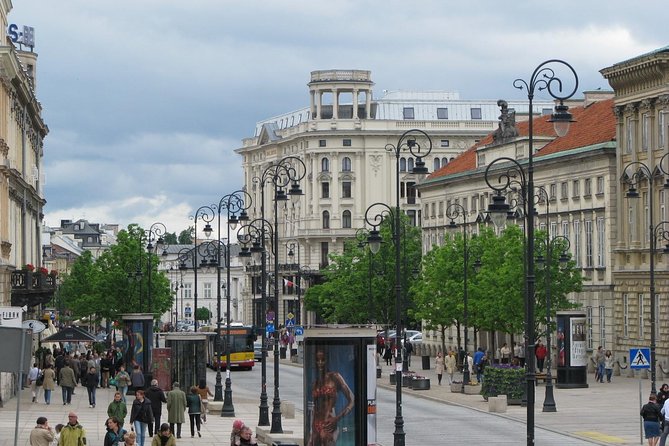
Your meeting point is the Nicolaus Copernicus Monument on Krakowskie Przedmiescie. Look for the PolinTours sign and allow enough time to find the statue before the start. The guide is scheduled to meet you there and accompany your group for roughly two hours.
This is a sensible place to begin. Krakowskie Przedmiescie links central Warsaw with the Old Town and gathers several important buildings along one walk. You get your bearings quickly, with the city’s intellectual, religious, royal, and political stories all close together.
The walk is described as private, even though group discounts are available. That matters if you want to ask about Polish politics, the Second World War, Chopin, or rebuilding without waiting for a large group to catch up. It also means the experience may feel quite different for one person or a family than it would for a full group.
The language needs checking. The tour is advertised as offered in English, but the detailed guide description calls the guide German-speaking. Since language is central to a history walk, contact PolinTours before booking if you need English service.
More Walking Tours in Warsaw
- Warsaw: Old Town Highlights Walking Tour in English
★ 4.7 · 1,516 reviews - Warsaw: Old Town Guided Walking Tour
★ 4.9 · 599 reviews - Half-Day Polish Food Walking Tour with Guide and Dinner
★ 4.5 · 381 reviews
Chopin’s heart at Holy Cross Church
The first short stop is Holy Cross Church, where Chopin’s heart is kept. The planned visit lasts about five minutes, so expect an explanation rather than a long church visit.
This is a useful introduction to Frédéric Chopin’s connection with Warsaw. The detail is personal and memorable: his music is heard around the world, yet this church holds a physical link to the composer and the city where he spent his early years.
Because the stop is brief, you may want to ask your guide a direct question about Chopin while you are there. The tour’s strength is not extended indoor sightseeing at every stop. It is the way the guide connects a series of places into one story.
Warsaw University and the city’s intellectual life
The route continues to the oldest part of the University of Warsaw. The scheduled stop is also short, about five minutes, and focuses on the university’s historic section.
This gives the walk a useful change of subject. You are not hearing only about kings and battles. The route also points to education, public life, and the people who shaped Poland’s cultural identity.
Do not expect a campus tour or a long interior visit from the time allotted. Think of this as a compact orientation stop. The guide can explain why the university matters, then keep the walk moving toward the ceremonial center of Warsaw.
Saxon kings at the Tomb of the Unknown Soldier
At the Tomb of the Unknown Soldier, you hear about the former estate of the Saxon kings in Poland. The stop lasts around ten minutes, which gives the guide more room to set the monument in its political and architectural context.
The tomb is especially useful for understanding how Warsaw remembers national sacrifice. It is not presented as an isolated memorial. The nearby royal story helps explain how power, ceremony, and public memory have shaped this part of the city.
This section should appeal to you if you like history tied to actual streets and buildings. The tour does not ask you to memorize a long list of dates. Instead, it uses visible places to explain how Poland’s rulers and citizens have been represented in the capital.
Same city, a completely different kind of day:
- Warsaw: Chopin Concert in the Old Town
★ 4.8 · 2,287 reviews - Warsaw: Traditional Galar Cruise on The Vistula River
★ 4.6 · 1,640 reviews - Warsaw Concert: Chopin – Painted by Candlelights with Wine
★ 4.8 · 1,442 reviews - Warsaw: City Sightseeing Hop-On Hop-Off Bus Tour
★ 3.6 · 1,415 reviews
The Presidential Palace and modern Poland
The Presidential Palace receives another ten-minute stop. Here you hear about the building’s unusual past and see the seat of Poland’s president.
This is one of the route’s more direct links to present-day Poland. After the stories of Chopin, the university, and the Saxon kings, the palace brings you to the country’s current political center.
The guide’s role is important here because the building’s significance is not obvious from the outside alone. You will be viewing it as part of the street scene, while the explanation supplies the political background. No separate admission is listed for this stop.
Castle Square and Warsaw’s rebuilt Old Town
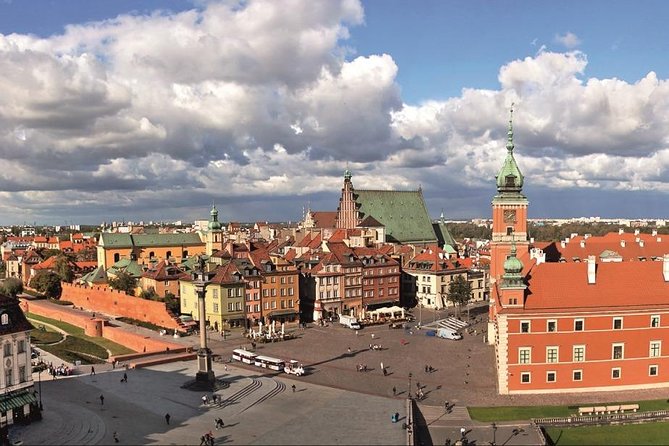
Castle Square is the heart of the tour. The Old Town is a UNESCO World Heritage Site, yet it is also one of the youngest reconstructed historic centers in the world. That apparent contradiction is the key to understanding Warsaw.
Here, the guide explains the destruction of the Old Town, the work required to rebuild it, how the project was financed, and the role of a Venetian painter. You also hear about the Royal Castle and the first democratic constitution in Europe, as presented in the tour.
The planned stop lasts about fifteen minutes. That is enough time for a focused explanation and views of the square, but not enough for a full Royal Castle visit. Admission to the castle is not included, and the tour does not list an interior visit.
I like this section because it asks an important question: what makes a historic place authentic? Warsaw’s Old Town was reconstructed, but the reconstruction itself is part of the city’s history. The rebuilt façades are not simply decoration. They tell you how Warsaw chose to remember and restore its center after catastrophe.
If the Old Town is your main reason for booking, pay close attention here. You will get far more from the colorful streets and market square once you understand why they exist in their present form.
St. John’s Cathedral and the wartime front
The walk continues to the Archcathedral Basilica of St. John the Baptist. The tour describes it as the only church in Europe through which the Second World War front ran, and the guide discusses the Warsaw Uprising and the role of the Russian army.
The stop is planned for about ten minutes. It brings the war story into the center of the Old Town, rather than treating the conflict as a distant event discussed only at a museum.
This part may be emotionally weightier than the earlier landmarks. You are hearing about the heroic struggle of the Polish people during the uprising and the military forces that shaped its outcome. The description gives special attention to the Russian army, so you can expect the guide to address a difficult and contested part of Warsaw’s wartime story.
The short time means the explanation will be selective. If this subject matters greatly to you, ask the guide where to continue after the walk. The tour itself is an introduction, not a full Uprising study.
Gnojna Góra and a look toward the Vistula
At Gnojna Góra, the group pauses for about five minutes to look toward the Vistula. The stop provides a break from the close-packed streets and gives you a broader sense of Warsaw’s position beside the river.
The description is simple, so do not expect a long viewpoint session or a separate river excursion. It is a brief visual pause within the Old Town route.
This kind of stop matters on a walking tour. You get a moment to connect the historic center with the wider city, then return to the streets and squares where the main stories unfold.
Market Square, legends, and everyday Warsaw
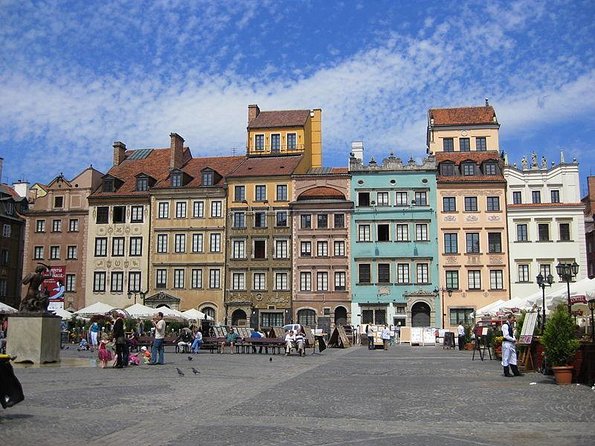
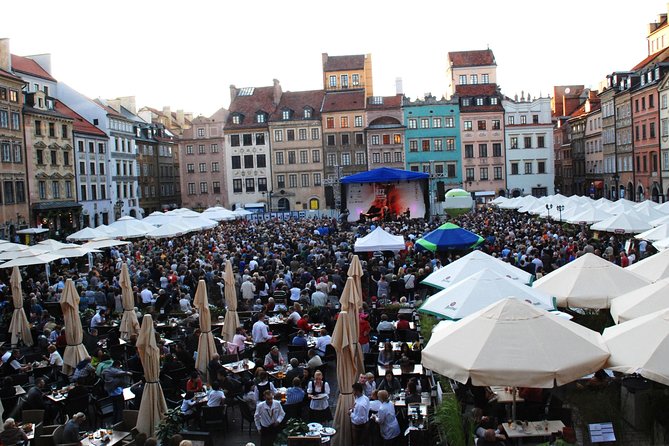
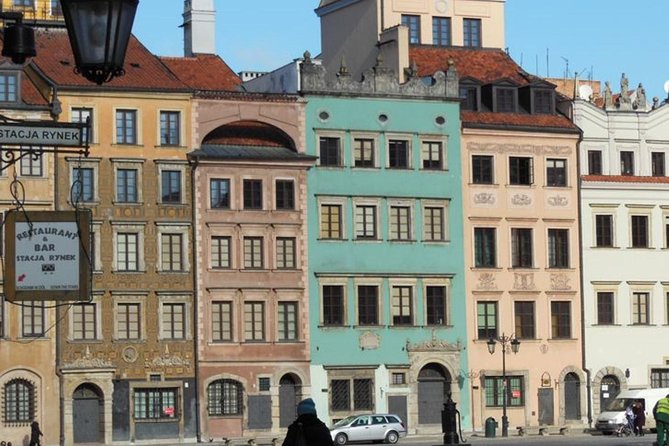
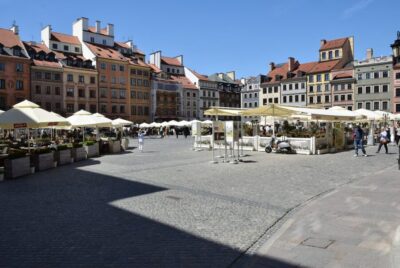
The Rynek Starego Miasta, or Old Town Market Square, is where the route turns from major monuments toward the character of the Old Town itself. You walk through picturesque streets, see well-known landmarks, and hear legends and authentic local stories.
The planned stop is about ten minutes, but the surrounding streets form part of the walk between stops. This is a good place to let the guide move beyond formal dates and explain how Warsaw presents its past through street names, buildings, and stories.
The market square is also likely to be one of the most photogenic parts of the route. Keep your attention on the guide, though. The point is not just to collect pictures of reconstructed façades. It is to understand how the square fits into the larger story of destruction and renewal.
From here, the route passes through a city gate into New Town. That transition is easy to miss if you are exploring alone, but it gives the walk a clear structure: royal and historic Old Town first, then a neighboring district with its own people and memorials.
Marie Curie’s birthplace and the paid museum stop
In New Town, you visit the Maria Skłodowska-Curie Museum, located at the birthplace of the scientist known worldwide as Marie Curie. The planned stop lasts about ten minutes.
Admission is not included, so factor that into the price if you want to enter. The supplied details do not specify an admission fee or confirm how much of the interior visit is included in the two-hour schedule, so ask PolinTours if the museum is open and accessible on your chosen date.
Even a short stop here adds balance to the route. Marie Curie is often presented as a French-Polish scientific figure, but this walk places her directly in Warsaw. You see the city connection instead of hearing her name as a separate biography.
The museum is also a useful choice for visitors who want more than royal history and wartime memorials. It brings science, education, and a Polish woman’s international achievements into the story.
Ending at the Warsaw Uprising Monument
The tour finishes at the Field Cathedral of the Polish Army and the Warsaw Uprising Monument at Plac Krasińskich. The final stop is planned for about ten minutes.
Ending at the uprising monument gives the walk a strong sense of purpose. The route has moved from royal power and cultural figures through wartime destruction, then toward the memory of those who fought in the uprising.
The end point is not the same as the starting point, so plan your next move from Plac Krasińskich rather than expecting to return to Krakowskie Przedmiescie. No transport is included, and the activity is designed as a walking experience from beginning to end.
This final location also gives you a natural place to continue learning about the uprising if you have more time. The tour explains the monument and its setting, but the two-hour format cannot cover every detail of the 1944 events.
What the $72.87 price gives you
At $72.87 per person, this is not a bargain-priced orientation walk. The value depends on how much you want from the guide.
You are paying for a licensed city tour, tax, a private group, and a carefully connected route through major Warsaw landmarks. There is no separate transport cost because the tour is on foot, and most stops do not list an admission charge.
The price is easier to justify for a small group that wants a private guide. One published experience had only one person booked, turning the walk into a one-on-one tour. That arrangement can make the per-person cost feel more reasonable, especially if you want to ask many questions or adjust the discussion.
For a larger group, group discounts may improve the value. The one clear extra cost is the Maria Skłodowska-Curie Museum, where admission is not included. Snacks are also not included, though the short duration makes a food stop unnecessary during the tour itself.
The booking pattern suggests that people often reserve well ahead, with an average booking time of 191 days. That does not guarantee every date sells out, but it is a good reason to book early if your Warsaw schedule is fixed.
Who should choose this Warsaw walk?
I would choose this tour if you want a big-picture introduction to Warsaw’s center, especially the way the city was rebuilt after the Second World War. It suits first-time visitors who want a guide to connect monuments that might otherwise feel unrelated.
It is also a good fit for history-minded families, couples, and small groups. The private format lets you ask about Poland’s kings, Chopin, the Warsaw Uprising, or Marie Curie without turning the walk into a lecture for strangers.
You should think twice if you want long interior visits. The schedule gives five to fifteen minutes to most stops, and the Royal Castle and Curie museum do not become full museum tours. You also need to be comfortable walking outdoors for two hours.
The language point is worth repeating. The experience is offered in English, but the guide description specifies German-speaking service. Confirm the exact language before booking, particularly if you are choosing the tour for detailed historical explanations.
Free cancellation is available when you cancel at least 24 hours before the start time. Changes or cancellations made inside that window are not accepted for a refund.
Should you book it?
Book this walk if you want Warsaw explained through places, not just viewed from a sightseeing bus. Its best feature is the route’s story: Chopin’s heart, royal power, the Presidential Palace, a reconstructed Old Town, wartime struggle, Marie Curie, and the Warsaw Uprising Monument all fit into one compact outing.
The price is reasonable for a private, licensed guide, but less compelling if you prefer to explore independently or spend an hour inside the Royal Castle or Curie museum. Confirm the language, wear comfortable shoes, and treat the two hours as a focused introduction rather than a complete tour of Warsaw.
FAQ
Where does the tour start?
The tour starts at the Nicolaus Copernicus Monument on Krakowskie Przedmiescie in Warsaw. The guide will have a PolinTours sign.
Where does the tour end?
The tour ends at the Warsaw Uprising Monument at Plac Krasińskich.
How long does the walking tour last?
The tour lasts approximately two hours.
Is this a private tour?
Yes. Only your group participates in the activity.
What language is the tour offered in?
The experience is offered in English, but the detailed guide information specifies a German-speaking guide. Confirm the language with PolinTours before booking.
Is admission included?
The tour includes a licensed city tour and tax, but admissions are not included. The Maria Skłodowska-Curie Museum specifically lists admission as not included.
Is transport included?
No. Transport is not included, and the route is presented as a walking tour between the listed Warsaw landmarks.
Can I cancel for a full refund?
Yes, if you cancel at least 24 hours before the experience start time. Cancellations or changes made less than 24 hours before the start time are not eligible for a refund.
Just added around Warsaw
- Wolfs Lair and Swieta Lipka Small Group Tour from Warsaw with Lunch★ 4.5 · 21 reviews
- Wolf’s Lair & Treblinka Tour in 1 day from Warsaw★ 5.0 · 37 reviews
- Wolfs Lair “Hitler’s Headquarters” – Full Day Tour from Warsaw by private car★ 4.5 · 4 reviews
- Tour from Warsaw: Wolf’s Lair, Hitler’s HQ Zones I and II★ 5.0 · 32 reviews
- Wolf’s Lair Private Day Trip from Warsaw★ 5.0 · 50 reviews
- Warsaw Must-See Local City Tour with Antek and Tomek★ 5.0 · 51 reviews
- Off the Beaten Track in Warsaw: Private City Tour★ 4.5 · 9 reviews
- Warsaw’s Old Town A Self-Guided Audio Tour★ 4.5 · 10 reviews
Walking Tours, compared.
Gdańsk City Sights & History Guided Walking Tour in English
Read our review →
Browse the lists this tour appears in