
Reviewed · CITY TOURS
Warsaw City Tour – PRIVATE (4h)
Warsaw’s story is unusually visible: a medieval Old Town rebuilt after near-total destruction, a royal castle restored through public support, and streets shaped by war, communism, and modern Poland. This private four-hour tour gives you that big picture quickly, with a guide who can explain what you are seeing instead of leaving you to read plaques.
I like the private format, which lets the guide adjust the route and answer your questions. I also like the contrast between the Old Town’s carefully rebuilt squares and the calm Rose Garden in Łazienki Park. The main caution is transportation: much of the historic center is explored on foot, so confirm how much driving is planned, especially if heat, mobility, or limited walking is a concern.
Key points to know before booking
- Warsaw’s rebuilt Old Town: Walk through a UNESCO World Heritage Site reconstructed after about 90 percent of the area was destroyed in 1944.
- A private English-speaking guide: Guides such as Anya, Karolina, Grazyna, and Margarita have led this experience, but the assigned guide can vary.
- Mixed walking and driving: The Old Town and Royal Route involve walking, while a vehicle is intended for sights farther across the city.
- Łazienki Park included: Take a quieter break among palace gardens, the Rose Garden, and Chopin’s famous monument.
- Four hours moves quickly: You will see many major sights, but most stops are short photo and explanation breaks rather than full museum visits.
- Transport needs clarification: The advertised service includes an air-conditioned vehicle, yet one experience required public transport, so confirm this before departure.
Warsaw in four hours: what this tour is really for
This is a city orientation tour, not a long museum visit or a slow architectural walk. In four hours, you can see the central sights, learn why Warsaw looks the way it does, and decide which places deserve a second visit.
The private setup is useful here. Warsaw’s past can be hard to read from the streets alone. A restored façade may look centuries old but date from the postwar period. A monument may mark an event that changed the city forever. A good guide connects those pieces as you move.
The tour includes hotel pickup and drop-off in an air-conditioned vehicle. It is offered in English, and only your group participates. The route combines short vehicle transfers with walks through areas where cars are restricted, especially the Old Town and parts of the Royal Route.
That last point matters. The four-hour duration does not mean four hours sitting in a car. Expect a substantial amount of walking in the historic center. One booking involved only about 15 minutes of driving because the pickup hotel was inside a restricted area. If you need a shorter walking route, tell the operator before the day of the tour, not when the guide arrives.
More City Tours in Warsaw
- Warsaw: City Sightseeing Hop-On Hop-Off Bus Tour
★ 3.6 · 1,415 reviews - Private Tour: Warsaw City Sightseeing by Retro Fiat
★ 5.0 · 562 reviews - Warsaw: Afternoon Public City Tour with Pickup and Drop-off
★ 4.4 · 421 reviews
Sigismund’s Column and Castle Square
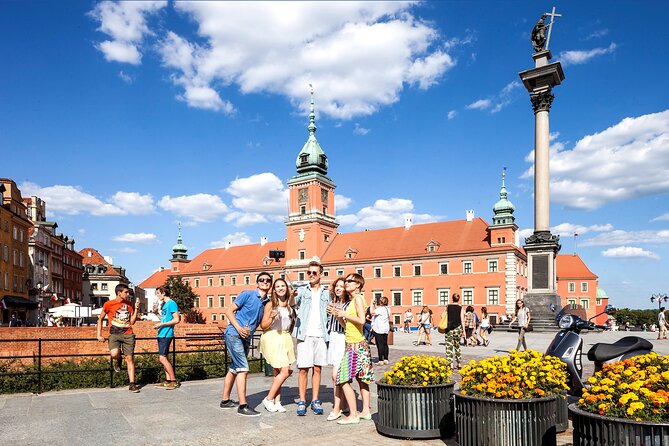
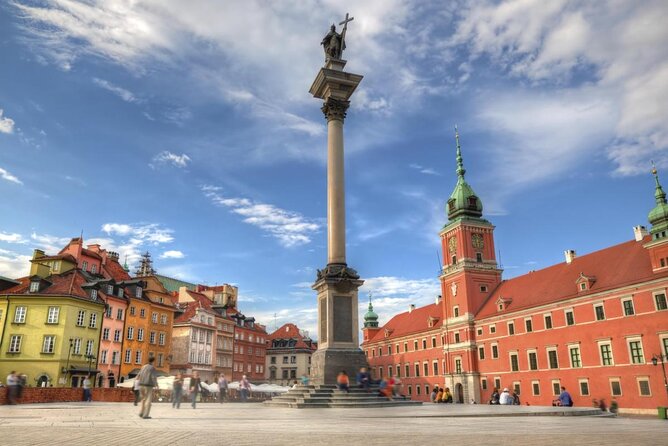
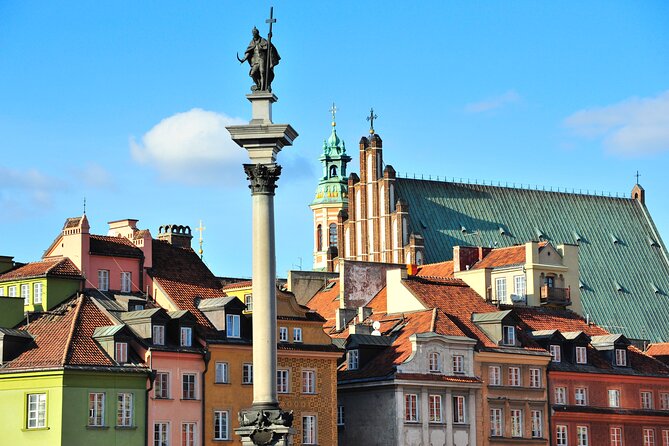
The usual starting point is King Sigismund’s Column, the tall monument at Castle Square. Sigismund III Vasa moved Poland’s capital from Kraków to Warsaw in the late 16th century, and this column honors him. It is also a useful place to begin because the square opens directly toward the Royal Castle and the Old Town.
The monument you see is a reconstruction. German troops brought down the column on September 2, 1944, during the destruction of Warsaw. The statue and column were rebuilt by 1949. Older sections of the column are displayed beside the Royal Castle walls.
You get about 10 minutes here, enough for photographs and a short explanation. The real value is context. From this one point, your guide can show how royal Warsaw, the medieval town, and the postwar city meet in one view.
The Royal Castle is generally seen from outside on this route. It became a royal residence in the 16th century, suffered repeated destruction, and was nearly wiped out during the Second World War. Its reconstruction began in 1971, funded in large part by public donations, and the building opened to visitors in 1984.
That story gives the castle more weight than its grand façade alone. It is an example of a city choosing to rebuild a symbol of national identity. If you want to tour the interior, check whether there is enough time and whether admission is available, since entry fees are not included.
Walking through Warsaw’s UNESCO-listed Old Town
The Old Town receives the longest stretch of the walking portion, about 45 minutes. You will pass rebuilt townhouses, defensive walls, church buildings, and the lanes leading toward the marketplace.
Warsaw began here because the river location suited trade between the Baltic and the Black Sea. Craftspeople and merchants helped the settlement grow, while wooden buildings gradually gave way to masonry houses and stronger defenses. The medieval town once had a town hall, parish church, ramparts, towers, and a barbican.
The most important fact is what happened in 1944. Roughly 90 percent of the Old Town was destroyed. The buildings around you are not untouched medieval survivors. They are the result of a long and careful reconstruction that was later recognized by UNESCO.
I find this one of the best reasons to take a guide. Without explanation, the Old Town can look simply pretty. With the wartime context, the façades become evidence of a national decision to restore an old center rather than replace it with something new.
The pace may feel brisk. Forty-five minutes is enough to get oriented and hear the main story, but not enough for every lane, church, or shop. Wear comfortable shoes, and save any detailed museum visits for another time.
St. John’s Cathedral and the Old Town Marketplace
The Archcathedral Basilica of St. John the Baptist is one of Warsaw’s oldest churches. The tour allows about 15 minutes here, usually enough to see the interior if open and hear about the major events connected with it.
The church hosted the oath connected with the Constitution of May 3, described as the first constitution of its kind in Europe. Its crypt contains the tombs of important Polish figures, including the Chapel-Mausoleum of the Primate of the Millennium.
From there, the route continues to Rynek Starego Miasta, the Old Town Marketplace. The square is lined with colorful tenement buildings now used for restaurants, cafés, clubs, galleries, and museums. A statue of the Warsaw Mermaid marks the center.
The marketplace is divided into four sections named for Enlightenment-era activists: Kołłątaj, Dekert, Barss, and Zakrzewski. You get about 15 minutes, which is enough to understand the layout and take in the square, but probably not enough for a meal.
If lunch matters to you, ask your guide for a recommendation. One guide helped a group find an excellent place to eat, and the private format makes that sort of practical request possible.
A few more Warsaw half-days worth comparing
- Warsaw: Chopin Concert in the Old Town
★ 4.8 · 2,287 reviews - Warsaw: Traditional Galar Cruise on The Vistula River
★ 4.6 · 1,640 reviews - Warsaw: Old Town Highlights Walking Tour in English
★ 4.7 · 1,516 reviews - Warsaw Concert: Chopin – Painted by Candlelights with Wine
★ 4.8 · 1,442 reviews
The Barbican and Warsaw’s wartime memory
The Warsaw Barbican is a surviving piece of the city’s old defensive system. Built in 1548, it formed part of roughly 4,000 feet of ramparts. Today, artists and musicians often add life to the passage around it.
From May through October, an exhibition inside the walls presents old photographs, plans, and models of the former defenses. This is a worthwhile optional stop if the schedule allows, because it helps you compare the medieval city with the rebuilt one around you.
The tour then reaches the Warsaw Uprising Monument, one of the most serious stops of the morning. The sculpture shows insurgents emerging from battle, recalling the 1944 uprising against German occupation. The revolt ended in defeat, with about 200,000 Polish deaths.
Your guide can explain why this event remains central to Warsaw’s identity. The monument is not a light sightseeing stop, and the short 10-minute visit may feel compressed. Still, it gives the tour emotional balance after the cheerful marketplace and reconstructed façades.
Nearby, the Krasiński Palace adds another layer. This Baroque residence is now connected with special collections of the National Library. The park behind it was once among the early public green spaces open to residents across social classes. The contrast between palace, park, monument, and modern Supreme Court building makes this a useful part of the drive and walking route.
Miodowa Street, Theatre Square, and the Tomb of the Unknown Soldier
Miodowa Street is a narrow historic street lined with former aristocratic residences and religious buildings. The guide can point out the former Collegium Nobilium at number 24, now associated with the Academy of Theatre, and the Palace of Warsaw’s Archbishops at number 17.
You may also see Warsaw’s Eastern Catholic Church, Pac Palace, and the Church of the Capuchins. The latter contains the heart of Jan III Sobieski, its founder. Farther along, the Monument of Warsaw’s Heroes, commonly called the Monument of Nike, comes into view.
Theatre Square brings together the Blank Palace, the rebuilt Jabłonowski Palace, and the Grand Theatre, home of the National Opera and National Theatre. The Jabłonowski Palace was destroyed during the war and rebuilt in the 1990s. Only the façade and clock tower retain the earlier design, with older foundations visible through the gate.
These quick drive-by or stop-and-explain moments are useful for orientation, but do not expect long interior visits. The route is designed to show you a broad slice of Warsaw rather than spend an hour in one building.
At the Tomb of the Unknown Soldier, the tone turns solemn again. The tomb honors Polish soldiers who died for the country’s freedom. It contains ashes connected with the defense of Lviv and urns with soil from battlefields where Polish forces fought during the last century.
A military honor guard changes daily at noon. If your timing matches, this can add a strong visual moment, but the tour timing is not stated as being built around the ceremony. The stop itself lasts about 10 minutes.
The Royal Route and Warsaw’s changing center
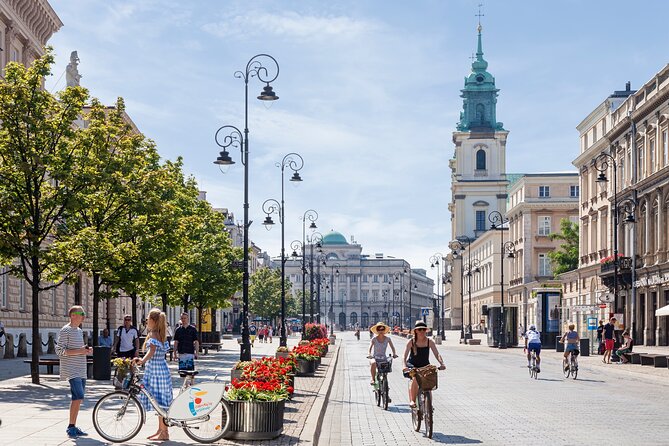
The Royal Route runs from Castle Square toward Three Crosses Square. The tour allows about 20 minutes, so you will see only a portion, but this stretch links royal, academic, religious, and modern Warsaw.
Look for St. Anne’s Church, with a well-known view from its tower, and the Polonia House, where Maria Skłodowska-Curie once worked when the building was used for industry and trade. The Radziwiłł Palace is now the residence of Poland’s president.
The Warsaw University campus, Kazimierzowski Palace, Czapski Palace, and the shops and restaurants of Nowy Świat follow along the route. This is one of the city’s best areas for a later independent walk because it combines grand buildings with everyday cafés and stores.
Do not expect the tour to cover every block in detail. The Royal Route works best here as a quick introduction, with the guide showing you what to return to after the tour.
Łazienki Park and the Rose Garden
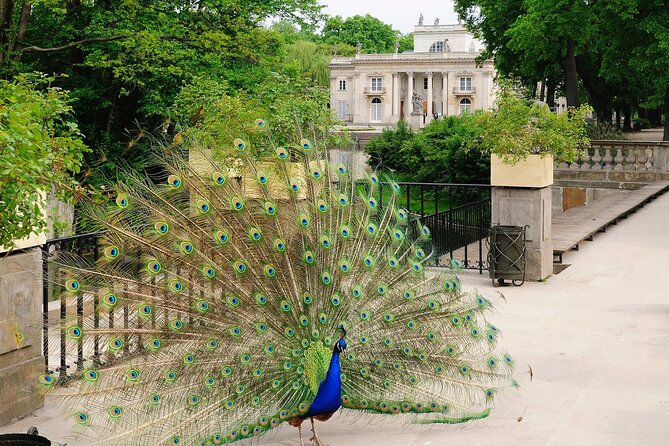
Łazienki Park offers a welcome change after the monuments and city streets. This palace and garden complex occupies what was once wild forest and now includes museums, historic buildings, open lawns, and cultural venues.
The tour allows about 30 minutes. That is enough for a pleasant walk and a look at the Rose Garden, but not enough to explore every palace interior or corner of the park.
The park is also linked with Warsaw’s musical life through the famous Chopin monument. Free piano concerts have been held beside it on summer weekends for decades. The tour does not promise a concert, so treat that as a seasonal possibility rather than part of the booking.
This is one of the tour’s best stops for pacing. After hearing about destruction, political change, and military sacrifice, you get time to breathe. If your group prefers gardens and quiet spaces to additional monuments, ask whether the Łazienki portion can receive extra time.
Modern Warsaw from the Palace of Culture to Copernicus
The route also points out the Palace of Culture and Science, built from 1952 to 1955 as a gift from the Soviet people to Poland. At 230.5 meters and 42 floors, it remains the country’s tallest building. Its 30th-floor observation deck offers views across Warsaw, but admission is not included.
The building contains offices, institutions, museums, libraries, theaters, a cinema, café, clubs, and other facilities. Even if you do not go inside, its scale and Soviet-era symbolism help explain the city’s 20th-century character.
You may also see the National Stadium, built for the 2012 European Football Championship. It occupies the site of the former Tenth Anniversary Stadium, once used for major sporting events, political rallies, and the Jarmark Europa market after 1989.
The final named stop is the Copernicus Science Centre, opened in 2010. It features hands-on exhibits, including an earthquake simulator and a magic carpet, along with a rooftop garden and views. About 10 minutes is allotted, and admission is not included, so this is mainly an exterior orientation unless you arrange extra time.
Price, private value, and transport concerns
At $195.18 per person, this is not a cheap sightseeing loop. The price makes more sense for a private group that values hotel pickup, an English-speaking guide, and the ability to adjust the route. Group discounts may improve the value when several people share the experience.
The tour is less convincing if you expect four hours of private driving between every sight. The Old Town is a pedestrian area, and parts of the Royal Route also restrict vehicle access. One booking ended up using public transport for sites outside the Old Town, despite the stated inclusion of an air-conditioned vehicle.
Because of that mixed record, I would confirm three points in writing before booking:
- Is an air-conditioned vehicle reserved for your group?
- How much of the four hours will be walking?
- Can the route be shortened or modified for a disability, heat, or limited stamina?
The operator has adjusted routes when walking was difficult, but advance notice is important. A guide may be able to use more seated explanations or arrange taxi access near restricted areas, though those costs may not be part of the tour.
The cancellation policy is flexible if your plans change: cancel at least 24 hours before the local start time for a full refund. Later cancellations and changes are not accepted.
Who will get the most from this Warsaw tour?
I would choose this for a first visit when you want a clear introduction to Warsaw without spending a full day on one museum. It suits couples, families, and small private groups who want a guide to connect the Old Town, wartime monuments, royal sites, parks, and modern buildings.
It is also a good fit if you have only half a day before a train, flight, or longer city stay. One guide even drove a group to the airport, though that should be confirmed rather than assumed.
I would be more cautious if you dislike walking or want a relaxed pace. The route contains many short stops, and the Old Town portion cannot simply be driven. At 34 degrees Celsius, or for anyone with a disability, the pace may be too demanding unless modified in advance.
Guide quality can vary. Anya has been especially effective at tailoring the route to personal interests, while Margarita has led a comfortable vehicle-based visit. Grazyna and Karolina were also described as friendly and helpful, though one booking raised concerns about English clarity, organization, and driving. Since the assigned guide is not guaranteed, clear communication before pickup is worth the effort.
Should you book it?
Book this private Warsaw tour if you want broad coverage in four hours, a personal guide, and a mix of landmark explanations and short walks. The Old Town reconstruction, Warsaw Uprising Monument, Royal Route, and Łazienki Park make a strong first-day framework.
Skip it, or choose a different arrangement, if your priority is a fully vehicle-based tour or long visits inside museums. The most important booking tip is simple: confirm the vehicle, expected walking time, and any mobility needs before paying. With those details settled, the private format can give you a useful and memorable first look at a complicated city.
FAQ
How long does the Warsaw City Tour last?
The tour lasts approximately four hours.
Is the tour private?
Yes. Only your group participates in the activity.
Is hotel pickup and drop-off included?
Yes. Pickup and drop-off at your hotel are included, and the guide is expected to wait in the hotel lobby with your name.
Is transportation included?
Private transportation in an air-conditioned vehicle is included in the stated service. However, much of the Old Town is explored on foot, and one booking used public transport for sites outside the Old Town. Confirm the vehicle arrangement before departure.
Is the tour offered in English?
Yes. The experience is offered in English.
Are admission fees included?
No. Optional entry or admission fees are not included. This applies to places such as the Copernicus Science Centre and possible interior visits.
Does the tour visit Łazienki Park?
Yes. The tour spends about 30 minutes at Royal Łazienki Park, including the Rose Garden area and the Chopin monument area.
Can the guide adjust the route?
The private format allows the route to be adjusted. Advance notice is especially important if someone in your group has a disability or cannot manage extended walking.
What is the cancellation policy?
You can cancel at least 24 hours before the local start time for a full refund. Cancellations or changes made less than 24 hours before the start are not accepted.
Just added around Warsaw
- Wolf’s Lair & Treblinka Tour in 1 day from Warsaw★ 5.0 · 37 reviews
- Wolfs Lair and Swieta Lipka Small Group Tour from Warsaw with Lunch★ 4.5 · 21 reviews
- Wolfs Lair “Hitler’s Headquarters” – Full Day Tour from Warsaw by private car★ 4.5 · 4 reviews
- Tour from Warsaw: Wolf’s Lair, Hitler’s HQ Zones I and II★ 5.0 · 32 reviews
- Wolf’s Lair Private Day Trip from Warsaw★ 5.0 · 50 reviews
- Warsaw Must-See Local City Tour with Antek and Tomek★ 5.0 · 51 reviews
- Off the Beaten Track in Warsaw: Private City Tour★ 4.5 · 9 reviews
- Warsaw’s Old Town A Self-Guided Audio Tour★ 4.5 · 10 reviews
City Tours, compared.

City Sightseeing Tour Eco Electric Buggy Golf Cart
Read our review →
Gdańsk City Sights & History Guided Walking Tour in English
Read our review →
Extended City Sightseeing Tour – Eco Buggy Golf Cart
Read our review →
Private Tour: Warsaw City Sightseeing by Retro Fiat
Read our review →Browse the lists this tour appears in