
Reviewed · CITY TOURS
Torun – City of Copernicus Private Tour
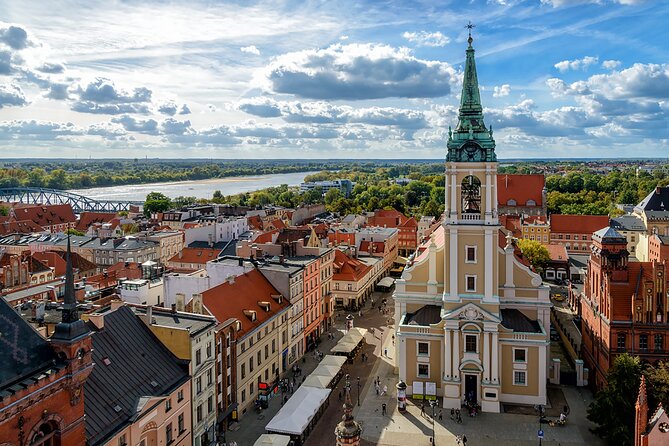
Toruń is one of Poland’s best day trips, especially if you want a medieval city that escaped major wartime damage and still feels shaped by its old street plan. This private tour links its finest sights with the story of Nicolaus Copernicus, the astronomer who changed how people understood the heavens.
I like the private vehicle and hotel pickup, which remove the usual fuss of arranging a long trip from Gdańsk. I also like the three-hour guided walk, long enough to cover the Leaning Tower, Gothic churches, castle ruins, Copernicus’s birthplace, and the Old Town Hall without reducing the visit to a quick photo stop.
The main catch is the long road journey. You leave at 9:00 a.m. and return around 4:00 p.m., with roughly two hours each way, so Toruń itself gets about four hours including the guided visit and free time. Lunch is meant to be included in that free hour, but make sure the guide clearly explains when it happens.
Key Points at a Glance
- Private day trip from Gdańsk: Pickup and drop-off are offered from hotels or apartments in Gdańsk, Sopot, and Gdynia.
- Toruń’s UNESCO-listed Old Town: See a largely intact medieval street plan and major Gothic buildings.
- Copernicus connection: Visit the house associated with Nicolaus Copernicus and hear about his life and work in astronomy.
- Three-hour city walk: Cover the Leaning Tower, Old Town Hall, Artus Court, churches, castle ruins, and more.
- Local flavor: Sample Toruń’s famous gingerbread before returning north.
- Best for convenience: The private format suits families, couples, and small groups who prefer a set schedule.
The Long Road From Gdańsk to Toruń
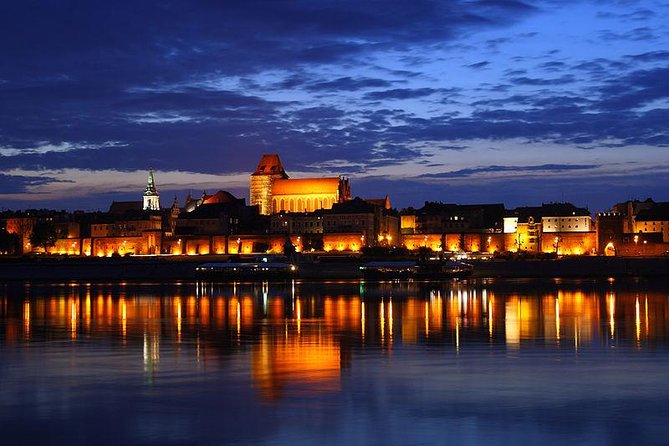
This is an eight-hour outing, not a quick side trip. The advertised price is $302.83 per person, and its value depends heavily on your group size. For one person or a couple, it is a costly day. For a family or small group, the private vehicle, personal pickup, dedicated guide, and flexible pace may make the price easier to justify.
Your day begins at 9:00 a.m. with pickup from your hotel or apartment in Gdańsk, Sopot, or Gdynia. The drive south takes about two hours each way. That is a serious amount of time on the road, but it also gives you a simple way to reach Toruń without changing trains, finding a rental car, or working out local transport on arrival.
The vehicle is private, so only your group participates. One driver, Mirek Kopec, is specifically praised for being courteous, punctual, and generous with stories and facts about Poland. Your Toruń guide is a separate local guide who leads the walking portion.
The tour is offered in English. Confirmation arrives when you book, and you need to provide your pickup point. Children under seven are free, but you should tell the operator about young children in advance.
A few more Poland half-days worth comparing
- Panorama of Toruń – 30-minute cruise
★ 4.9 · 80 reviews - Evening Cruises in Toruń
★ 4.9 · 50 reviews - Walking Tour of the medieval Toruń
★ 5.0 · 46 reviews
Toruń’s Old Town and Its Medieval Street Plan
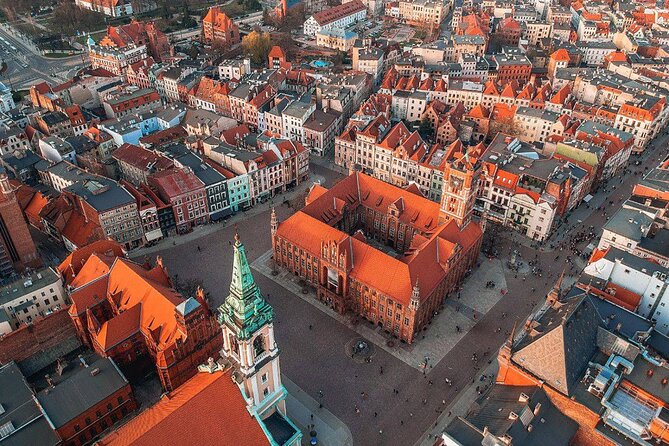
Toruń’s great strength is its sense of continuity. The Old Town was largely undamaged during the Second World War, and UNESCO added it to its World Heritage list in 1997 because its medieval street pattern and historic buildings remain largely intact.
That matters when you walk. You are not looking at one isolated monument surrounded by modern construction. The streets, walls, churches, civic buildings, and merchant houses work together to show how a medieval trading city was organized.
The guide starts with the Leaning Tower, part of Toruń’s old defensive walls. It is an easy landmark and a good first stop because it introduces the city’s medieval fortifications before you move into the main streets. The tower’s tilt gives the visit a touch of fun, but its real value is historical: it belongs to the defensive edge of the old city.
From there, the walk includes the Town Halls and Artus Court. The Old Town Hall is the main museum stop, listed as the Regional Museum in Toruń. Its scale reflects Toruń’s importance as a commercial center, while the Artus Court points to the city’s links with merchants and urban society.
You should expect the walk to focus on exterior views as well as historic interiors. The included admission specifically covers St. John Cathedral, while the description highlights the Old Town Hall as a major stop. If entering the museum is important to you, confirm with the guide how much indoor time is planned on the day.
The New Town, Red Brick, and Gothic Spires
The route continues into Toruń’s adjacent New Town, founded in 1264. Twelve years later, it joined the Hanseatic League, a network of trading cities that linked ports and commercial centers across northern Europe.
Here, the visual story changes slightly. You will see red-brick merchant houses and the Gothic spires of churches, including the late Gothic Church of St. James. Toruń is a place where brick tells much of the story. Stone was less readily available in this part of northern Europe, so brick became the material of choice for churches, walls, civic buildings, and homes.
I like this part of the route because it keeps the city from becoming only a Copernicus pilgrimage. The astronomical connection is important, but Toruń is also a trading city with religious, civic, and military layers. The New Town helps you see how ordinary urban life sat beside grand churches and powerful institutions.
The three-hour walk should give you a useful overview rather than a slow study of every building. If you like lingering inside churches, reading every museum panel, or stopping often for photographs, the schedule may feel tight. One person on the tour wanted more time in Toruń, and that is the main planning issue to keep in mind.
Teutonic Castle Ruins and the City’s Rebellion
The ruins of the Teutonic Order’s castle add a rougher, more political note to the walk. Toruń residents destroyed the castle in 1454, a reminder that this was not simply a peaceful trading center. The city had its own interests, and its people were willing to challenge the power of the Teutonic Order.
You will not see a complete fortress here. The appeal lies in the remains and in what they explain about Toruń’s place in medieval northern Europe. A guide can connect the ruins to the city’s political struggles, its trading wealth, and the changing balance between local towns and military orders.
This stop is especially useful if you enjoy history that goes beyond famous names. The castle ruins are not as polished as the Old Town Hall or the churches, but they help explain why the city developed as it did. They also offer a change of pace during a walk otherwise filled with handsome façades and formal Gothic architecture.
Same city, a completely different kind of day:
- From Krakow: Auschwitz-Birkenau Guided Tour & Hotel Pickup
★ 4.5 · 33,358 reviews - From Krakow: Auschwitz-Birkenau Guided Tour & Hotel Pickup
★ 4.5 · 29,340 reviews - Krakow: Auschwitz Guided Tour with Optional Hotel Pickup
★ 4.5 · 15,280 reviews - Krakow–Zakopane: Cable Car, Chocholow Baths, Cheese & Vodka
★ 5.0 · 10,720 reviews
Copernicus’s Birthplace and Toruń’s Scientific Identity
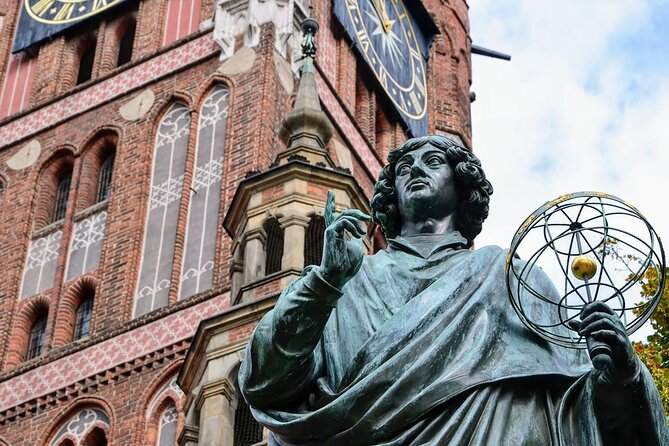
Nicolaus Copernicus is the name that gives this tour its focus. You stop at the house where he was born and learn about his life and work in astronomy.
The Copernicus connection is valuable because it ties a local place to a major shift in European thought. You are not simply seeing a plaque and moving on. The guide places Copernicus within the city that shaped his early life, then explains the work that made him famous.
The tour is best suited to visitors who want context rather than a specialist astronomy lecture. The supplied details do not promise a long museum visit or an in-depth scientific program, so you should think of this as a city tour built around Copernicus, not a full astronomy experience.
Still, the birthplace gives the subject a human scale. After seeing walls, churches, merchant homes, and civic buildings, you reach a specific address connected with one person. That balance between city history and personal biography is one of the tour’s better features.
St. John Cathedral and Toruń’s Sacred Architecture
Entrance to St. John Cathedral is included. This is important because the city’s churches are not just exterior ornaments. They help show the religious life, wealth, and artistic ambitions of medieval Toruń.
The church also fits neatly into the broader walking route. You see how religious buildings, commercial houses, defensive walls, and public spaces were all part of one compact historic center. The Gothic architecture is particularly effective when viewed alongside the red-brick churches and civic structures elsewhere in the Old Town.
Your exact amount of time inside the cathedral will depend on the guide and the pace of the group. Since the complete walking tour lasts about three hours, you should not expect unlimited time at every interior. If sacred art and church architecture are high on your list, tell the guide early so the visit can be paced well.
Gingerbread, Lunch, and the Practical Midday Question
Toruń is famous for gingerbread, and the tour includes a chance to sample it. This small tasting gives the day a local flavor and breaks up the historical commentary with something edible and distinctly associated with the city.
Food and drinks are not included, however. The tour schedule is intended to include about one hour of free time for lunch or shopping, but this needs to be communicated clearly. One past group found the lunch arrangement confusing and felt they had to insist on eating. The operator acknowledged that problem and said clearer communication would be needed.
My advice is simple: ask at the start of the day when your free hour will begin. Do not assume that lunch is arranged for you. You have time to eat, but you pay for your own meal, and the free hour is also the only clear chance for shopping or a longer personal look around.
That hour is valuable. After three hours with a guide, you may want a pause before the drive back to Gdańsk. You can use it for lunch, gingerbread, shopping, or a final walk through the streets. If you want more than a quick meal and a few purchases, the day may feel compressed.
How the Private Format Changes the Experience
A private tour gives you more control than a standard group excursion. Your group travels together in a private vehicle, and the guide can explain the city without addressing a large crowd. Families may appreciate the easier logistics, especially with young children. Couples and small groups can also avoid spending the day waiting for strangers.
The tradeoff is price. At $302.83 per person, this is not a budget bus trip. The cost pays for convenience, transport from three possible cities, a driver, a local guide, private participation, and entrance to St. John Cathedral. It does not cover lunch or drinks.
For a group of several people, the private setup can be reasonable. For a solo visitor, the price is harder to defend unless convenience matters more than saving money. If you are already planning to visit Toruń by train or car, a self-guided day may cost less, though it will not provide the same door-to-door service or guided explanation.
The private format also makes this a good choice for visitors who want a straightforward plan. You leave at a fixed time, see the major sights in one route, and return to your accommodation without handling the transport yourself.
Who Should Book This Toruń Day Trip?

I would choose this tour if you are staying in Gdańsk and want to see Toruń without changing your base. It is particularly useful for:
- Families who want private pickup and a dedicated vehicle
- Couples who prefer a personal guide and fixed schedule
- First-time visitors who want the main Old Town sights explained
- History fans interested in the Teutonic Order and medieval city life
- Copernicus enthusiasts who want the birthplace and local setting
- Small groups that can share the cost of a private excursion
I would think twice if you want a relaxed, full-day exploration of Toruń. The drive takes about four hours in total, and the city visit is structured around a three-hour guided walk plus about one hour of free time. That is enough for a solid introduction, but not enough for an unhurried museum day.
Free cancellation is available if you cancel at least 24 hours before the 9:00 a.m. start. Changes or cancellations made later are not accepted for a refund.
Should You Book This Toruń Tour?
Book it if you want the simplest way to reach Toruń from Gdańsk, Sopot, or Gdynia and you value a private guide more than a low price. The strongest parts are the door-to-door transport, the clear focus on Copernicus, and the broad Old Town route covering the Leaning Tower, churches, civic buildings, castle ruins, and gingerbread.
Skip it if you dislike long road days or want several hours of unplanned time. The tour gives you a well-shaped introduction, not a slow exploration. Ask about the lunch hour when you meet the guide, and you will avoid the one practical problem that has caused confusion.
FAQ
Where does the tour start?
Pickup is available from your hotel or apartment in Gdańsk, Sopot, or Gdynia. You need to provide your meeting point when booking.
What time does the tour begin?
The tour starts at 9:00 a.m.
How long does the tour last?
The experience lasts approximately eight hours. The stated schedule is about two hours of driving each way, three hours of guided touring, and one hour of free time.
Is the tour private?
Yes. Only your group participates in the activity.
What language is offered?
The tour is offered in English.
Is hotel pickup and drop-off included?
Yes. Pickup and drop-off from hotels or apartments in Gdańsk, Sopot, and Gdynia are included.
What sights are included in the walking tour?
The route includes the Leaning Tower, the Old Town Hall area, Artus Court, the New Town, the Church of St. James, the Teutonic castle ruins, Copernicus’s birthplace, and St. John Cathedral.
Is admission to St. John Cathedral included?
Yes. Entrance to St. John Cathedral is included.
Are lunch and drinks included?
No. Food and drinks are not included. The schedule allows about one hour for lunch or shopping, but you pay for your own meal.
Are children allowed on the tour?
Yes. Children under seven are free, but you should inform the operator about children when booking.
Just added around Poland
- Lower Silesia Tour From Wroclaw★ 4.5 · 33 reviews
- Wroclaw Old Town Private Tour★ 5.0 · 6 reviews
- Museum of Illusions Wroclaw Entrance Ticket★ 5.0 · 42 reviews
- Jewels of Lower Silesia★ 5.0 · 22 reviews
- Krakow and Wieliczka Salt Mine Tour from Wroclaw – Local guides included★ 4.0 · 5 reviews
- Legends of Old Town 1 Hour Walking Tour in Wroclaw★ 5.0 · 6 reviews
- Guided Private Tour to Auschwitz Birkenau & Krakow from Wroclaw★ 5.0 · 4 reviews
- Highlights of Wroclaw Private Tour with one Entrance★ 5.0 · 5 reviews
City Tours, compared.

City Sightseeing Tour Eco Electric Buggy Golf Cart
Read our review →

Gdańsk City Sights & History Guided Walking Tour in English
Read our review →
Extended City Sightseeing Tour – Eco Buggy Golf Cart
Read our review →
Private Tour: Warsaw City Sightseeing by Retro Fiat
Read our review →Browse the lists this tour appears in