
Reviewed · WALKING TOURS
Katowice Old Town Walking Tour
Katowice’s story is written in church façades, communist-era shopping halls, grand tenements, and postwar monuments, all within one long city walk. This is not a quick old-town stroll. Over about 6.5 kilometers, you trace how Silesia moved between Polish and German influence, industrial ambition, religious variety, war, and modern cultural life.
I like two things in particular. First, the route puts famous sights such as Spodek and the Silesian Insurgents’ Monument beside less obvious places, including the Academy of Music and the former Silesian Parliament. Second, the private format lets the guide adjust the conversation to your interests. Malwina is specifically praised for making the walk feel like a personal learning session.
The main consideration is the distance. Three hours and 6.5 kilometers require a moderate level of fitness, and the tour is mostly about outdoor city discovery rather than entering attractions. At $81.62 per person, it makes the most sense for a small group that can share the cost, especially since group discounts are available.
Key points before you book
- 6.5-kilometer city walk: You cover much more than the central square, so wear comfortable shoes and expect a steady pace.
- Private English-language experience: Only your group takes part, with room for questions and a more personal discussion.
- Silesian identity is the main theme: The route explains the region’s changing Polish, German, Catholic, Protestant, communist, and modern influences.
- Major sights and everyday streets: You see Spodek and official monuments, but also Stawowa, old tenements, shopping buildings, and local cultural venues.
- No admission fees are listed: The value comes from the guide’s interpretation rather than included tickets or indoor attractions.
- Flexible cancellation: You can cancel at least 24 hours before the start for a full refund, subject to the stated weather and minimum-group conditions.
Starting at the Silesian Theatre
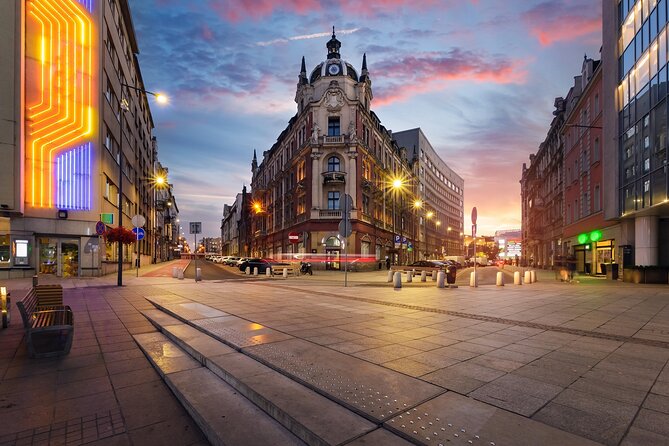
The walk begins at the Silesian Theatre on Rynek 10, beside Katowice’s Market Square. This is a useful starting point because the square gives you an immediate sense of the city’s layers.
The opening section includes the Silesian Theatre, the Skarbek and Zenit buildings, and some of Katowice’s oldest structures. Skarbek and Zenit are especially useful for understanding daily life in communist Poland. They were associated with shopping and city-center commerce, and the tour presents them as the shopping dream place of that period.
That detail keeps the opening from becoming a standard parade of façades. You are not only looking at old buildings. You are also considering what people bought, where they met, and how the center functioned under a very different economic system.
The square is also described as one of Silesia’s main places for eating, drinking, and evening social life. The tour does not include food or drinks, but the setting gives you a chance to see how the historic center works today.
The first 15 minutes are free of admission charges, as are the other listed stops. That is worth understanding when you assess the price. You are paying for a private guide and a carefully connected route, not for entry to a series of ticketed monuments.
More Walking Tours in Katowice:
- Katowice Old Town Highlights Private Walking Tour
★ 4.9 · 14 reviews - Warsaw: Old Town Highlights Walking Tour in English
★ 4.7 · 1,516 reviews - Old Town Krakow & Wawel Castle Walking Tour
★ 5.0 · 1,508 reviews
Kosciol Mariacki and Katowice’s church architecture
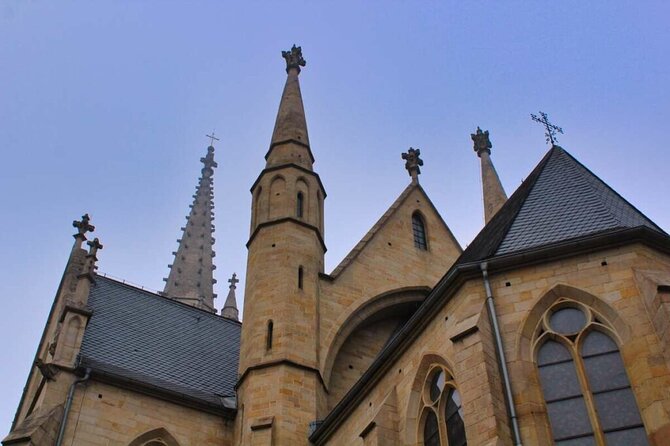
The next stop is the Immaculate Conception Catholic Church, known locally as Kosciol Mariacki. You spend about 10 minutes here, taking in the exterior architecture and the artworks inside by leading Polish artists.
The short timing suggests a focused stop rather than a long church visit. You can expect the guide to draw attention to what makes the building important and to explain the artwork, but the information does not promise a full interior tour or extended time inside.
That is one of the tour’s strengths and one of its limits. The route gives you a broad view of Katowice, so individual stops are brief. If you prefer to sit quietly in one church and examine every detail, this pace may feel quick. If you want context and variety, the short visit keeps the walk moving.
The church also helps introduce Silesia’s complicated spiritual identity. The next major religious stop, the Cathedral of Christ the King, is presented as Catholic in its exterior feel but Protestant in its interior character. Together, the two churches make a useful pair.
The Academy of Music and the sound of modern Silesia
The Academy of Music in Katowice gets about seven minutes. It is described as Poland’s most prestigious music academy, making it an important cultural stop even though it may not be as visually familiar as a church or monument.
A brief visit here works best when your guide explains why the institution matters to the city. Katowice is often reduced to its industrial past, but the academy points to another side of local life: formal music training, performance, and the city’s place in Polish culture.
Do not expect a concert or a scheduled performance. The tour information only promises a stop at the academy, with no event included. Still, it is a worthwhile addition because it broadens the story beyond architecture and politics.
The Silesian Parliament and regional power
The former seat of the parliament of the autonomous Silesian Region is the next major landmark. You spend roughly 10 minutes here.
This stop gives the guide a clear opening to discuss Silesia’s political position and its changing relationship with Poland and Germany. The region’s identity cannot be reduced to one national story, and the parliament building helps make that point in physical form.
This is where the tour’s historical approach becomes most useful. You are not simply collecting old buildings. You are seeing places connected with questions of regional authority, self-government, and identity.
The tour also passes a local favorite theater with an informal atmosphere. Its name is not specified in the supplied details, so you should treat it as a passing cultural stop rather than an attraction with a promised performance or interior visit. It adds another reminder that Katowice’s cultural life is not confined to formal institutions.
A few more Katowice half-days worth comparing
- Private One-Way Transfer from Kraków to Katowice Airport
★ 5.0 · 157 reviews - Pub Crawl 1hr Unlimited Beer + Vodka then Clubs in Katowice
★ 4.2 · 22 reviews - Katowice and Nikiszowiec: bicycle tour with guide
★ 4.3 · 14 reviews - Katowice Airport Krakow Private Transfer, Private Driver Service
★ 5.0 · 7 reviews
The Cathedral of Christ the King
The Cathedral of Christ the King receives about 10 minutes. Its unusual description is the key: Catholic-like from the outside, Protestant-like inside.
That contrast reflects Silesia’s mixed origins and spiritual traditions. The building is not presented as a simple example of one religious style. Instead, it helps explain why the region can feel culturally blended, with influences that do not fit neatly into a single category.
I would pay close attention to the guide’s explanation here. A church can tell you a great deal about a city, but only if someone connects the design and use of the building to the wider regional story. This is one of the stops where a private guide adds real value.
Again, the visit is short. You may see the key features and hear the main explanation, but you should not expect a lengthy worship-site visit. Dress and behave respectfully, as you would in any active religious building.
From Miarka Square to Stawowa
The longest part of the route is the 30-minute walk through Miarka Square, Dworcowa Street, and 3 Maja Street toward Stawowa. This is less about one monument and more about reading the city as you move through it.
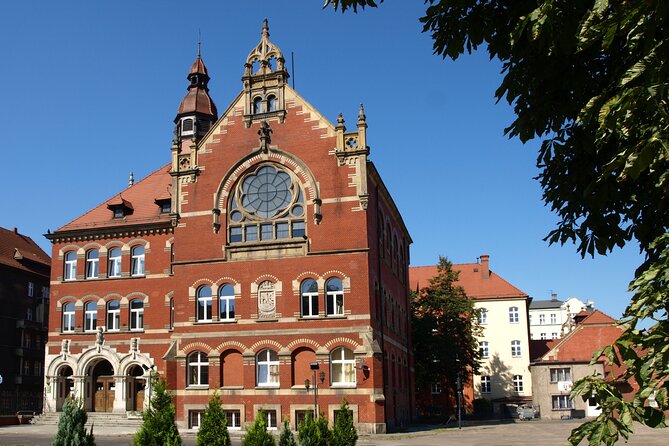
The route highlights 19th-century tenements and the oldest high school in Katowice. These streets help fill in the space between grand civic buildings and daily urban life. You get to see the scale and texture of older Katowice, rather than viewing the city only through its official landmarks.
This section also shows why comfortable shoes matter. Six and a half kilometers is not extreme, but it is a substantial walk when you are stopping, listening, crossing streets, and looking upward at façades. If you have mobility concerns, ask about the route before booking. The stated requirement is a moderate physical fitness level.
Stawowa adds another layer to the city-center story. The route moves from historic buildings and civic institutions into a street associated with movement and everyday urban activity. The appeal is not a single ticketed attraction. It is the chance to notice how old buildings, shops, public spaces, and local habits sit beside one another.
The scouts’ memorial and Katowice’s wartime memory
Along the way, the walk passes a monument commemorating Silesian scouts who opposed the Nazis in 1939. This is a small but important detail in the route.
A monument like this brings national events down to a local scale. Instead of treating the Second World War as something that happened elsewhere, the stop points to young people and local communities caught in the conflict.
The information provided does not give the monument a separate stop time, so it appears to be a brief point along the walk. That can be an advantage. You receive the context without breaking the overall rhythm of the tour, though anyone wanting a long memorial visit may find it too short.
The route also passes a venue used for art exhibitions, international meetups, and other events. Its name is not supplied, so there is no specific exhibition or program included. Still, it shows Katowice as a city with current cultural activity, not only old buildings and historical markers.
The Silesian Insurgents’ Monument
The Silesian Insurgents’ Monument is one of the clearest historical landmarks on the walk. You spend about 10 minutes here.
The monument commemorates three Silesian uprisings. That makes it an important stop for understanding the region’s contested identity and the struggle over its political future.
The monument is also a useful bridge between the earlier parliament stop and the final visit to Spodek. The parliament represents regional government. The monument represents conflict and memory. Spodek represents the modern city. Taken together, these places create a compact outline of Silesia’s political and cultural story.
This is the kind of place where your guide’s ability to answer questions matters. The tour is conducted privately, so you can ask for clarification instead of simply moving on with a large group.
Spodek, Katowice’s unmistakable symbol
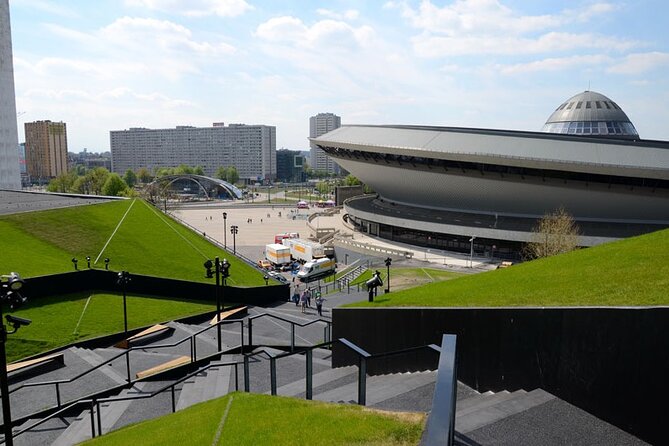
The final main stop is Spodek, the saucer-shaped arena that serves as Katowice’s best-known symbol. You spend about 10 minutes here before returning to the Silesian Theatre.
Spodek gives the tour a strong visual ending. After old churches, 19th-century tenements, parliament buildings, and historical monuments, you finish with a bold piece of modern architecture.
The stop is about seeing and understanding the building, not attending an event. No admission or performance is included, and the schedule does not promise access inside. Even so, Spodek is an essential part of Katowice’s public image, and it gives the walk a clear connection to the city you see today.
I like the way the route ends here. You begin with the old center and communist-era shopping buildings, then finish with a modern structure recognized across Poland. The progression makes Katowice feel like a living city rather than a preserved historic district.
What $81.62 means in real value
At $81.62 per person, this is not a bargain-priced group stroll. The price needs to be judged against what you receive: about three hours, an English-speaking guide, a private format, and a route covering 6.5 kilometers.
The private setup is the biggest value point. If you are traveling alone, the cost is harder to justify, although the format means the guide’s attention is yours. If you are with family or friends, group discounts can make the price more sensible.
There are no listed entrance fees, meals, drinks, or transport included. That is not a flaw if your goal is an explained walking tour. It does mean you should book this for the guide’s interpretation and the breadth of the route, not for included extras.
The feedback attached to the tour puts special weight on the guide. Malwina is described as experienced and able to turn the walk into a personal learning session. Another detailed response highlights the explanation of Silesia changing hands between Slavic and German powers. Those comments point to the experience’s strongest feature: the human explanation tying separate sights together.
Who will enjoy this walk most
I would recommend this tour to you if you want a broad introduction to Katowice and Silesia in one sitting. It suits people interested in regional identity, architecture, religion, political history, and the city’s transition from communist-era life to its present cultural role.
It is also a good fit if you prefer private guiding. You can ask direct questions, set the pace within reason, and focus more closely on the subjects that matter to you.
You may want a different plan if you are looking for extensive time inside museums, churches, or theaters. The route is built around outdoor walking and short visits. It also may not suit anyone who finds 6.5 kilometers difficult.
The tour is offered in English. Service animals are allowed, and the route is near public transportation. Confirmation is sent within 48 hours of booking, subject to availability.
Should you book the Katowice Old Town Walking Tour?
Book it if you want more than a photo stop at Spodek. The tour connects Silesian politics, religious variety, communist city life, wartime memory, old streets, and modern culture in a single private walk.
I would be especially inclined to book it for a first visit to Katowice, a small group sharing the cost, or anyone who wants a guide to explain why Silesia feels different from a simple Polish regional story. I would hesitate only if you want a low-cost stroll, indoor attraction tickets, or a shorter route.
The cancellation terms are fair: cancel at least 24 hours before the start for a full refund. The tour requires good weather and a minimum number of participants. If poor weather or an unmet minimum causes cancellation, you are offered another date or experience, or a full refund.
FAQ
Where does the Katowice Old Town Walking Tour begin?
It begins at the Silesian Theatre, Rynek 10, 40-003 Katowice, Poland.
Where does the tour finish?
The walk ends back at the Silesian Theatre meeting point.
How long does the experience last?
The tour lasts approximately three hours.
How far do you walk?
The route covers about 6.5 kilometers.
Is the tour private?
Yes. Only your group participates in the activity.
What language is offered?
The tour is offered in English.
Are admission tickets included?
The listed stops have no admission charge. The supplied information does not list any separate paid attractions or included tickets.
What happens if the weather is poor?
The experience requires good weather. If it is canceled because of poor weather, you are offered a different date or a full refund.
Just added around Katowice
- Katowice: Private Traditional Polish Food Tour★ 5.0 · 4 reviews
- Katowice Old Town Highlights Private Walking Tour★ 4.9 · 14 reviews
- Katowice Private Vodka Tasting Tour★ 5.0 · 3 reviews
- Explore Katowice in 60 minutes with a Local★ 3.5 · 4 reviews
- Gun Shooting Experience with Hotel Transfers in Katowice★ 4.5 · 3 reviews
- Katowice Private Traditional Polish Food Tour★ 5.0 · 3 reviews
- Katowice Airport Krakow Private Transfer, Private Driver Service★ 5.0 · 7 reviews
- Katowice KTW Airport – Kraków City/KrakówAirport Private Transfer★ 5.0 · 6 reviews
Walking Tours, compared.
Gdańsk City Sights & History Guided Walking Tour in English
Read our review →
Browse the lists this tour appears in