
Reviewed · JEWISH HERITAGE TOURS
Krakow: Old Town, Jewish Kazimierz and Ghetto Sightseeing by Electric Golf Cart
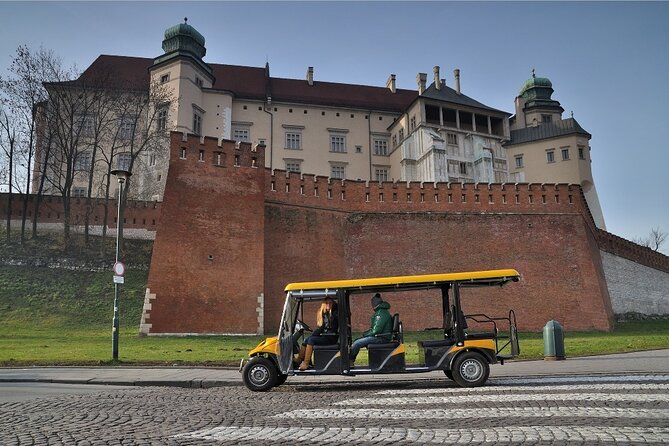
Krakow packs centuries of public squares, churches, Jewish heritage, and wartime memory into a fairly compact center. This 2.5-hour electric golf-cart tour gives you a fast look at all three main areas: the Old Town, Kazimierz, and the former Ghetto in Podgórze. Guides such as Filip W, Michael, Peter, Tom, and Radic have been praised for adding clear explanations beyond the onboard audio.
I like the small group limit of eight and the chance to cover far more ground than you could comfortably walk in one short outing. I also like the mix of grand sights and difficult history, from St. Mary’s Basilica and the Cloth Hall to the Ghetto wall and Pharmacy Under the Eagle. The main tradeoff is time: busy streets can slow the cart, and you may only get brief stops for photographs or a quick look inside a church.
Key points at a glance
- Three sides of Krakow in one ride: Cover the Old Town, Jewish Kazimierz, and Podgórze’s former Ghetto.
- A practical vehicle: The electric cart helps when long walks are difficult or your stay is short.
- Eight-person maximum: A small group leaves more room for questions and personal guidance.
- Strong guide element: The audio system supplies the structure, while guides including Filip W, Michael, Peter, Tom, and Radic have added useful commentary.
- Important wartime sites: See part of the former Ghetto wall, Plac Zgody, and the pharmacy linked to Tadeusz Pankiewicz.
- Book an earlier departure if possible: Old Town traffic and other sightseeing carts can make later rides feel crowded.
Why this cart tour works for a short Krakow stay
Krakow is easy to admire on foot, but its main sights are not all in one small pocket. The Old Town sits north of Wawel, Kazimierz lies to the south, and the former Ghetto is across the river in Podgórze. This ride links them without asking you to spend much of the day walking between districts.
That makes it especially useful if you have only a day in Krakow, or if your legs are not up to a long city walk. One rider specifically found the tour helpful because walking for extended periods was difficult. You still need to get in and out of the vehicle at times, but the cart removes much of the distance between sights.
The experience costs $56.47 per person. That is not the cheapest way to see Krakow, especially if you are happy walking and already know where you want to go. But the price can make sense if you value transport, a fixed route, English commentary, and a guide who can explain the city while you ride. You are paying for coverage and convenience more than for long visits inside individual buildings.
More Golf Cart Tours in Krakow
- Krakow: City Sightseeing Tour by Electric Golf Cart
★ 4.5 · 3,264 reviews - Krakow: City Sightseeing Tour Eco Electric Buggy Golf Cart
★ 4.7 · 3,143 reviews - Krakow: Extended City Sightseeing Tour – Eco Buggy Golf Cart
★ 4.7 · 794 reviews
Starting among Krakow’s biggest sights
The tour starts at Mikołaja Zyblikiewicza 2 and ends at Mikołaja Kopernika 3. Both addresses are in central Krakow, and the tour is near public transportation. Arrive on time, since this is a shared departure rather than a private vehicle waiting for late arrivals.
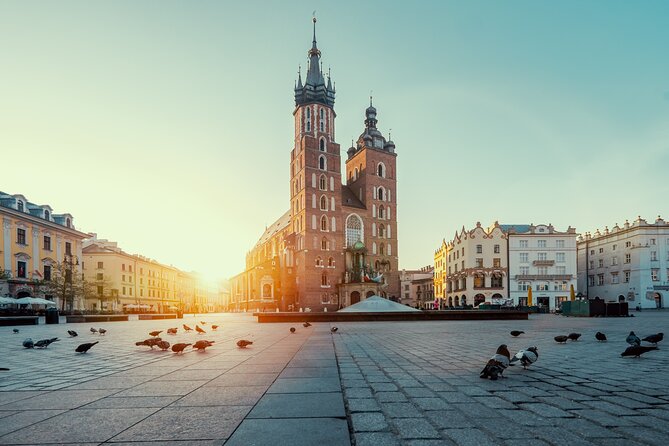
The Old Town section begins with Krakow’s Main Market Square, one of Europe’s broadest medieval market spaces. It is the city’s main public stage, lined with the buildings and monuments that most visitors want to see first. The scale is impressive, but it also creates the tour’s biggest practical problem: the square can be crowded, and several sightseeing carts may gather in the same area.
From the cart, you get a useful first look at the layout. You may not get a clear photograph of every facade, though, so keep your camera ready and listen closely while the vehicle is moving slowly. If you want detailed architectural study, return to the square later on foot.
The Cloth Hall, Town Hall Tower, and St. Mary’s
The Cloth Hall, or Sukiennice, occupies the center of the Main Market Square. Once Krakow’s commercial heart, it remains one of the city’s defining buildings and one of its best-known examples of Renaissance architecture. The cart gives you the setting and the outside view, while a separate visit is better if you want time to browse or study the interior.
Nearby, the Town Hall Tower is the sole surviving part of Krakow’s former municipal headquarters. The tower rises 70 meters and has 110 stone steps. Its executioner’s dungeons and long connection with the square give it a darker edge than its elegant profile suggests.
St. Mary’s Basilica brings together several Krakow symbols: a history reaching back more than eight centuries, a high altar carved by Veit Stoss, murals by Jan Matejko, and the hourly bugle call associated with the city. You may get a short chance to step inside, but do not assume the cart will pause long enough for a full visit. Tell your guide if entering the church matters to you. The timing of stops can vary, and one tour experience included about ten minutes to walk around selected sites.
The Słowacki Theatre and medieval defenses
The Juliusz Słowacki Theatre adds a different kind of Krakow landmark. Open continuously since 1893, it is among the city’s finest theatre buildings and an important part of its cultural life. It is easy to overlook when you focus only on churches and royal buildings, so its inclusion broadens the picture of Krakow beyond medieval monuments.
The Barbican brings you back to the city’s defensive past. This rounded brick fortification once guarded the approach to the Old Town and is one of the best-known pieces of Krakow’s medieval military architecture. Its legend includes a successful defense in which the attackers were repulsed with a single shot, an entertaining detail for the guide to explain as you pass.
These stops work well from a cart because they are primarily orientation points. You see how the theatre, defensive walls, gates, and central square fit together. The drawback is the same one found across the Old Town: the cart cannot always stop exactly where you want, and crowds can block your view.
More Jewish Heritage Tours in Krakow
- Krakow: Schindler’s Factory & Ghetto Guided Tour
★ 4.7 · 1,694 reviews - Krakow: Jewish Quarter and Former Ghetto Tour
★ 4.9 · 1,441 reviews - Krakow: Bike Tour of Old Town, Jewish Quarter and the Ghetto
★ 4.9 · 1,155 reviews - Krakow: Kazimierz Jewish Quarter Walking Tour
★ 4.8 · 571 reviews
Kazimierz, the former Jewish quarter
The ride then moves into Kazimierz, once an independent town south of Wawel. For centuries it was the center of Jewish life in Krakow. Today it is one of the city’s most visited districts, but its importance is not only about cafés, restaurants, or attractive streets. The tour places the area within the longer story of Jewish Krakow.
Szeroka Street is the key setting. It was the center of Jewish life in Kazimierz, and four synagogues once stood along the street, an unusual concentration even in Europe. Seeing the street after learning that fact changes how you read its buildings and open space.
The Tempel Synagogue is noted for its well-preserved stained-glass windows and its non-Orthodox character. The Old Synagogue, also on Szeroka Street, is one of Poland’s oldest preserved synagogues in good condition. The Remuh Synagogue is the smallest of Krakow’s seven synagogues and is more restrained in decoration than the others. After its renovation in 2016, it became the main place of prayer for members of Krakow’s Jewish community.
The cart can introduce you to all three, but it cannot replace a dedicated museum or synagogue visit. If Kazimierz is your main reason for coming to Krakow, use this ride as an overview, then return on foot for more time. If your schedule is tight, the tour gives you a useful framework and helps you decide which places deserve a longer visit.
Podgórze and the former Krakow Ghetto
The route continues to Podgórze, a district that was made into the Krakow Ghetto in 1941 under Nazi occupation. This is where the tone changes. The tour moves from civic landmarks and religious buildings to sites connected with confinement, deportation, and the destruction of a community.
At Plac Zgody, now known as Plac Bohaterów Getta, Jewish residents were forced to gather before deportation. The square served as an Umschlagplatz, a collection and transfer point during the occupation. It is a place where the physical space is fairly open, yet the events connected with it are hard to take in. Give yourself a quiet moment here rather than treating it as just another stop for a photograph.
You also see a surviving fragment of the original Ghetto wall, with a plaque marking the fate of its inhabitants. The fragment is small, but that is part of its force. It is not a grand monument. It is a piece of the boundary that confined people in the district.
The Pharmacy Under the Eagle connects this history to one individual. Tadeusz Pankiewicz took over his father’s pharmacy and could not have known that the business would place him in the middle of the Ghetto’s story. The site helps bring the wartime section down to a human scale, away from dates and military movements.
The final portion connects the war to ordinary homes and private lives. You are shown places where global events reached into daily routines. The audio system provides the basic account, while a good guide can make the sequence easier to follow and answer questions as they arise.
What the guide and audio system add
The tour includes an audio system, so you are not dependent only on live commentary. That is useful when traffic noise or the open-sided vehicle makes conversation hard to catch. The audio also helps keep the route organized, especially because the tour covers several districts and a long period of history.
The best version of this experience combines the recording with a strong driver-guide. Filip W was praised for adding information beyond the audio and for explaining the sights in an engaging way. Michael was singled out for taking time with the history, while Peter was described as friendly and entertaining. Tom was particularly helpful with questions and photo stops. Radic was noted for explaining both the past and how people live in the city today.
Guide quality can vary by departure, so I would treat the audio as the dependable base and the live guide as an important bonus. Ask questions when the cart stops. Also tell the guide early if you want to take photographs or enter a church, since the schedule may otherwise move on quickly.
Timing, crowds, and the eight-person limit
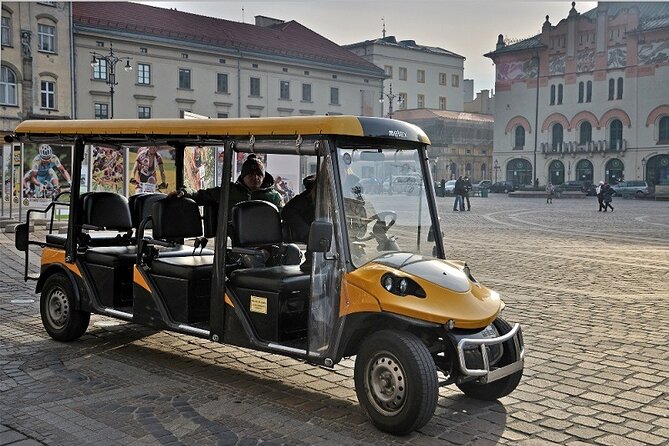
The ride lasts about two hours and 30 minutes. That is enough time for a broad introduction, but not enough time to explore every site in depth. Think of it as a moving overview, not a series of museum visits.
The maximum group size is eight. That is a real advantage over a large coach. It is easier to hear the guide, ask a question, and request a short photo stop. Some departures may have fewer people, and one group effectively had a private experience when other bookings did not appear, but you should book on the assumption that it is a shared tour.
An early time slot is the safer choice. Later in the day, the Old Town becomes more congested, with pedestrians and other sightseeing carts competing for space. Crowding can mean obstructed views and less time stopped at each landmark. If your schedule allows, start earlier and return to favorite sights later on foot.
Do not bring large baggage. The cart has room for passengers to sit, but not much space for bulky luggage. Wear clothing suited to sitting outdoors, though no special equipment is listed. Most people can take part, and the vehicle is near public transportation.
Is $56.47 good value?
I see this as fair value for a visitor who wants orientation, transport, and history in one booking. The route covers enough ground that walking it all in the same period would be tiring, especially for anyone with limited mobility. The small group and English presentation also improve the experience over a generic city loop.
The value drops if you want long stops, detailed interior visits, or complete control of the route. You will need separate time for the Main Market Square, synagogues, churches, and wartime museums if you want to go inside and read at your own pace.
Free cancellation is available up to 24 hours before the start time. Within 24 hours, the fare is not refunded, so confirm your plans before that deadline.
Who should book this Krakow ride?
I would choose it for a first day in Krakow, a one-day stay, or a visitor who wants a clear introduction before exploring independently. It also suits anyone who finds long walks difficult and families or couples who prefer a smaller vehicle to a large sightseeing bus.
I would be more cautious if your main goal is photography. The cart may pause only briefly, and crowded streets can make clean views difficult. In that case, use the ride to learn the city’s shape, then return to the places you want to photograph.
FAQ
How long does the tour last?
The tour lasts approximately two hours and 30 minutes.
What areas of Krakow does the route cover?
It covers Krakow’s Old Town, the Jewish quarter of Kazimierz, and Podgórze, including sites connected with the former Krakow Ghetto.
What is the maximum group size?
The tour has a maximum of eight travelers.
Is the tour offered in English?
Yes. The experience is offered in English and includes an audio system.
Where does the tour start and finish?
It starts at Mikołaja Zyblikiewicza 2, 31-029 Kraków, and ends at Mikołaja Kopernika 3, 31-034 Kraków.
Can I bring large luggage?
No. The vehicles have enough room for passengers to sit but not for large baggage.
Should you book it?
Book this tour if you want to see Krakow’s main districts in one sitting, need to limit walking, or have only a short stay. The mix of Old Town landmarks, Kazimierz synagogues, and former Ghetto sites gives you a useful first map of the city.
Skip it if you prefer slow visits and long time inside each monument. For the best balance, choose an early departure, arrive ready to listen, and plan to revisit the places that catch your attention on foot.
Just added around Krakow
- stag dog chase Krakow prank★ 5.0 · 4 reviews
- Divine Mercy Sanctuary – Private Tour from Krakow★ 5.0 · 4 reviews
- ZALIPIE – painted village, unique small group tour from Krakow★ 5.0 · 7 reviews
- ZALIPIE – painted village, unique PRIVATE tour from Krakow★ 5.0 · 20 reviews
- Zalipie Private Tour from Krakow The Painted Village★ 5.0 · 4 reviews
- Wooden Churches Unesco List Private Tour from Krakow★ 5.0 · 14 reviews
- Guided tour to Salt Mine & Schindler Factory with Pick-Up Options★ 4.0 · 58 reviews
- Wawel Castle, Cathedral, & Rynek Underground Tour with Lunch★ 5.0 · 4 reviews
Jewish Heritage Tours, compared.
Bike Tour of Old Town, Jewish Quarter and the Ghetto
Read our review →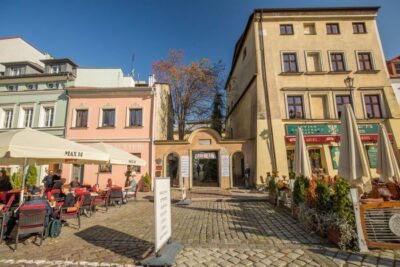
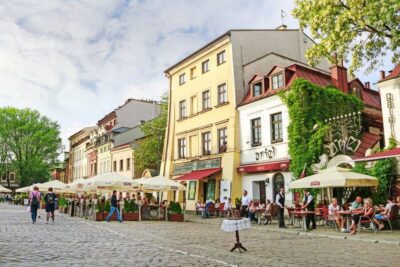
Kazimierz, Schindler’s Factory & Ghetto Guided Tour
Read our review →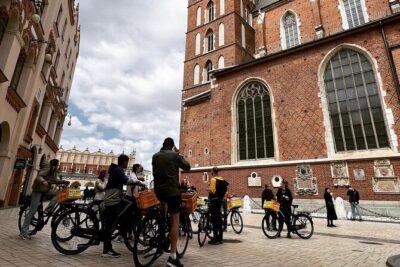
Full Bike Tour – the Old Town, Jewish Qtr & the Ghetto NEW BIKES
Read our review →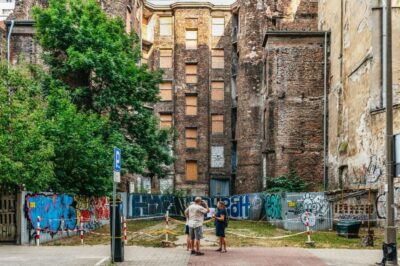
Warsaw Ghetto Private Walking Tour with Hotel Pickup
Read our review →
Bike Tour of the Old Town, Kazimierz, and the Ghetto
Read our review →Browse the lists this tour appears in