
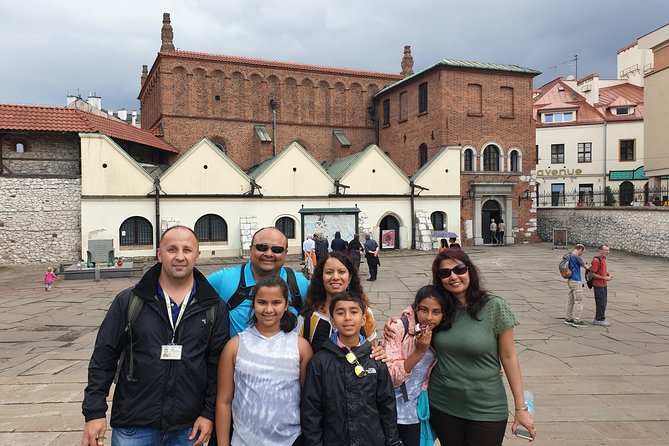
Reviewed · JEWISH HERITAGE TOURS
Krakow Jewish District Private Tour. Kazimierz and Jewish Ghetto
Krakow’s Jewish Quarter is not simply a collection of old synagogues. It is a place where Jewish life, Nazi persecution, postwar memory, and modern Krakow meet on the same few streets. This private walk connects those layers, from Szeroka Street and its historic synagogues to the former ghetto across the river.
I like the personal format and the serious focus on history. You get a licensed local guide rather than an audio recording, and the route includes quiet courtyards, film locations, and memorial sites that are easy to miss alone. The main consideration is that most synagogue stops are viewed from outside, so this is primarily a guided street walk rather than an indoor museum tour.
Key points to know before booking
- A private 2.5-hour walk gives your group direct access to an English-speaking local guide.
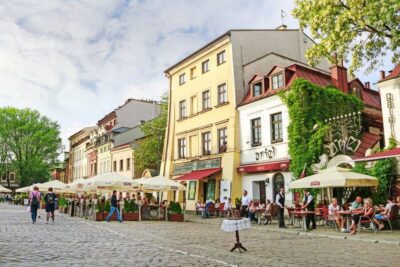
- Szeroka Street is the main historical anchor, with several synagogue exteriors and the old Jewish quarter around it.
- Schindler’s List locations add a visual link to Krakow’s wartime story.
- Ghetto Heroes Square and the wall fragment shift the tour from Jewish life to Nazi occupation and forced relocation.
- The route is free of admission charges, but comfortable shoes matter because the experience is conducted on foot.
- The $96.11 per-person price makes the most sense for couples, families, or small groups that value private attention.
From Kazimierz’s synagogues to the former ghetto
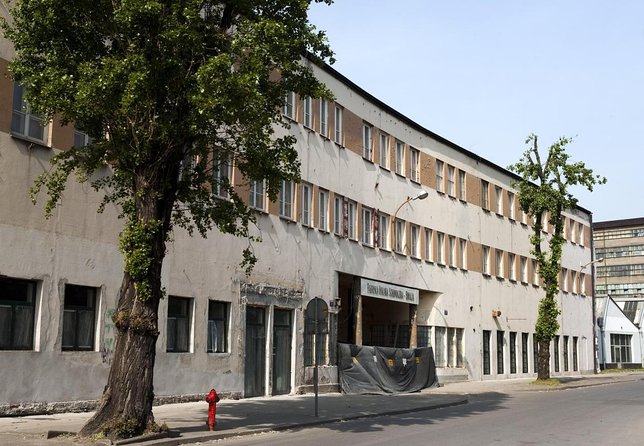
The route covers two connected but distinct parts of Krakow. Kazimierz was the historic Jewish quarter, while the ghetto area lies across the river in Podgórze. That change of setting matters. You first see places tied to religious life and community, then move toward sites linked to persecution and wartime destruction.
The tour begins around the old quarter, where the streets are compact and full of historic markers. Your guide explains the area rather than simply pointing at buildings. This helps you understand why Szeroka Street matters, how the synagogues relate to one another, and how much of the old neighborhood has changed.
The later stops are more somber. A courtyard used in Schindler’s List, a surviving fragment of the ghetto wall, and Ghetto Heroes Square place the history in physical surroundings. I find that progression useful because it avoids treating the Jewish quarter as only a photogenic old-town district.
More Jewish Heritage Tours in Krakow
- Krakow: Schindler’s Factory & Ghetto Guided Tour
★ 4.7 · 1,694 reviews - Krakow: Jewish Quarter and Former Ghetto Tour
★ 4.9 · 1,441 reviews - Krakow: Bike Tour of Old Town, Jewish Quarter and the Ghetto
★ 4.9 · 1,155 reviews
Wolf Popper Synagogue and Szeroka Street
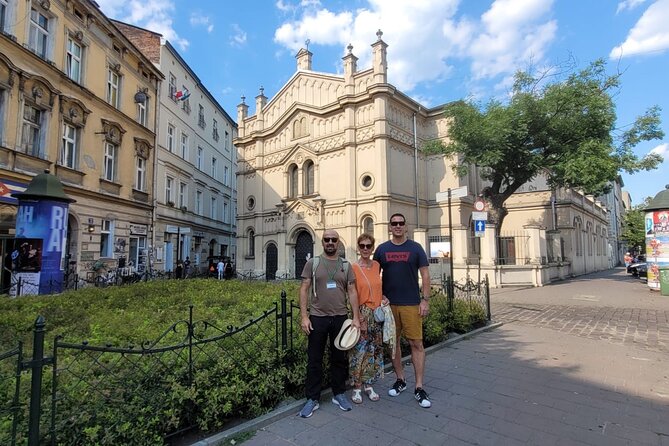
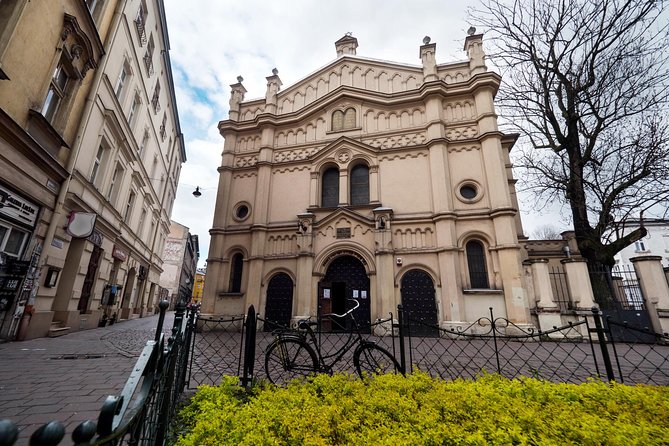
The first stop is Wolf Popper Synagogue, with about 10 minutes of explanation. Admission is free, and the focus is on the building and its place in the quarter rather than a long indoor visit.
From there, the walk reaches Szeroka Street for roughly 45 minutes. This is the longest single stop, and rightly so. Szeroka is described as the oldest part of Krakow’s Jewish Quarter, making it the natural place to spend time getting the basic story straight.
Expect your guide to use the street itself as a classroom. The buildings, facades, and synagogue sites help explain the former community’s religious and social life. You are not rushing through a checklist of sights here. The extended stop gives you time to ask questions and notice how the historic quarter functions today.
One practical point: much has changed in Kazimierz. Modern cafes and businesses now share space with historic buildings, and some religious sites may be closed during holidays or special observances. A previous visit coincided with Simchat Torah, when everything was closed, so the guide relied on exterior views and explanation. That is not necessarily a flaw, but it is worth knowing if you expect every synagogue to be open.
Remuh, the Old Synagogue, and the Jewish Community Center
The route continues with outside explanations at Remuh Synagogue and the Old Synagogue. Each receives about 10 to 15 minutes of attention. Since these are exterior stops on this experience, your guide’s interpretation carries much of the value.
The Remuh stop is paired with the Old Synagogue, allowing you to compare two important religious sites without needing a long transfer. The Old Synagogue is also seen from outside, so you should not book this walk expecting an included museum entrance.
The Jewish Community Center adds a modern point of reference. It gives the walk a connection to Jewish life in Krakow today, rather than leaving the subject trapped in the past. That balance is important. A tour about Jewish Krakow should cover loss and destruction, but it should also show that Jewish identity and community are not only historical subjects.
This portion works best when you are willing to listen and ask questions. The buildings alone cannot explain the full story, and the tour is designed around a live guide rather than recorded narration. One person who expected an audio recording found the format different from other walks. If you prefer a guide who can respond to your questions, that is a benefit. If you prefer to move at your own pace with headphones, it may take some adjustment.
The smaller synagogue sites and Plac Nowy
The walk also passes several other synagogue locations, including a 17th-century synagogue, the Reformed Synagogue, the 17th-century Izaak Synagogue, and a 16th-century synagogue. These are generally outside explanations, with about 10 minutes noted for several of the stops.
This is where the private format earns its keep. A large group can make a string of exterior stops feel rushed. With only your own party and the guide, you can ask why one site matters, pause for a closer look, or move on if your interest is stronger elsewhere.
Plac Nowy adds a more everyday public space to the route. It helps you see Kazimierz as a neighborhood, not just a row of monuments. The square is part of the district’s present-day life, while the nearby synagogues point to earlier Jewish communities. The contrast is useful, although the tour does not promise a food tasting or a market visit.
You may also pass through less polished side streets and back lanes. That is a strength for anyone who wants more than the main postcard views. At the same time, the area has changed considerably, so some historic traces are subtle. You will get more from this section if you pay attention to the guide’s explanation instead of waiting for dramatic ruins.
Same city, a completely different kind of day:
- Kraków: Evening or Night River Cruise
★ 4.0 · 7,386 reviews - Krakow: Oskar Schindler’s Factory Entry Ticket & Guided Tour
★ 4.2 · 3,793 reviews - Krakow: City Sightseeing Tour by Electric Golf Cart
★ 4.5 · 3,264 reviews - Krakow: Schindler’s Factory Tour with Entrance Ticket
★ 4.5 · 3,182 reviews
The Schindler’s List courtyard and stairs
One of the most distinctive stops is Mrs. Dresner’s courtyard and stairs, identified as a filming location from Schindler’s List. The visit takes about 10 minutes and is free.
Film locations can be handled badly, with the movie becoming more important than the real history. Here, the location works best as a visual aid. You see an actual Krakow setting connected to a widely known story, then return to the historical context of the ghetto and the people who lived through it.
Do not expect a theme-park-style presentation. This is a short outdoor stop. Its value comes from seeing the setting and hearing how it fits the wider story of wartime Krakow. If you have seen the film, the connection may be especially clear. If you have not, the guide’s explanation still gives the site purpose.
Crossing into the ghetto story
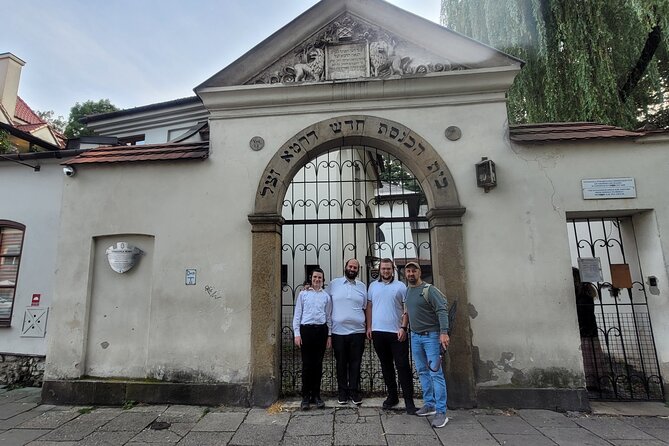
The route then turns toward the former Jewish Ghetto, where the mood changes. The ghetto wall fragment takes about 10 minutes. Even a surviving section can be powerful because it makes the policy of confinement physical and visible.
A wall fragment cannot tell the whole story by itself. The guide’s explanation is essential here, especially for understanding why the wall was built, what it represented, and how the ghetto fit into Nazi occupation policy. This is a short stop, but it is not a light one.
The tour continues to Ghetto Heroes Square for around 20 minutes. This is the longest of the later memorial stops and gives the guide room to explain the site’s meaning. You should expect a reflective ending rather than a cheerful final attraction.
The square is a place of memory, and the experience handles the transition from the Jewish quarter to the ghetto directly. I appreciate that the route does not stop after the attractive streets of Kazimierz. It makes the connection between community life and persecution clear, while keeping the focus on places you can actually see.
What the private format adds
This is not a standard group walk where you follow a flag and hope you hear the guide. Only your group participates. That usually makes it easier to ask about family history, religious traditions, wartime events, or the buildings that catch your eye.
The route is also flexible in spirit. A guide associated with the experience, Christopher, is described as not pressuring the group to do more than it wanted. That matters after a full morning of sightseeing, especially if you have already taken another walking tour.
You should still expect a structured route. The tour covers a lot in about two and a half hours, so it cannot provide a long indoor visit at every synagogue or detailed museum treatment at each memorial. The private setting improves the conversation, but it does not turn a short walk into a full-day historical study.
The experience is offered in English. Pickup is available, although the supplied details do not specify the exact pickup area or whether transportation is included. It is near public transportation, and most people can participate. Wear comfortable shoes, since the route includes several streets, squares, and outdoor stops.
Is $96.11 per person fair value?
At $96.11 per person, this costs more than a standard group walking tour. The comparison is not quite equal, though. You are paying for a licensed private local guide, a route focused on one of Krakow’s most important historical subjects, and the ability to ask questions without a large group competing for attention.
The price is easier to justify for two or three people who want a focused introduction. It can also work well for a family with mixed knowledge levels, since the guide can explain basic points without holding back more curious members of the group.
The value is weaker if your main goal is entering several synagogues. The listed route includes many exterior explanations and no admission tickets. You are paying for interpretation and private attention, not a bundle of museum admissions.
Group discounts are available, so check the final price for your party before deciding. The experience is booked well ahead on average, around 75 days in advance, which suggests you should not leave it until the last moment if your Krakow dates are fixed.
Who will get the most from this walk?
I would choose this for someone visiting Krakow for the first time who wants historical context without spending a full day in museums. It suits history enthusiasts, film fans familiar with Schindler’s List, and anyone who wants to understand the relationship between Kazimierz and the former ghetto.
It is also a good option if you have already taken a general Krakow walking tour. The route adds a more focused story instead of repeating the main square and castle highlights.
You may want another experience if you need extensive indoor access, a museum-heavy schedule, or a self-guided audio format. The walk is serious and information-led. It is not built around entertainment, food, or a broad survey of all Krakow sights.
The tone can also feel heavy, especially at the ghetto wall and Ghetto Heroes Square. That is appropriate to the subject, but plan something lighter afterward rather than stacking this immediately before another demanding historical visit.
Practical details before you go
Confirmation arrives when you book. Free cancellation is available until 24 hours before the start time, with the local time used for the cutoff. Changes or cancellations inside that 24-hour window are not accepted for a refund.
Service animals are allowed, and the route is near public transportation. Most people can participate, but comfortable shoes are specifically advised. Since pickup is offered, confirm the meeting arrangement before the day of the tour.
The mobile ticket makes arrival simple. Keep in mind that the experience is conducted in English, and the private setup means your group will not be combined with other people.
Should you book it?
Book this tour if you want a focused, personal walk through Jewish Krakow and the former ghetto, with a guide who can connect synagogues, streets, film sites, and memorials into one clear story. The high rating and full recommendation rate fit its strongest qualities: detailed explanation, a moving World War II focus, and a route that reaches beyond the obvious streets.
Skip it if you mainly want synagogue interiors or a recorded tour you can pause whenever you like. For everyone else, the private format, modest two-and-a-half-hour length, and serious historical route make this a strong choice, especially early in your Krakow stay when you want the city’s past to come into focus.
FAQ
How long does the Krakow Jewish District Private Tour last?
The tour lasts approximately 2 hours and 30 minutes.
Is this a private tour?
Yes. Only your group participates in the activity.
Is the tour offered in English?
Yes. The experience is offered in English.
Does the tour include a local guide?
Yes. A licensed private local tour guide service is included.
What places are covered?
The walk covers Kazimierz and the former Jewish Ghetto, including Wolf Popper Synagogue, Szeroka Street, several synagogue exteriors, the Jewish Community Center, Plac Nowy, a Schindler’s List filming location, a ghetto wall fragment, and Ghetto Heroes Square.
Are admission tickets included?
The listed stops have free admission, and the route mainly features outdoor explanations and synagogue exteriors. No paid admission is listed as included.
Is pickup available?
Yes. Pickup is offered, though the specific pickup details are not provided.
What should I wear?
Wear comfortable shoes, since this is a walking tour through streets and squares.
Can I cancel for a full refund?
Yes, if you cancel at least 24 hours before the experience’s start time. Cancellations or changes made less than 24 hours before the start time are not accepted for a refund.
Just added around Krakow
- stag dog chase Krakow prank★ 5.0 · 4 reviews
- Divine Mercy Sanctuary – Private Tour from Krakow★ 5.0 · 4 reviews
- ZALIPIE – painted village, unique small group tour from Krakow★ 5.0 · 7 reviews
- ZALIPIE – painted village, unique PRIVATE tour from Krakow★ 5.0 · 20 reviews
- Zalipie Private Tour from Krakow The Painted Village★ 5.0 · 4 reviews
- Wooden Churches Unesco List Private Tour from Krakow★ 5.0 · 14 reviews
- Guided tour to Salt Mine & Schindler Factory with Pick-Up Options★ 4.0 · 58 reviews
- Wawel Castle, Cathedral, & Rynek Underground Tour with Lunch★ 5.0 · 4 reviews
Jewish Heritage Tours, compared.
Bike Tour of Old Town, Jewish Quarter and the Ghetto
Read our review →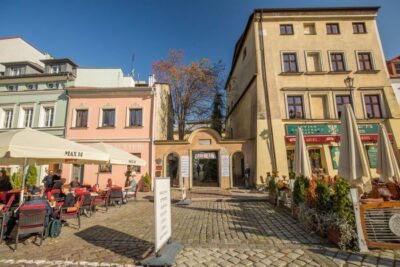
Kazimierz, Schindler’s Factory & Ghetto Guided Tour
Read our review →
Full Bike Tour – the Old Town, Jewish Qtr & the Ghetto NEW BIKES
Read our review →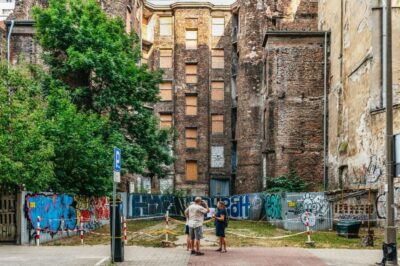
Warsaw Ghetto Private Walking Tour with Hotel Pickup
Read our review →
Bike Tour of the Old Town, Kazimierz, and the Ghetto
Read our review →Browse the lists this tour appears in