
Reviewed · JEWISH HERITAGE TOURS
Jewish Legacy in Warsaw. Private Tour with the best local specialist.
Warsaw’s Jewish story is told most powerfully through the small pieces that survived: a working synagogue, a short section of wall, a quiet patch of earth marking the Mila 18 bunker, and the street where people were forced toward trains. This private tour connects those places in one morning, with pickup anywhere in Warsaw and an English-speaking local specialist.
I like the private format, especially for a subject that can call for questions and pauses. I also like the mix of major memorials and less polished street sites, including Chlodna Street and Praga. The main concern is reliability: one documented booking ended with no guide appearing at the 9:00 am pickup, though the refund arrived within one business day.
Key points to know before booking
- Nozyk Synagogue is the oldest existing synagogue in Warsaw, and you get about 20 minutes there.
- The Polin Museum stop is brief, focused on the building and interior design rather than a full museum visit.
- Umschlagplatz and Mila 18 bring the ghetto’s final chapter into sharp focus.
- The tour includes the remaining fragment of the ghetto wall, a stop that takes only about 20 minutes.
- Chlodna Street and Praga add film and neighborhood context, including places connected with The Pianist and The Zookeeper’s Wife.
- The $361.23 price covers up to three people, making the cost easier to justify for a small private group.
Why this private Warsaw tour matters
You can see Warsaw’s Jewish sites on your own, but they are scattered across a city rebuilt after almost total wartime destruction. A guide helps connect a synagogue, memorial, street crossing, wall fragment, and deportation point into one clear story.
The private setup matters here. You are not tied to a large group’s pace, and you can ask for more explanation at places that may otherwise seem like ordinary city corners. The tour is offered in English, begins at 9:00 am, and includes pickup from anywhere in Warsaw.
The route takes roughly four hours of scheduled sightseeing, not counting the time between stops. The listed visits add up to about 250 minutes, so allow part of the morning for moving around the city as well. Because the tour is private, the experience should feel more personal than a standard coach outing, but the actual quality depends heavily on the guide who arrives that day.
More Jewish Heritage Tours in Warsaw
- Warsaw: Warsaw Ghetto Private Walking Tour with Hotel Pickup
★ 4.9 · 369 reviews - Warsaw: Jewish History Guided Walking Tour in English
★ 4.7 · 324 reviews - Private Tour: Warsaw’s Jewish Heritage by Retro Fiat
★ 5.0 · 208 reviews
Nozyk Synagogue and the Jewish life that survived
The first stop is Nozyk Synagogue on Twarda Street, with about 20 minutes to look around. It is described as the oldest existing synagogue in Warsaw, making it an important starting point for a tour about continuity rather than destruction alone.
The synagogue survived the Nazi occupation in part because of its location and use during the final chapter of the ghetto period. That fact gives the building unusual weight. You are not looking at a replica or a monument built after the war. You are seeing one of the few surviving places tied directly to Warsaw’s Jewish religious life.
Twenty minutes is enough for a focused visit, but not for a long architectural study or extended prayer service. If the synagogue is open for the planned visit, dress and behave respectfully. The tour information does not promise a full service, special access, or a long interior visit, so think of this as an introduction to the building and its place in the city’s story.
Polin Museum: a short look at a major institution
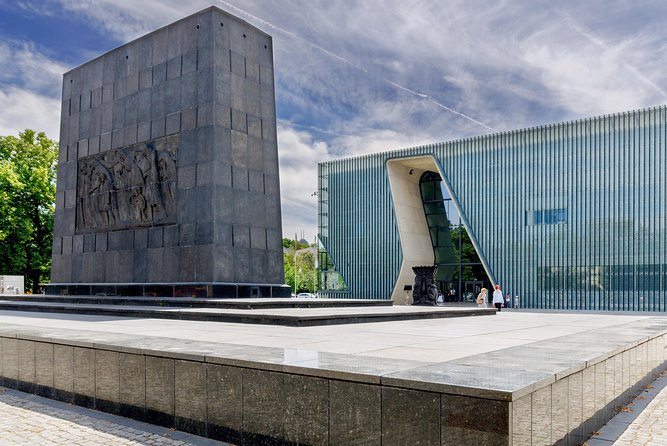
Next comes the area around the POLIN Museum of the History of Polish Jews. You get about 50 minutes, including a quick look inside at the museum’s interior design.
The museum is one of the most important institutions in Poland devoted to Jewish history, and its location near the former ghetto gives the visit added force. Even without a full museum session, the building provides a useful pause between the surviving synagogue and the memorial sites ahead.
Pay attention to the wording here: this is not presented as a full museum tour. If you want to see the exhibitions, you will need to make separate plans and allow much more time. The scheduled stop is best for understanding the museum’s setting and design, then continuing with the outdoor sites.
The nearby Willy Brandt monument is passed during the route. It recalls the German chancellor’s 1970 gesture of kneeling before the Ghetto Heroes Monument, an act associated with apology and reconciliation. You may not stop there, but the guide can place that moment within the broader story of how Germany and Poland later faced the memory of the Holocaust.
The ghetto wall fragment on Zlota Street
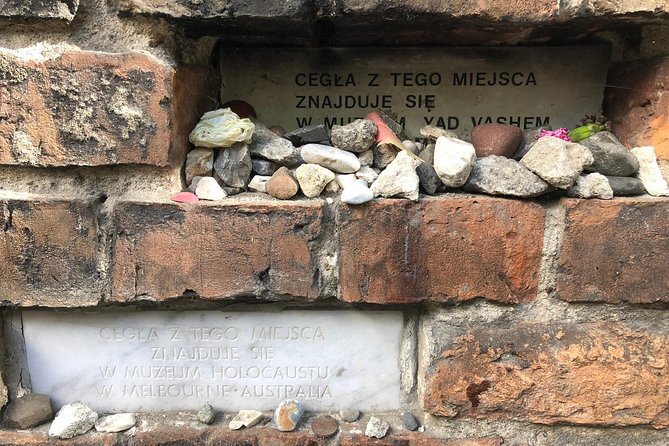
The fragment of ghetto wall at Zlota 60 is one of the tour’s most striking stops because it is so modest. You get about 20 minutes at the only remaining fragment of the largest Jewish ghetto described in the tour.
The wall is surrounded by modern Warsaw, which can make the site easy to miss without help. That contrast is part of its power. A short stretch of brick and mortar marks the forced boundary of a place that once controlled the daily movement, food, work, and survival of hundreds of thousands of people.
The visit is brief, so do not expect a large museum complex or a long preserved section. This is a compact memorial stop. I would use the time to look closely, listen to the explanation, and consider how much of the original city has disappeared.
Same city, a completely different kind of day:
- Warsaw: Chopin Concert in the Old Town
★ 4.8 · 2,287 reviews - Warsaw: Traditional Galar Cruise on The Vistula River
★ 4.6 · 1,640 reviews - Warsaw: Old Town Highlights Walking Tour in English
★ 4.7 · 1,516 reviews - Warsaw Concert: Chopin – Painted by Candlelights with Wine
★ 4.8 · 1,442 reviews
Umschlagplatz and the road to Treblinka
At Umschlagplatz, the tour reaches the point known as the cargo railroad terminal. From here, Jews from the ghetto were taken to the Treblinka death camp.
You get roughly 20 minutes at the corner of Stawki and Dzika streets. The short stop works best if you treat it as a memorial visit, not simply another address on a sightseeing route. The location represents the machinery of deportation: people gathered, loaded onto trains, and sent away under force.
A guide’s explanation matters here because the site itself may not communicate its full meaning to someone arriving without context. The tour connects Umschlagplatz with the earlier wall and the later uprising sites, showing how the ghetto changed from a sealed district into a place of mass deportation and armed resistance.
Again, twenty minutes is not a long time. You will get an orientation and the central story, but not an exhaustive treatment of every event linked with the site.
Mila 18 and the final stand of the uprising
The memorial at Mila 18 marks the largest bunker in the Jewish ghetto. It is associated with Mordechaj Anielewicz, leader of the Jewish Fighting Organization, and nearly 30 other members who hid there during the uprising.
This is one of the most important stops for understanding resistance. The ghetto was not only a place of suffering and deportation. People also organized armed opposition, and Mila 18 became a symbol of that final stand.
The memorial is not a preserved underground bunker you can enter as part of this tour. It is an outdoor site, with the guide explaining what happened there and why it matters. The surroundings are quieter than the main streets, giving you room to take in the memorial without a long formal visit.
The scheduled 20 minutes is enough for the basic story. If this part of Warsaw’s history is especially important to you, a private guide gives you a better chance to ask about the uprising, its leaders, and the meaning of the site than you would have on a self-guided walk.
The Ghetto Heroes Monument and Willy Brandt’s gesture
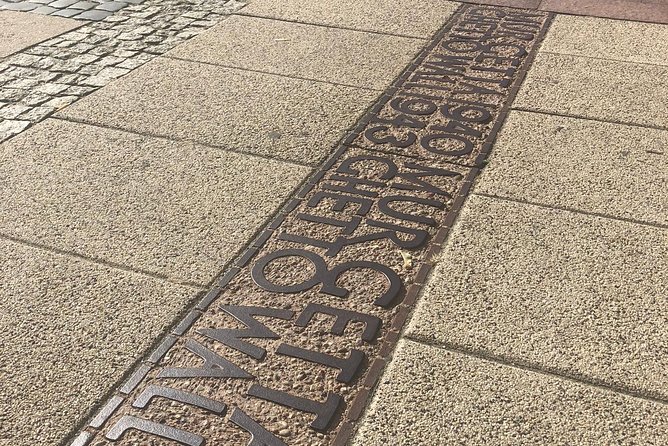
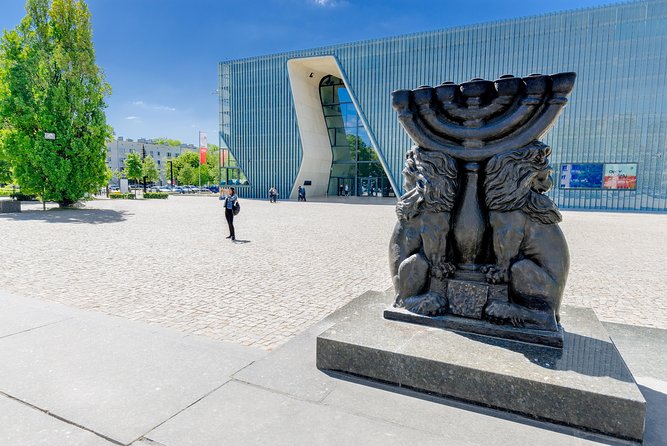
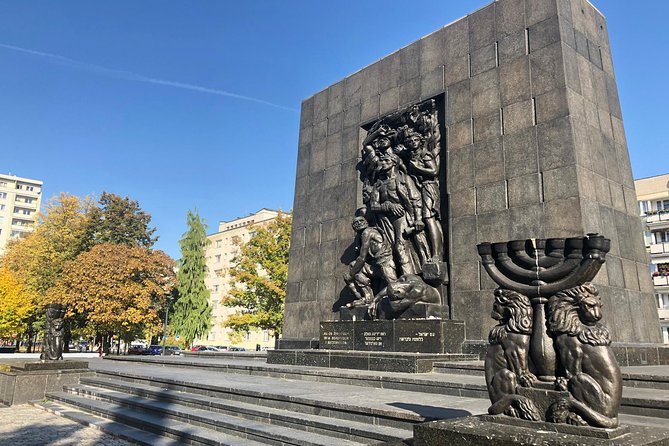
The route includes about 50 minutes at the Monument to the Heroes of Warsaw, described here as a memorial to the Jews who endured the nightmare of the ghetto. In this part of the city, the memorial setting carries both the memory of the uprising and the later effort to confront that memory publicly.
The Willy Brandt monument is passed nearby rather than listed as a main stop. It recalls the German chancellor kneeling before the monument in a gesture of apology and reconciliation. That brief pass-by adds a political layer to the tour: the sites do not only remember what happened during the war, but also how later generations have tried to respond.
The 50-minute allocation is generous compared with several other stops. That gives you time to hear the main explanation, view the memorial, and ask questions without being hurried immediately onward. The tour description does not promise entry to POLIN or another indoor memorial building during this portion, so expect an outdoor visit.
Chlodna Street and the divided ghetto
Chlodna Street offers a different kind of evidence. The tour points out the footbridge that linked the smaller ghetto section with the larger one. This was described as one of the liveliest and most dangerous parts of the ghetto.
You get about 10 minutes here, making it the quickest stop of the day. That is understandable because Chlodna is a street-based location rather than a single museum or memorial. The value is in seeing the physical setting and hearing how movement between the two sections worked.
A short stop can also be a limitation. You may have only enough time to orient yourself, hear the explanation, and move on. Still, this is exactly the sort of place that benefits from a guide. Without context, a modern road and surrounding buildings can hide the significance of the former footbridge.
Praga and Warsaw on film
The final major stop moves to Praga Północ, on the eastern side of the Vistula. The tour selects streets connected with Roman Polanski’s filming of The Pianist. It also includes a visit to the villa associated with The Zookeeper’s Wife, if you are interested.
This portion gives the morning a different tone. Instead of standing only at formal memorials, you see how Warsaw’s surviving streets have been used to represent wartime Warsaw on screen. Film locations can help you notice the older street fabric and the parts of the city that escaped the level of postwar rebuilding seen elsewhere.
The villa visit is optional and depends on your interest, so do not assume it is guaranteed. The tour description also does not promise entry or a private viewing inside the villa. Think of this as a chance to see the setting and discuss the film connection, with the exact depth depending on the guide and your group.
The 40-minute allocation makes Praga more than a quick drive-by. It also means the overall tour is not limited to the former ghetto district. You get a wider view of Warsaw’s wartime memory, cinema, and surviving streets.
Price, group size, and practical value
The cost is $361.23 per group of up to three people. For one person, that is a costly morning. For three people, it works out to about $120.41 each, before any separate admission or personal expenses.
The value rests on the private pickup, the specialist guide, and the amount of ground covered in one morning. You are visiting sites spread across Warsaw, so arranging every transfer and explanation on your own would take planning. The private format also lets you ask questions and adjust the emphasis within the available schedule.
There is no separate full museum admission promised in the tour details, so budget for that independently if you want to visit the POLIN exhibitions. The tour itself focuses on the museum’s location and interior design, not a complete gallery visit.
Pickup is offered throughout Warsaw, and the start time is 9:00 am. The route is near public transportation, service animals are allowed, and most people can participate. No specific accessibility details are supplied, so you should confirm any mobility needs before booking.
The experience is commonly booked about nine days in advance. That is a useful planning hint, especially if your Warsaw visit has fixed dates. Free cancellation is available until 24 hours before the start time, but changes or cancellations inside that window are not refundable.
The reliability question you should not ignore
The overall rating is 4.6 from nine reviews, which suggests a generally strong impression but is still a small sample. One serious problem is documented: a group waited at the pickup point after receiving a message at 8:45 am, but no guide arrived at 9:00 or by 9:15.
Calls to the local tour number went unanswered. After contacting the booking service, the group received a refund within one business day. That is a good outcome after a failed start, but it does not erase the practical cost of losing a morning in Warsaw.
I would confirm the pickup details shortly before the tour and keep the booking service contact information handy. Arrive at the stated pickup point a few minutes early, and if nobody appears, use the provided local number and the booking platform without waiting too long. This is not a reason to dismiss the tour outright, but it is a real consideration when your schedule is tight.
Who should book this tour
I would recommend it most strongly to a small group of up to three people who want a guided introduction to Warsaw’s Jewish legacy without joining strangers. It suits you if you want the major sites connected in a single morning and prefer pickup rather than building a route through the city yourself.
It is also a good fit if you are interested in how memory appears in ordinary streets, not only in museums. Nozyk Synagogue, the wall fragment, Chlodna Street, and Praga each show a different layer of the city.
You may want another option if your main goal is a full day inside POLIN Museum. The museum visit here is brief, and the tour gives only a quick look at the building and interior design. You may also prefer a different plan if you need guaranteed operational certainty, since the failed pickup described above is a concern.
Should you book it?
Book this private tour if you value a focused route, hotel pickup, and the freedom to ask questions at difficult sites. The strongest part is the combination of major memorials with physical traces that are easy to miss, especially the wall fragment, Chlodna Street, and Mila 18.
For three people, the price is easier to defend. For a solo visitor, it is a premium choice. Confirm the pickup before the morning begins, and remember that POLIN is only a short stop rather than a full museum visit. With those expectations in place, this is a thoughtful and efficient way to begin understanding Warsaw’s Jewish past.
FAQ
Where does the tour start?
The tour starts at 9:00 am, with pickup offered from locations throughout Warsaw.
Is the tour private?
Yes. Only your group participates, and the price covers up to three people.
What language is the tour offered in?
The tour is offered in English.
Does the tour include a full visit to POLIN Museum?
No full museum visit is specified. The tour includes the museum area and a quick look inside at the building’s interior design.
How long is the tour?
The listed sightseeing times total about 250 minutes, or roughly four hours and ten minutes, not including travel between stops.
Can I cancel for a full refund?
Yes, if you cancel at least 24 hours before the experience start time. Cancellations or changes made less than 24 hours before the start time are not refunded.
Just added around Warsaw
- Wolfs Lair and Swieta Lipka Small Group Tour from Warsaw with Lunch★ 4.5 · 21 reviews
- Wolf’s Lair & Treblinka Tour in 1 day from Warsaw★ 5.0 · 37 reviews
- Wolfs Lair “Hitler’s Headquarters” – Full Day Tour from Warsaw by private car★ 4.5 · 4 reviews
- Tour from Warsaw: Wolf’s Lair, Hitler’s HQ Zones I and II★ 5.0 · 32 reviews
- Wolf’s Lair Private Day Trip from Warsaw★ 5.0 · 50 reviews
- Warsaw Must-See Local City Tour with Antek and Tomek★ 5.0 · 51 reviews
- Off the Beaten Track in Warsaw: Private City Tour★ 4.5 · 9 reviews
- Warsaw’s Old Town A Self-Guided Audio Tour★ 4.5 · 10 reviews
Jewish Heritage Tours, compared.

Bike Tour of Old Town, Jewish Quarter and the Ghetto
Read our review →
Kazimierz, Schindler’s Factory & Ghetto Guided Tour
Read our review →
Full Bike Tour – the Old Town, Jewish Qtr & the Ghetto NEW BIKES
Read our review →
Warsaw Ghetto Private Walking Tour with Hotel Pickup
Read our review →
Bike Tour of the Old Town, Kazimierz, and the Ghetto
Read our review →Browse the lists this tour appears in