
Reviewed · JEWISH HERITAGE TOURS
Private Tour: Warsaw’s Jewish Heritage by Retro Fiat
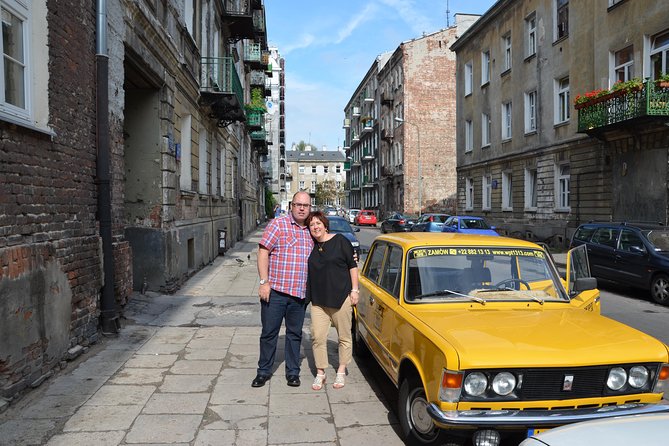
Warsaw’s Jewish story is best understood by moving through the city itself, and this tour does that in a wonderfully old-fashioned Fiat 125p. Over about four hours, you see fragments of the ghetto wall, the former Muranów ghetto, Chłodna Street, Nożyk Synagogue, the Jewish Cemetery, and the Ghetto Heroes Monument while your private guide explains what happened here.
I like the one-to-one attention and the chance to shape the route around your interests. I also like the practical design: hotel pickup and drop-off are included, and the car links sites that are too spread out for a comfortable walk. The main drawback is that the synagogue and cemetery are closed from Friday evening through Saturday, while museum admission is extra.
Key points to know before booking
- The Fiat adds character: You ride in a vintage Fiat 125p, though groups of four or more use a retro minivan instead.
- The route covers more than wartime sites: You learn about Jewish life before the war, the ghetto years, the 1943 uprising, and Jewish Warsaw today.
- The guide can tailor the visit: Ask about family history, The Pianist film locations, the uprising, or particular memorials.
- The cemetery is an important extra stop: Entry is not included, but the site adds a solemn human dimension to the tour.
- Timing matters: A late-afternoon departure may miss access to both Nożyk Synagogue and the Jewish Cemetery.
- This is a true private tour: Only your group rides with the guide, making it easier to ask questions and slow down at meaningful places.
Why the retro Fiat works well for this history tour
The car is not just a decorative prop. Warsaw’s Jewish sites are scattered across several parts of the city, and the Fiat lets you move between them without spending much of your limited sightseeing time figuring out buses or walking long stretches between memorials.
The vintage vehicle also gives the tour a local Warsaw flavor. It is a Fiat 125p, a car associated with the Communist-era city, and several guides have been praised for handling it confidently through modern traffic. You may also notice people taking photos of the car as it passes, which adds a light, amusing touch to an otherwise serious experience.
The tradeoff is space. The Fiat is suited to smaller private groups, while groups of four or more are placed in a vintage minivan. That larger vehicle may be more comfortable, but it does not offer quite the same classic-car feel.
The tour costs $108.28 per person. For a four-hour private outing with transport, hotel pickup, an English-speaking driver-guide, and a route built around a difficult subject, I consider that a fair price. You are paying for the guide’s time and access to several distant places, not simply a ride past monuments. Add the price of the synagogue or cemetery entry if you plan to go inside, and remember that POLIN Museum admission is separate.
More Historical Tours in Warsaw
- Warsaw: POLIN Museum of the History of Polish Jews Ticket
★ 4.7 · 1,142 reviews - Warsaw: Chopin Concert at Historical Venue in Old Town
★ 4.7 · 445 reviews - Small-Group Historical Guided Tour of Warsaw with pick up/drop off. Public Tour.
★ 4.5 · 343 reviews
Starting at the ghetto wall
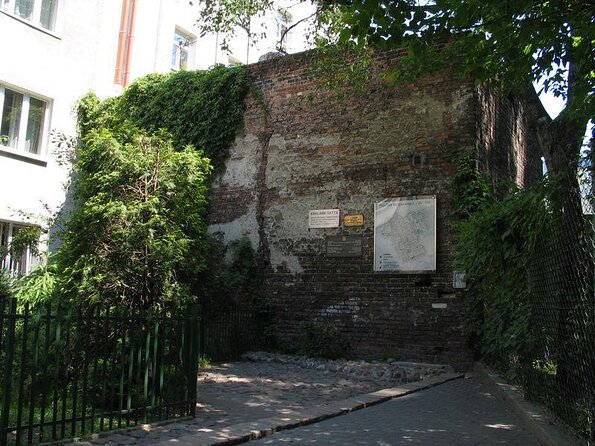
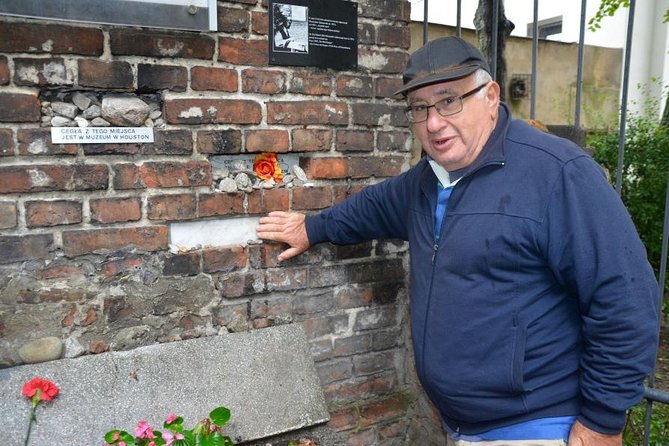
The tour begins at your chosen pickup point, usually your central Warsaw hotel or the Palace of Culture and Science. The first major stop is a surviving fragment of the ghetto wall, marked by commemorative plaques.
This is a small physical remnant, so do not expect a large preserved fortification. Its value comes from what the guide adds. In 1940, the Nazi authorities created the Warsaw Ghetto, imprisoning more than 400,000 Jewish people in a tightly controlled area. The remaining wall fragment helps you picture the division of the city and the cramped conditions that followed.
A good guide will use photographs and maps to show how the wartime streets differed from the modern city around you. Guides such as Karol, Marcin, Martin, Conrad, and Konrad have been singled out for explaining the timeline clearly and putting today’s buildings beside images of wartime Warsaw. Your assigned guide will vary, but the private format gives you room to ask for more detail if the first explanation raises questions.
You spend about 15 minutes here. That is enough for an introduction, photographs, and a short explanation before moving on.
Chłodna Street and the Footbridge of Memory
Chłodna Street offers one of the tour’s most striking reminders that the ghetto was divided into separate sections. You see the site associated with the Footbridge of Memory, which once connected the smaller and larger parts of the ghetto above the street.
The footbridge itself is gone, but the location remains meaningful. It shows how ordinary city roads became barriers inside a prison-like system. You also see the building connected with Adam Czerniaków, head of the Jewish Council, known as the Judenrat. The stop lasts about 10 minutes, making it brief but important.
This is one place where a guide’s explanation matters more than the physical remains. On your own, you might pass the street without understanding what happened there. Ask your guide to show you how the two ghetto areas related to each other and how the bridge functioned within the Nazi system.
The route also includes other locations connected with the uprising, including a memorial for people who died by group suicide during the Ghetto Uprising, a street that survived from both sides of the former ghetto area, and the departure point associated with deportations to Treblinka. These are short viewing stops rather than full museum visits, so expect explanation from the car or at the roadside.
Muranów, the former Large Ghetto
The Muranów district was the site of the former Large Ghetto. Today, modern apartment blocks and street art cover much of the area, creating a sharp contrast with the wartime photographs your guide may show you.
This contrast is central to the experience. Warsaw was almost completely destroyed during the Second World War, and much of what you see is a rebuilt city. That makes it difficult to read the streets without help. Your guide connects present-day buildings, open spaces, memorials, and surviving fragments to the city that stood here before and during the war.
You spend roughly 30 minutes in the Muranów area. This is a useful point to slow down and ask questions. If you are interested in the 1943 uprising, tell your guide early in the tour. The private setup lets the conversation move toward the uprising, daily life inside the ghetto, prewar Jewish Warsaw, or the postwar city, depending on what matters most to you.
The subject is painful, but the strongest guides keep the presentation clear and respectful rather than theatrical. Several guide profiles praised by past customers include advanced academic study of history, personal knowledge of Poland before and after the Cold War, and a talent for explaining a long timeline in plain English.
More Jewish Heritage Tours in Warsaw
- Warsaw: Warsaw Ghetto Private Walking Tour with Hotel Pickup
★ 4.9 · 369 reviews - Warsaw: Jewish History Guided Walking Tour in English
★ 4.7 · 324 reviews - Warsaw: Ghetto, Jewish Cemetery & POLIN Museum Private Tour
★ 4.8 · 132 reviews - Warsaw: Jewish Heritage & Holocaust Walking Tour
★ 4.7 · 119 reviews
The Ghetto Heroes Monument
The Ghetto Heroes Monument commemorates the Warsaw Ghetto Uprising of 1943. It is one of the central stops, and you spend about 15 minutes here.
The monument is especially powerful because of its setting. It sits in the former ghetto area, close to the POLIN Museum, so the surrounding streets are part of the historical lesson. Your guide can explain how the uprising began, how limited the resistance fighters’ resources were, and why the event became such an important symbol.
Give yourself a little quiet time here. The tour is private, so you are not being rushed through a large group. If you want a longer pause, say so. The guide can also help connect the monument to nearby memorials and the wider story of the ghetto.
POLIN Museum: a major visit to add if you have time
The tour takes you to the POLIN Museum of the History of Polish Jews, usually for an exterior look. The museum entry fee is not included, and the listed visit is short. If you want to see the galleries, the guide can leave you there after the tour rather than returning you to the original starting point.
I recommend treating POLIN as a separate visit if your schedule allows. The museum covers more than the wartime period, tracing about 1,000 years of Jewish life in Poland. That wider setting helps prevent the tour from becoming only a story of persecution and destruction. You gain a fuller picture of communities, religious life, culture, work, politics, and the many centuries before the Holocaust.
Do not assume you can fit a full museum visit into the four-hour drive. The tour’s strength is its city route and guide commentary. POLIN works best when you give it additional time, either after the tour or on another day.
Nożyk Synagogue and the importance of timing
Nożyk Synagogue is described as the only surviving prewar Jewish house of prayer in Warsaw. You may spend about 30 minutes here, and entry is not included in the tour price.
This is one of the few active religious sites on the route, so dress and behave respectfully. You may be required to cover your head at some Jewish sites. The synagogue is closed from Friday evening through all of Saturday for the Sabbath, which makes scheduling essential.
A late start can also cause trouble. One visitor booked a 5 p.m. departure during summer, expecting plenty of daylight, but found that the synagogue and cemetery were already unavailable. If entering both sites matters to you, book a morning or earlier afternoon departure and confirm the opening arrangements before you go.
The synagogue gives the tour a living connection to Jewish Warsaw. It is not only a memorial or a ruined building. You see a place that continues to serve a religious community, which adds balance to the many stops focused on wartime loss.
The Jewish Cemetery and the human scale of the story
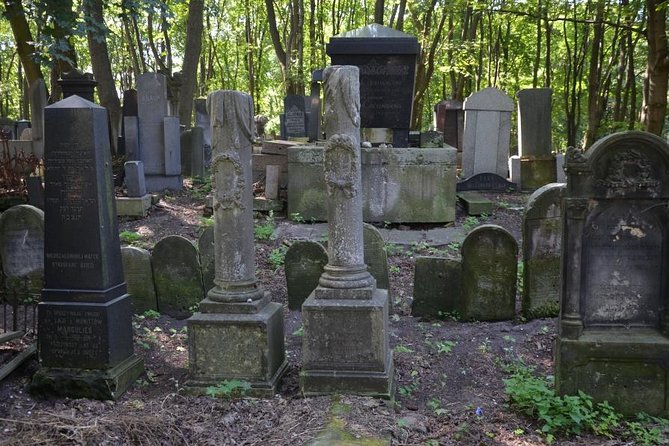
The Jewish Cemetery is one of the most meaningful stops on the route. You spend about 30 minutes among graves associated with more than 200,000 people, including religious and political leaders, creators of Jewish culture, generations of Jewish Varsovians, and people who died without marked graves.
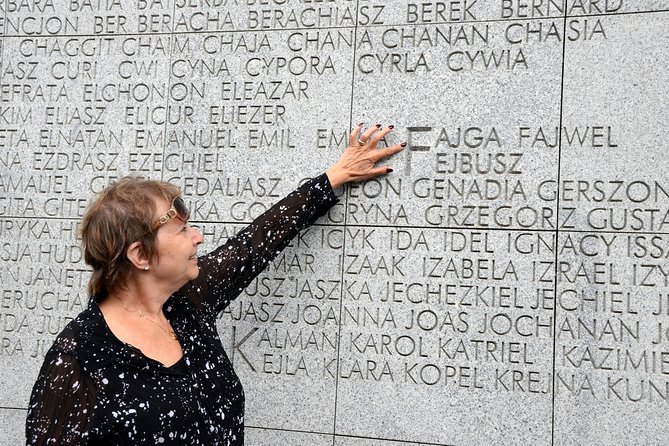
The cemetery can be difficult to interpret without guidance. Your guide can point out important sections and explain how the site reflects both ordinary Jewish life and the destruction of the ghetto. The experience is not simply a walk among old stones. It gives names, families, public figures, and generations a place within the larger story.
Entry is not included, and the cemetery is closed from Friday evening through Saturday. As with the synagogue, check the departure time before booking. A four-hour tour that reaches the cemetery after closing time may still cover the exterior area and other sites, but it will not give you the full experience.
Wear comfortable shoes. The tour includes short walks and standing at several stops, and cemetery paths may not be as easy as city sidewalks. The general participation information says most people can take part, but tell the operator about any specific mobility needs before booking.
How much can the guide tailor the tour?
This is where the private format earns its keep. You can ask for special attention to family research, the Warsaw Ghetto Uprising, the prewar community, current Jewish life, or locations connected with The Pianist.
Some people use the tour to investigate a family connection. A guide can help place a family story within the city’s geography, though the supplied tour details do not promise genealogy research or access to personal records. If you have names, addresses, photographs, or a particular neighborhood in mind, bring them and explain your interests before the car leaves.
You can also ask for extra wartime photographs. Several guides have used images to show how the streets looked during the occupation, which is especially useful in rebuilt parts of Warsaw. Modern Muranów can otherwise appear disconnected from the history beneath it.
Guide quality is central here. Past guide names include Alex, Alec, Karol, Marcin, Martin, Conrad, Konrad, and others, and the comments describe strong English, patience, good driving, friendliness, and serious command of Warsaw’s past. One less positive experience cited a poorly maintained car and a guide who did not match the customer’s stated interests. That is a useful warning: write your priorities clearly when booking and repeat them at pickup.
Who should book this tour?
I would choose this tour if you want a serious introduction to Jewish Warsaw but prefer a private conversation to a large walking group. It suits first-time visitors, people with family connections to Poland, and anyone interested in the Second World War who wants to see places that are easy to miss.
It is also a good choice if you have only half a day. The car covers a lot of ground, and hotel pickup removes the need to navigate between distant sites.
You may want another arrangement if you prefer a full museum visit, a long walking tour, or a more relaxed pace at each memorial. The four-hour schedule covers many locations, so some stops are necessarily brief. It is best understood as a guided overview with meaningful walks, not as an exhaustive study of every site.
Book carefully around the Sabbath closures. Ask for an earlier time if Nożyk Synagogue and the cemetery are priorities. Groups of four or more should expect a vintage minivan instead of the Fiat 125p. Free cancellation is available up to 24 hours before the start time; changes or cancellations made later are not accepted for a refund.
Should you book Warsaw’s Jewish Heritage by Retro Fiat?
Yes, if you want a personal, focused introduction to Warsaw’s Jewish past and value having a guide explain what the rebuilt city no longer makes obvious. The strongest reasons to book are the private format, the efficient transport between sites, and the chance to shape the conversation around your own interests.
Book it for the history and the guide, with the Fiat as a memorable extra. Add the cemetery and synagogue when open, and plan a separate visit to POLIN if you want the wider story. If you do that, the tour becomes a thoughtful half-day foundation for understanding Warsaw, rather than just a drive past monuments.
FAQ
How long does the tour last?
The tour lasts approximately four hours.
Is hotel pickup included?
Yes. Hotel pickup and drop-off are included for hotels in the city center. If your hotel is outside the pickup area, contact the operator to discuss another meeting arrangement.
What vehicle is used?
Small groups ride in a private retro Fiat 125p. Groups of four or more are transported in a vintage minivan instead.
Is the tour private?
Yes. Only your group participates in the activity.
Is the tour offered in English?
Yes. The tour is offered in English with a professional driver-guide.
Are Nożyk Synagogue and the Jewish Cemetery open every day?
No. Both are closed from Friday evening through the whole of Saturday because of the Sabbath.
Is admission to the museum or Jewish sites included?
No. POLIN Museum admission is optional and paid separately. Admission to Nożyk Synagogue and the Jewish Cemetery is also not included.
Just added around Warsaw
- Wolfs Lair and Swieta Lipka Small Group Tour from Warsaw with Lunch★ 4.5 · 21 reviews
- Wolf’s Lair & Treblinka Tour in 1 day from Warsaw★ 5.0 · 37 reviews
- Wolfs Lair “Hitler’s Headquarters” – Full Day Tour from Warsaw by private car★ 4.5 · 4 reviews
- Tour from Warsaw: Wolf’s Lair, Hitler’s HQ Zones I and II★ 5.0 · 32 reviews
- Wolf’s Lair Private Day Trip from Warsaw★ 5.0 · 50 reviews
- Warsaw Must-See Local City Tour with Antek and Tomek★ 5.0 · 51 reviews
- Off the Beaten Track in Warsaw: Private City Tour★ 4.5 · 9 reviews
- Warsaw’s Old Town A Self-Guided Audio Tour★ 4.5 · 10 reviews
Jewish Heritage Tours, compared.

Bike Tour of Old Town, Jewish Quarter and the Ghetto
Read our review →
Kazimierz, Schindler’s Factory & Ghetto Guided Tour
Read our review →
Full Bike Tour – the Old Town, Jewish Qtr & the Ghetto NEW BIKES
Read our review →
Warsaw Ghetto Private Walking Tour with Hotel Pickup
Read our review →
Bike Tour of the Old Town, Kazimierz, and the Ghetto
Read our review →Browse the lists this tour appears in