
Reviewed · HISTORICAL TOURS
Warsaw History and Reality Walking Tour
Warsaw’s story is one of destruction, stubborn rebuilding, and daily life carried forward. This walk makes that story visible, from the Mermaid statue and its wartime meaning to the carefully rebuilt Old Town, then along the Royal Route toward Marshal Piłsudski Square.
I like the small maximum of 10 people, which gives Mona, also referred to as Monika, room to answer questions and adjust the route. I also like the rooftop stop at the University of Warsaw Library, a welcome change from churches and monuments, with city and river views when the garden is open. The main drawback is pace: 2 hours and 30 minutes is enough for an excellent introduction, but not enough for long visits inside every landmark.
Key points to know before booking
- Warsaw’s wartime story leads the walk, especially at the Mermaid and in the reconstructed Old Town.
- The University of Warsaw Library rooftop garden provides a viewing terrace and a break from street-level sightseeing. It is open from April through October.
- Mona or Monika guides the walk in English, with a strong focus on personal stories, overlooked places, and practical local suggestions.
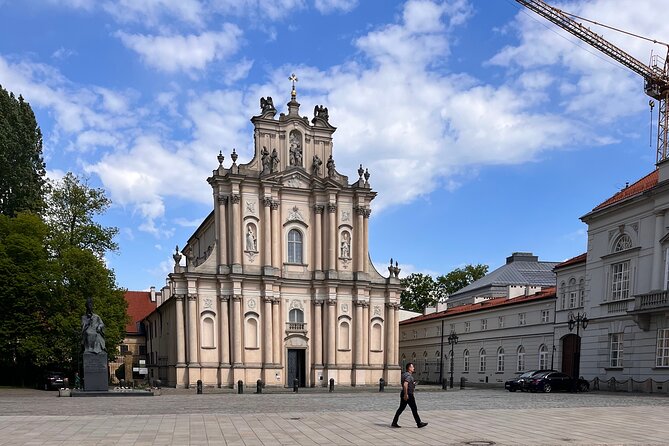
- The route ends near the Visitants’ Church, rather than returning to the starting point.
- The group is limited to 10 people, a useful size for questions and conversation.
- The price is $114.39 per person, so the value depends on how much you want a private-guide style of introduction rather than a basic landmark walk.
Why Warsaw’s past works so well on foot
Warsaw can look polished and historic at first glance, but much of the center had to be rebuilt after World War II. That gives this walk a useful purpose. You are not simply ticking off handsome buildings. You are learning how a city reconstructs its streets, symbols, public spaces, and sense of itself.
The route begins beside the Vistula at the Mermaid’s Statue on Generała George’a Smitha Pattona Street. From there, it moves uphill and into the central historic districts. You get a clear change of mood as the walk progresses: riverfront symbol, modern architecture, Old Town lanes, the Royal Route, and a broad ceremonial square.
Mona’s approach appears especially suited to people who want context rather than a string of dates. She is described as flexible, willing to add stops when time and interest allow, and good at explaining the less obvious parts of Warsaw. That matters here because the most useful details are often not on the main sign beside a monument.
More Historical Tours in Warsaw
- Warsaw: POLIN Museum of the History of Polish Jews Ticket
★ 4.7 · 1,142 reviews - Warsaw: Chopin Concert at Historical Venue in Old Town
★ 4.7 · 445 reviews - Small-Group Historical Guided Tour of Warsaw with pick up/drop off. Public Tour.
★ 4.5 · 343 reviews
The Mermaid: Warsaw’s symbol with a wartime story
The Mermaid is more than a city logo. Your guide explains why she appears on Warsaw’s coat of arms, who served as the model for the sculptor, and how the figure connects to World War II.
The stop lasts about 10 minutes and has no admission charge. That sounds brief, but it is enough for an introduction before you move on. I would pay close attention here, since the Mermaid gives you a symbol to recognize throughout the rest of your time in Warsaw.
This opening also sets the tone for the whole walk. Warsaw’s symbols often carry several layers at once: civic pride, old legends, artistic choices, and memories of war. If you like understanding why a city displays a particular figure or monument, this is a strong start.
The University of Warsaw Library rooftop garden
The library is one of the most distinctive stops. Its rooftop garden combines a working modern library with a green public space shaped in relation to the Vistula embankment. The tour includes an entrance ticket for a viewing terrace, so this is not only an exterior photo stop.
The visit lasts about 40 minutes, making it the longest planned pause. From the roof, you can look toward the river and across the city. The garden is open from April through October, so check the season carefully when choosing your date. The supplied details do not promise the same rooftop access outside those months.
I like this stop because it broadens the picture of Warsaw. The city is not only royal buildings, church interiors, and reconstructed facades. The library shows a modern side, with architecture designed for study, public use, and time outdoors.
It is also a practical photography stop. You get a higher viewpoint without turning the walk into a separate sightseeing excursion. If you prefer architecture and city views to long museum visits, this may be one of the most rewarding sections.
A rebuilt workers’ district
Along the route, you see the first district in Warsaw rebuilt after World War II. It was intended for workers involved in reconstructing the Old Town.
This is a small but important piece of the city’s recovery. The walk does not treat rebuilding as an abstract national project. It connects reconstruction with the people who did the physical work and then needed homes in the city they were restoring.
The exact stop is not given a formal name in the supplied route, so you should think of it as a contextual pause rather than a major attraction. Its value comes from the explanation. It helps connect the Old Town’s restored appearance with the social cost and labor behind it.
More Walking Tours in Warsaw
- Warsaw: Old Town Highlights Walking Tour in English
★ 4.7 · 1,516 reviews - Warsaw: Old Town Guided Walking Tour
★ 4.9 · 599 reviews - Half-Day Polish Food Walking Tour with Guide and Dinner
★ 4.5 · 381 reviews - Warsaw: Warsaw Ghetto Private Walking Tour with Hotel Pickup
★ 4.9 · 369 reviews
St. Anne’s Church and Castle Square
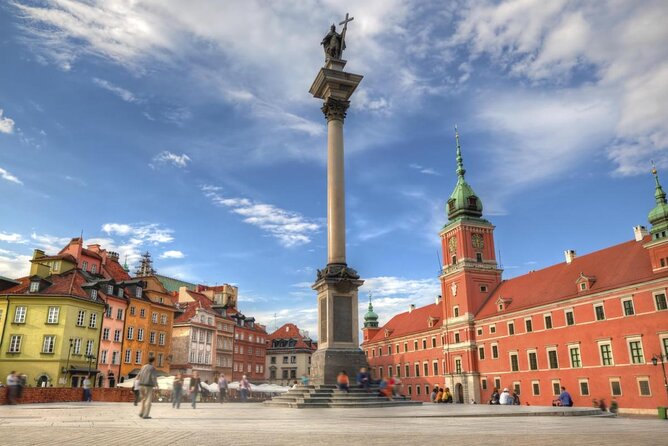
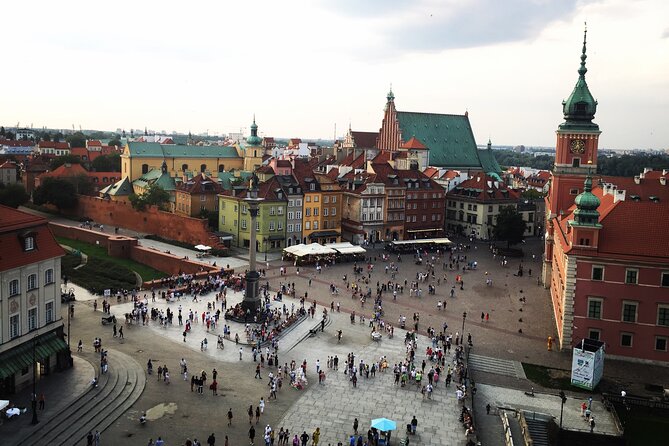
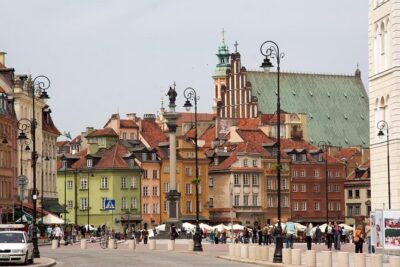
St. Anne’s Church is described as one of Warsaw’s finest Baroque churches. The stop takes about 15 minutes and also gives you a look at Royal Castle Square and the reconstructed tenement houses nearby.
You should not expect a long interior visit. The time is better understood as a guided orientation to the church, the square, and the surrounding architecture. Your guide can point out how these buildings fit into the Old Town setting and why the area matters.
The nearby tenement houses are especially useful to see before walking deeper into the Old Town. They look old, but the larger story is reconstruction. Their carefully restored fronts help recreate an earlier atmosphere, while the city around them reflects a modern Warsaw shaped by war and rebuilding.
Old Town: reconstructed, not untouched
The Old Town section lasts about 30 minutes. You walk through cobblestone streets and narrow lanes, passing churches, tiered burgher houses, and detailed facades. There is also a favorite meeting place for couples, a small human detail that keeps the stop from becoming a list of architectural terms.
The key point is that Warsaw’s Old Town was masterfully reconstructed after its wartime destruction. You can still enjoy the Gothic lines, colorful fronts, and intimate lanes, but the guide helps you understand that the atmosphere was deliberately brought back.
That does not make it less meaningful. In some ways, the rebuilding is the story. You are looking at a place where memory, archival research, craftsmanship, and civic determination came together. I find that more interesting than simply being told that a street is old.
The 30-minute timing is brisk. You will get the shape of the district and several stories, but you will not cover every lane or stop for extended photographs at every corner. Wear comfortable shoes, since the route includes cobblestones and continues through several central districts.
Krakowskie Przedmieście and the Royal Route
The walk continues along Krakowskie Przedmieście, part of Warsaw’s Royal Route. The full route is about 2.5 miles, though this experience covers only a section of it. The avenue brings together major buildings and monuments linked to Warsaw’s royal, political, artistic, and civic life.
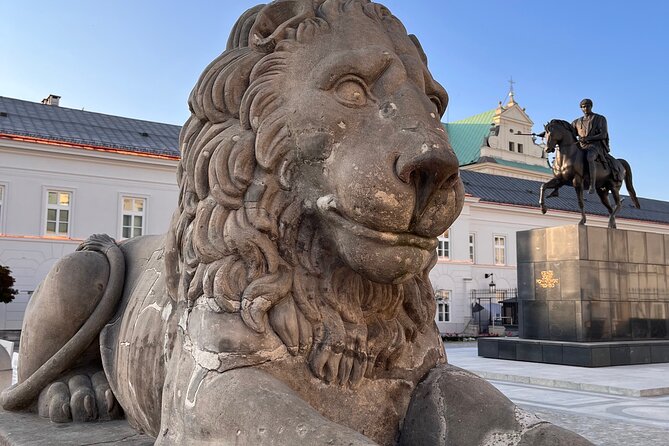
One highlight is the Presidential Palace, a Neoclassical building where the Polish president resides. Four lions sculpted by Camillo Laudini guard the entrance, and the building also has a connection to Frederic Chopin, who played there publicly at age eight.
That Chopin detail gives the route a personal touch. Instead of treating the palace as a closed political building, the guide connects it to a child prodigy and to the cultural life of Warsaw. The stop lasts around 10 minutes, so expect an exterior explanation rather than a palace tour.
Krakowskie Przedmieście is also a good stretch for seeing how Warsaw’s public life changed over time. Churches, government buildings, monuments, and city streets sit close together. Mona’s strength, based on the way this tour is presented, is making those connections clear without forcing you to memorize a long timeline.
Marshal Piłsudski Square and the Unknown Soldier
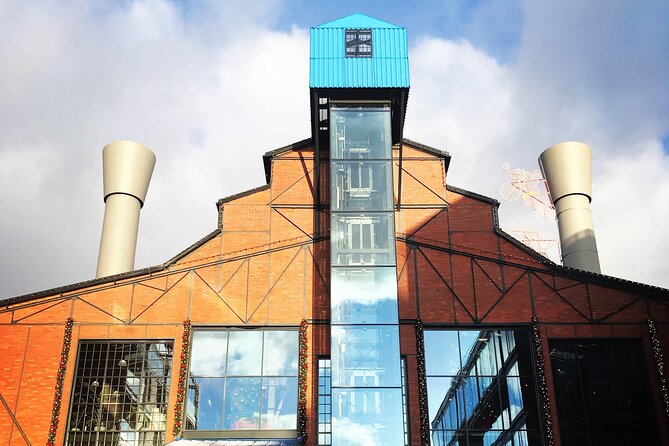
The final listed stop is Marshal Józef Piłsudski Square, a broad parade ground and gathering place. Its central memorial is the Tomb of the Unknown Soldier, while Saxon Garden lies behind it.
The square matters to Varsovians as a place for meetings, concerts, public events, and ceremonies. That gives the ending a different feel from the enclosed lanes of the Old Town. You finish in a space built for national memory and large civic occasions.
The planned stop lasts about 10 minutes. It is a fitting close because the route has moved from local symbol to national memory. The Unknown Soldier memorial also brings the themes of war, loss, and public remembrance back into focus.
The official endpoint is near the Roman Catholic Church of the Visitants on Krakowskie Przedmieście 34, at the Cardinal Stefan Wyszyński Statue. Plan your next activity from there. This is not a loop back to the Mermaid’s Statue.
What the guide adds to the route
The strongest feature of this experience is likely the guide’s storytelling. Mona or Monika is presented as someone who can explain formal history and the smaller human details around it. She has also guided people through subjects beyond this central route, including Warsaw’s Evangelical-Augsburg Cemetery, where she focuses on architecture, symbolism, notable people, and old trees.
That wider interest matters because it suggests a guide who sees Warsaw as a city of people, not just monuments. On this walk, you may get more from asking questions than from trying to cover every planned point quickly.
The route can also be adjusted in a practical way. Mona has been described as adding a few extra stops when suitable and offering restaurant suggestions at the end. The exact additions are not guaranteed, so treat that as a possible advantage, not part of the fixed itinerary.
This is particularly useful for a first visit. You can ask for help deciding what to see next, where to eat, or which parts of Warsaw deserve a longer visit. The guide’s local tips may be as useful as the formal route.
Price, group size, and overall value
At $114.39 per person, this is not a bargain-priced orientation walk. The 2.5-hour duration and free admission at the main stops mean you are paying mainly for the guide’s time, English storytelling, route planning, and the included viewing terrace ticket.
That price makes more sense if you want a small-group experience with room for questions. A maximum of 10 people is far more personal than a large coach or crowded public tour. It may also suit you if Warsaw’s wartime rebuilding feels hard to understand without a guide connecting the pieces.
The value is less clear if you only want quick facts and photographs. You can see many of these public spaces without admission fees, and the walk does not include coffee, tea, or a major museum entrance. You are paying for interpretation, not a package of paid attractions.
The average booking lead time is 88 days, which suggests you should not assume last-minute availability. Confirmation is provided within 48 hours of booking, subject to availability. If your schedule is fixed, book ahead and leave room for the weather policy.
Who should book this Warsaw walk
I would choose this experience if you want a clear first look at central Warsaw and care about how the city was rebuilt after World War II. It suits first-time visitors, couples, solo visitors, and small groups who prefer conversation over a large organized tour.
It is also a good fit for people who like local stories. The guide’s ability to explain overlooked areas, adapt to requests, and suggest places to eat adds value beyond the listed monuments.
Families can participate because most travelers can take part, and service animals are allowed. The route is near public transportation, which makes the start and finish easier to connect with the rest of your day.
You may want something else if you need extensive indoor sightseeing, a museum visit, or a slow architectural study. The tour is outdoors, weather-dependent, and fairly compact in time. The rooftop garden also operates from April through October, so seasonal access matters.
Free cancellation is available until 24 hours before the start time. Late cancellations and late changes are not accepted for a refund. If bad weather or an unmet minimum number of participants cancels the experience, you are offered another date or experience, or a full refund.
Should you book the History and Reality Walking Tour?
Book it if you want Warsaw explained as a living city shaped by war, reconstruction, politics, art, and ordinary people. The Mermaid, the library roof, the rebuilt workers’ district, the Old Town, Chopin’s connection to the Presidential Palace, and the Unknown Soldier form a well-chosen sequence.
The best reason to choose it is Mona or Monika’s personal guiding style. You get a small group, an English-speaking local guide, room for questions, and the chance of extra stops or useful restaurant advice. At $114.39, it is worth it for that level of interpretation, but not if you only want a low-cost walk past free sights.
FAQ
How long does the Warsaw History and Reality Walking Tour last?
The tour lasts approximately 2 hours and 30 minutes.
What language is the tour offered in?
The tour is offered in English.
How many people can join the tour?
The maximum group size is 10 travelers.
Where does the tour start?
The meeting point is at the Mermaid’s Statue on Generała George’a Smitha Pattona Street in Warsaw.
Where does the tour end?
The tour ends near the Roman Catholic Church of the Visitants at Krakowskie Przedmieście 34, at the Cardinal Stefan Wyszyński Statue.
Is the University of Warsaw Library rooftop garden open all year?
The rooftop garden is open from April through October. The tour includes an entrance ticket for a viewing terrace.
Can I cancel for a full refund?
Yes. You can cancel at least 24 hours before the experience start time for a full refund. If poor weather or an unmet minimum number of participants cancels the tour, you are offered another date or experience, or a full refund.
Just added around Warsaw
- Wolfs Lair and Swieta Lipka Small Group Tour from Warsaw with Lunch★ 4.5 · 21 reviews
- Wolf’s Lair & Treblinka Tour in 1 day from Warsaw★ 5.0 · 37 reviews
- Wolfs Lair “Hitler’s Headquarters” – Full Day Tour from Warsaw by private car★ 4.5 · 4 reviews
- Tour from Warsaw: Wolf’s Lair, Hitler’s HQ Zones I and II★ 5.0 · 32 reviews
- Wolf’s Lair Private Day Trip from Warsaw★ 5.0 · 50 reviews
- Warsaw Must-See Local City Tour with Antek and Tomek★ 5.0 · 51 reviews
- Off the Beaten Track in Warsaw: Private City Tour★ 4.5 · 9 reviews
- Warsaw’s Old Town A Self-Guided Audio Tour★ 4.5 · 10 reviews
Historical Tours, compared.

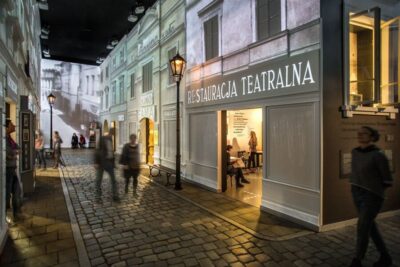
POLIN Museum of the History of Polish Jews Ticket
Read our review →
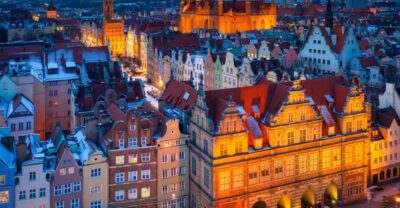
Gdańsk City Sights & History Guided Walking Tour in English
Read our review →


Small-Group Historical Guided Tour of Warsaw with pick up/drop off. Public Tour.
Read our review →Browse the lists this tour appears in